Roland Keefer's Damage-Control Actions at the Battle of Leyte Gulf
The Caine MutinyRoland Keefer's Damage-Control Actions at the Battle of Leyte Gulf are presented as a story of practical command under cascading shipboard failure. After the Montauk was struck during the fighting off Samar, Roland took charge of firefighting, helped restore communication, and assumed responsibility for directing the ship when its bridge could no longer do so. His actions brought order back to a crisis that had disabled the ship’s usual command channels; he continued working after being injured, and later died in sick bay.
Background and the news from Leyte Gulf
The episode reaches the reader not through a view from the battle itself, but through delayed news aboard the Caine, then becalmed at Ulithi. On the morning of October 26, Willie Keith was decoding terse dispatches about the Battle of Leyte Gulf. The reports reached the old minesweeper slowly and were chiefly accounts of damage, their unfamiliar place-names offering little sense of the battle’s full course. When Willie encountered the name Montauk, he took the unfinished message to Tom Keefer, whose brother Roland served aboard that ship.
The immediate scene at Ulithi makes the news personal. Tom first mistook an approaching boat’s passenger for his brother; an ensign from the Montauk, Ensign Whitely, then came aboard and told him that Roland had died of burns the previous day and had been buried at sea. Whitely explained that Roland had helped save the ship and had been recommended for the Navy Cross. The action that followed in his account thus carried two stakes at once: the survival of a warship in battle and the loss of a brother whose conduct had become the subject of an official commendation.
The attack and the collapse of command
Whitely’s account placed the Montauk in the confused encounter between Admiral Sprague’s escort-carrier force and the main battle line of the Japanese Navy off Samar. Rain squalls and smoke screens made the action difficult to reconstruct even for Whitely, whose description was fragmentary. He was more coherent about the damage to his own ship. Shellfire started fires aft, while the secondary conn was knocked out and the executive officer was lost. That mattered immediately: the executive officer ordinarily took charge at the scene of a fire during drills.
Roland, the ship’s damage-control officer, assumed that work instead. Fires had spread in the presence of aviation gasoline on the hangar deck, but he directed the jettisoning of torpedoes and ammunition and organized the firefighting parties. The fire was brought largely under control on the port side amidships, chiefly on the hangar deck. For a time, the crew appeared to have the emergency contained.
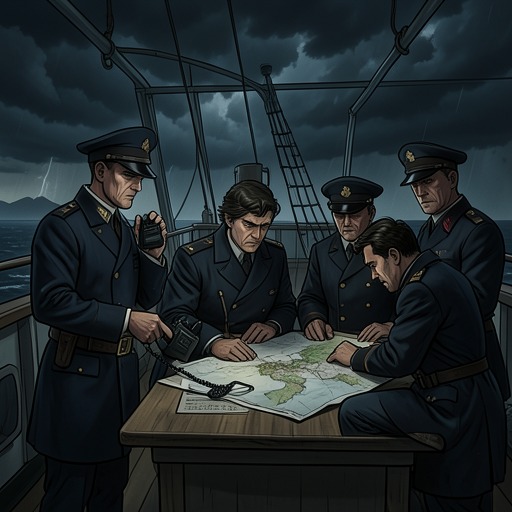
That recovery was interrupted by a Japanese suicide aircraft that came through smoke and rain and struck the bridge. The new explosion spread fire across the flight deck, and the Montauk took a list to starboard. The crew could not raise the bridge by telephone, the loudspeaker system had failed with its power connections torn out, and the ship was steaming in a circle at flank speed. With men moving in confusion and the gas-attack alarm sounding without apparent cause, the ship had lost the means by which its command could ordinarily coordinate a response.
Restoring control and continuing the work
Roland responded by finding a surviving route for orders. He connected a gasoline generator intended to provide standby communications power on the hangar deck’s port side, then used the loudspeakers to direct the firefighting. He ordered the crew to flood the magazines and activate the sprinklers and carbon-tetrachloride systems. When the steering engine room reported that it was receiving no steering orders, he took on the additional task of conning the ship. To see what lay ahead, he went out on the catwalk.
While there, falling wreckage pinned him. Sailors freed him, and others supported and treated him, but he continued both directing the fire response and conning the vessel. The scene’s central reversal is organizational as well as personal: the officer who had begun by managing damage became, when the normal channels failed, a working substitute for command itself. Roland’s authority mattered because it was joined to direct action—restoring communications, issuing orders, and maintaining the ship’s movement—rather than resting on rank alone.
The situation changed again when Lieutenant Commander Volk, the air officer, emerged from the bridge area. Though stunned, Volk was in better condition and was the senior surviving officer, so he took over the conn. Roland was taken to sick bay. By then, Whitely reported, Roland had returned the crew to carrying out the tasks they performed during drills. The transfer of command did not erase Roland’s contribution: his work had helped restore the routines through which the crew could function, and Volk subsequently recommended him for the Navy Cross.
Death, testimony, and significance
Whitely had spent hours with Roland in sick bay while taking over his department. Roland remained engaged with the ship’s work, asking to hear the damage-report dispatch and instructing Whitely on how to correct it. His condition was grave; despite medical treatment, he later developed pneumonia and died. Whitely told Tom that Roland had been asleep when he died. The account therefore closes not with a return to the battle’s broad movements, but with the aftermath of service continuing in sick bay: even there, Roland attended to the report and passed on practical direction to the officer assuming his duties.
The episode is also shaped by the distance between action and knowledge. The battle had been reported to the United States as it happened, but its details reached the Caine in coded dispatches; Roland’s actions became intelligible to Willie and Tom only when Whitely brought the account to them. That structure turns a distant naval engagement into a personal disclosure without pretending that the account is complete: Whitely himself could describe the encounter only in fragments, while giving a more definite sequence of the damage aboard his ship. The narrative identifies Roland’s effectiveness through concrete work under disrupted conditions, then measures its cost through his death and the news delivered to his brother.