Roland Keefer's Death Aboard the Montauk
The Caine MutinyRoland Keefer's death aboard the Montauk follows a sudden collapse of the ship's command and communications during the Battle of Leyte Gulf. As damage-control officer, Roland assumed responsibility for fighting the fires and then for conning the vessel when the steering team could not receive orders. He kept those efforts going after being badly injured, until a senior surviving officer took over. His death from pneumonia was later reported to his brother, Tom Keefer, by Ensign Whitely, who had been with him in sick bay.
The battle and the loss of command
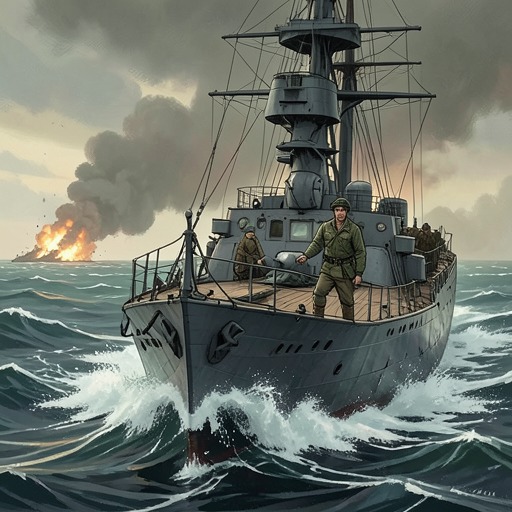
The account comes to Tom through Ensign Whitely's report of the Montauk's encounter with the Japanese fleet off Samar. The ship was already fighting fires aft after shelling had disabled secondary command and killed or incapacitated the executive officer, who ordinarily directed firefighting during drills. Roland, serving as damage-control officer, took over. Fires involving aviation fuel made the situation especially serious, while the loss of the bridge communications left the ship's departments without their usual means of coordination.
A Japanese suicide aircraft then came through the smoke and rain and struck the bridge. The impact brought a further explosion and spread fire across the flight deck. The ship listed, the bridge could not be reached by telephone, and the loudspeaker system had failed. With the vessel moving in a circle at high speed and the gas alarm sounding without an apparent cause, the crew faced overlapping emergencies and a breakdown in the systems meant to direct their response. The account's emphasis is not only on the damage, but on how quickly a trained organization can lose its central means of communication.
Roland takes charge
Roland found a way to restore communication using a gasoline-powered standby generator on the port side of the hangar deck. Once it was connected, he used the loudspeakers to direct the firefighting parties. He ordered the magazines flooded and the sprinklers and carbon-tet systems activated. When the steering-engine room reported that it was receiving no orders, he also took over the conn, relaying directions over the loudspeaker and going out onto the catwalk to see what lay ahead.
That combination of duties made Roland the acting center of the ship's response: he coordinated the fire teams while also helping guide the vessel. The account does not present this as an uninterrupted or effortless recovery. Flaming wreckage fell onto him on the catwalk and pinned him there. Sailors freed him and removed the wreckage, and he was badly injured. Even so, he continued directing the firefighting and conning the ship, supported by sailors who held him up, treated him, and gave him morphine.
Succession and death
The air officer, Lieutenant Commander Volk, eventually emerged from the bridge area. As the senior surviving officer in better condition to command, he took over the conn. Roland then lost consciousness and was taken to sick bay. By that point, Whitely reported, Roland had restored the crew to the firefighting routine they had practiced in drills. Volk submitted him for the Navy Cross; the account records the recommendation, not a confirmed award.
Whitely later visited Roland in sick bay while taking over his department. Though weak and extensively bandaged, Roland continued to attend to the work: he had Whitely read him the damage-report dispatch and instructed him on how to correct it. The doctor assessed his chance of survival as uncertain. Roland later developed pneumonia and died while asleep. His death came after, not during, the period in which he continued to direct the ship's response.
The report to Tom Keefer
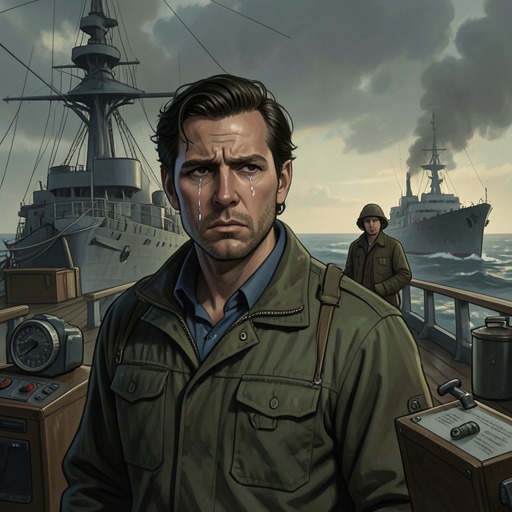
Whitely's account makes the death a personal loss as well as a record of shipboard action. He had been in sick bay with Roland for hours, and visited Tom to explain what had happened and convey Roland's last instructions. Tom listened with reddened eyes. Whitely also offered to show him the gear he had brought back, a small practical detail that connects the account of the battle to the immediate aftermath of death.
The episode gives Tom news of a brother whose conduct under pressure differed sharply from the confusion surrounding the attack: Roland restored communications, directed damage control, and took the conn when the ship's normal command channels failed. His service is presented through what he did and through the witness who reports it, rather than through a final speech or an award ceremony. The distinction between recommendation and confirmed recognition remains, while the account's concrete record of his work gives his actions their own measure of consequence.