Saipan
The Caine MutinySaipan is the setting for a revealing episode in the Pacific War narrative: while the USS Caine patrols during the invasion, Willie Keith watches Philip Francis Queeg appear to avoid the shore, then witnesses the ship withdraw when a shore battery fires on the Stanfield. The island thus matters not only as a military objective but as the place where Keith’s changing response to combat and the officers’ conflicting accounts of Queeg’s command become visible.
Setting and Campaign
The novel introduces Saipan as the invasion approaches. Before the operation, Willie Keith imagines the war ahead in terms of coral islands, shore batteries, aircraft, mines, and the possibility of dying at sea. This apprehension reflects his limited, shipboard perspective rather than a strategic overview. Although military histories may describe the course of the war by its major turning points, the novel places Keith among the sailors who must face each immediate assignment without knowing how it will unfold.
At dawn on the invasion day, Saipan appears on the horizon. Keith is already apprehensive: his earlier combat experience at Kwajalein has ended the untested confidence with which he approached battle. When daylight reveals the island’s cultivated hills and scattered homes, however, his fear briefly gives way to attention to the landscape. He imagines the Japanese inhabitants facing the invading force and feels a small measure of sympathy for them. This moment complicates the simple division between an American crew and an enemy target. The invasion is still a military operation, but Keith can also perceive the people on the island as vulnerable to the violence approaching from sea and air.
The Caine’s Patrol
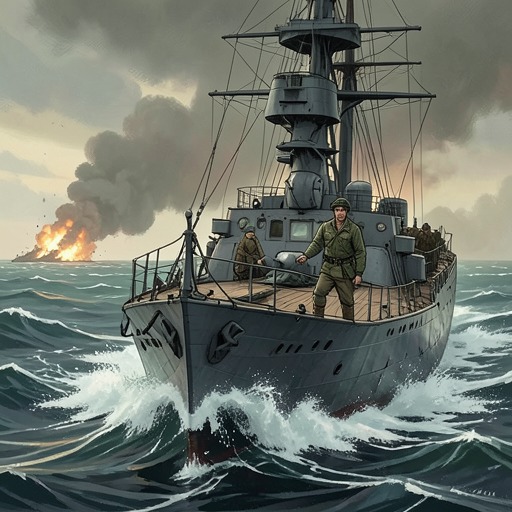
Once the invasion is under way, the USS Caine is assigned to an antisubmarine patrol rather than to a direct assault on the shore. It follows a long figure-eight route with twelve other ships, moving back and forth at ten knots as part of a protective screen around transports near the beach. The task is repetitive and exposed to the unfolding battle, yet from Keith’s position the patrol initially seems relatively safe. This contrast between the island’s danger and the Caine’s routine movement shapes the episode: the ship is close enough to observe combat but remains occupied with a supporting duty.
Keith watches Queeg as the Caine reverses course. He observes the captain repeatedly move to the seaward side of the bridge, away from the shore-facing side. Keith takes the pattern as evidence that Queeg is avoiding exposure, and deliberately moves in the opposite direction when the ship turns. His small, visible defiance is also a judgment on the captain’s conduct, made before the later crisis at the battery. Some sailors notice the maneuver and respond with grins and muttering. The moment therefore carries a social dimension: the bridge becomes a place where conduct is watched and silently interpreted by the crew, even as Queeg takes no apparent notice of Keith’s gesture.
The Stanfield Incident
The patrol’s relative quiet ends when the Stanfield is fired on by a shore battery. Keith sees tall splashes rise around the destroyer and alerts Queeg that it is being straddled. He then identifies the battery’s position and calls for the Caine’s gun watch. Queeg orders the ship to turn away. According to Keith’s later account, the Caine leaves without firing, although its guns are manned and the battery is within range. The episode places a practical command decision—whether to engage or continue the assigned patrol—at the center of a dispute about courage, duty, and responsibility.
The record presented in the novel distinguishes what Keith saw from what Steve Maryk recorded. Maryk’s entry, dated 19 June at Saipan, explicitly says that he did not witness the incident firsthand; he writes down what an officer of the deck reported. That report says the Caine was investigating an air-crash scene with a destroyer, that the destroyer was about one thousand yards away when the shore battery opened fire, and that Queeg reversed course and withdrew without firing, despite the guns being ready. The distinction matters: the log preserves the event as part of Maryk’s accumulating record of Queeg’s conduct, but its account of this particular episode is reported testimony rather than Maryk’s direct observation.
Testimony and Significance
The Saipan incident returns during Steve Maryk’s court-martial, where Barney Greenwald questions Keith about the Caine’s withdrawal from the battery. Keith’s description changes the atmosphere in the courtroom: the members who had listened with formal reserve begin to attend closely, while Jack Challee takes notes. The episode has become more than a patrol detail. It is evidence through which the court can assess the competing accounts of Queeg’s behavior and the judgments his officers formed at sea.
Queeg gives a sharply different version when Greenwald questions him. He denies that he habitually sheltered from the beach and says that his movement around the bridge reflected his combined responsibilities as captain, navigator, and officer of the deck. Regarding the Stanfield, he claims that firing was impossible because the destroyer lay in his line of fire, and that returning to the assigned patrol was proper. The courtroom therefore does not receive Saipan as an uncontested record: Keith’s observation, Maryk’s secondhand log entry, and Queeg’s defense expose the gap between an action and the explanations later attached to it.
The island’s narrative importance lies in this double perspective. Saipan is a place of invasion and danger, but also the setting for a test of how naval duty is interpreted under pressure. Keith’s attention shifts from fear, to a moment of sympathy for the people on shore, to contempt for what he sees as Queeg’s avoidance, and finally to testimony about the incident. The novel also warns that its historical setting is fictionalized: military details, including operational circumstances and ship missions, have been altered, and the people and events aboard the Caine are imaginary. Saipan should therefore be understood here as the setting of the novel’s fictional command conflict, not as a documentary account of the historical campaign.