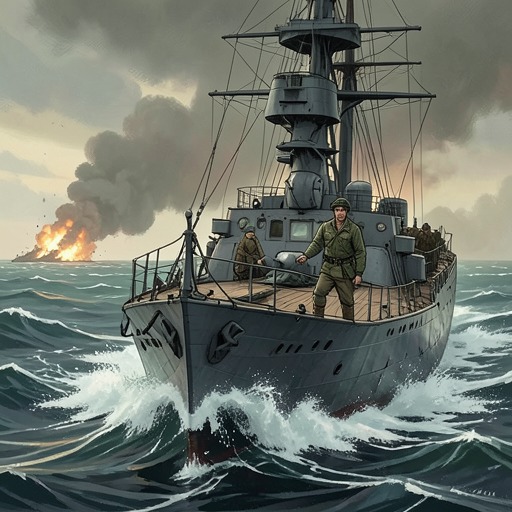
Saipan Shore Battery Incident
The Caine MutinyThe Saipan Shore Battery Incident is a combat encounter in which USS Caine came under the threat of shore fire while accompanying the destroyer Stanfield to investigate a crashed Navy Corsair. Willie Keith identified the battery and tried to bring USS Caine’s guns into action; Philip Francis Queeg instead turned the minesweeper away. The episode sets Keith’s prompt response and the ship’s readiness against Queeg’s failure to authorize fire, and its later appearance in Steve Maryk’s log gives the incident a second, documentary perspective.
Setting and Circumstances
During a quiet period in the patrol sector, the crew had been secured from battle stations. Keith, back on watch after a period of exhaustion, was looking through the binoculars when a Corsair came over the island’s northern hills, burst into flame, and fell into the water between USS Caine and Stanfield. He telephoned Queeg to report the crash. The captain’s first direction was for USS Caine to head toward the scene at twenty knots.
Queeg came to the bridge as the two ships approached the crash site, drawing within roughly a thousand yards of one another. The plane had left no visible wreckage on the water, only a film of gasoline. The incident therefore began as an investigation of an air crash, not as a planned engagement. That changed when water columns rose on both sides of Stanfield: the destroyer was being bracketed by shore fire.
Recognition and Response
Keith recognized the danger and called Queeg’s attention to the attack. Queeg ordered all engines ahead full and hard right rudder. Keith then spotted an orange flash and smoke high on a northern cliff, identifying the position of the shore battery. He called for the gun watch and passed the battery’s bearing and estimated range: 045 relative, 4,000 yards. The gun crew was ordered to train the main battery on the position.
Stanfield circled through the falling shells and fired its five-inch guns. USS Caine’s gun crews took their positions, and its three-inch guns swung toward the battery as the ship turned. Keith reported that the main battery was manned and on target. He asked permission to bring USS Caine broadside to fire, then made a further request to fire the number-four gun over the stern. The text presents the guns as ready and the target as within range; it does not describe USS Caine firing.
Queeg gave no answer to either request. USS Caine continued away from the shore. Stanfield fired additional salvos; one struck the cliff position, raising dust and flames, while the destroyer was again bracketed. As the distance widened, Keith could no longer be certain of the result. The passage does not establish that the battery was destroyed or that the danger to Stanfield had ended when USS Caine left.
The Log and the Incident’s Record
After dinner, Keith told Maryk what had happened. Maryk made no comment at the time, but later that night entered the incident in his log under the date 19 June, at Saipan. His entry explicitly distinguished between firsthand observation and a report: he had not seen the encounter himself and was recording what an officer of the deck had told him. According to that account, Queeg reversed course and left without firing, although the battery was within range and USS Caine’s guns were manned and ready.
That distinction matters to the record of the event. Keith is the officer shown witnessing the Corsair’s fall, identifying the battery, and requesting permission to fire; Maryk’s entry preserves the report rather than presenting him as an eyewitness. The log also turns a rapidly unfolding encounter into a specific claim about command: the ship had a target and ready weapons, but its captain did not authorize their use. The episode thus enters the continuing record Maryk was keeping of Queeg’s conduct, while the passage does not describe an immediate inquiry or punishment arising from it.
Campaign Context and Significance
The incident occurs during the Saipan campaign, amid a war whose wider course had shifted in the Allies’ favor by the beginning of 1944. Yet that strategic outlook does not remove the danger facing the ships on patrol. The scene narrows from the campaign’s broad movements to a local emergency: a crashed aircraft, a destroyer under fire, a battery on a cliff, and a second ship whose guns are ready but silent.
The encounter also precedes a return to the minesweeper’s more routine duties. Before the Saipan campaign was over, USS Caine was detached from the attack force and ordered to escort a damaged battleship to Majuro. That assignment ended its part in the Marianas battle; it missed the Turkey Shoot and the invasion of Guam and returned to escort work. These later orders are not presented as a consequence of the shore-battery incident. They place it within a service in which a moment of combat exposure was followed by the shifting escort and support tasks that occupied much of the ship’s time.
The novel’s prefatory note cautions that it is fiction set in World War II and that operational details, locations, ship missions, and naval procedures have been altered. USS Caine and the people aboard it are imaginary. The incident should therefore be read as part of the novel’s fictional portrayal of wartime command and shipboard responsibility, not as a factual account of a historical Saipan engagement.