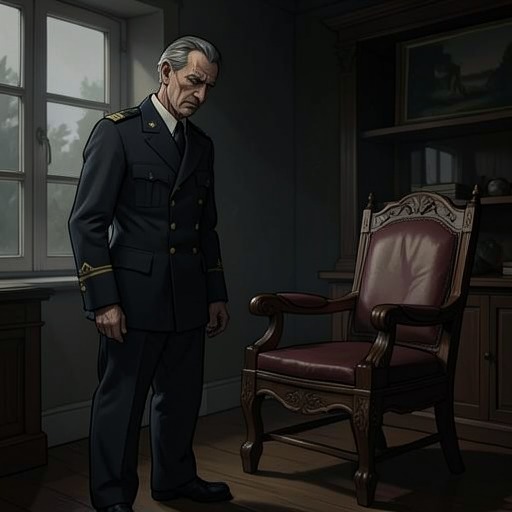
Stilwell's Court-Martial
The Caine MutinyStilwell’s Court-Martial turns the Caine’s formal legal process into a test of who controls justice aboard ship: the rulebook Keith studies, the captain who expects a predetermined sentence, or the officers who deliver a verdict that makes a mockery of that expectation. The hearing ends with six lost liberties for Stilwell, but its consequences extend beyond the accused. It exposes Queeg’s command of procedure as an instrument of personal authority, and it precipitates a harsher policy toward the wardroom.
Appointment and the Captain’s Expected Verdict
The proceeding is announced as a summary court-martial of Stilwell, a gunner’s mate, to be held in the wardroom. Queeg assigns Willie Keith to act as recorder. Keith has been studying Courts and Boards and understands that his duties combine prosecution and legal advice, but Queeg dismisses legal knowledge as unnecessary. He says that what matters is having a capable yeoman type the record correctly according to the book, and directs Keith to ensure that every detail of form is observed. At the same time, Queeg announces the expected result before the trial has begun: Stilwell is going to receive a bad-conduct discharge. In his view, the sailor is guilty of fraud and deserves the stiffest sentence available to a summary court.
That foregone conclusion unsettles Keith, who asks how Queeg can know the sentence in advance. The exchange establishes a sharp division between procedural correctness and an impartial hearing. Queeg insists on the book’s form while treating the outcome as settled; Keith, by contrast, has begun to see that knowledge of the rules may matter to the accused. The captain’s confidence also makes the recorder’s assignment more than clerical. Keith must help produce an official record of a proceeding whose commander has already declared its result.
The Confession and Keith’s Intervention
Keith reads the section on confessions to Stilwell. The sailor initially responds with desperate hope, then says it is too late because he had not known about the rule. Keith explains that repudiating the confession would prevent it from being used against him, and advises him that, if he pleaded not guilty, conviction by a summary court aboard the ship would be almost impossible. He offers to support the advice from the book, while warning Stilwell not to report that he had urged him to challenge the confession. His attempt is careful: he presents a legal option without openly defying Queeg.
The advice does not determine what happens next. Stilwell spends an hour in Queeg’s cabin. When he emerges, he carries Courts and Boards and a handwritten statement saying that his confession, made on February 13, 1944, was voluntary, that he had been promised no better treatment, and that he would repeat the account under oath if necessary. Its blue ink and broad nib identify Queeg’s fountain pen. The physical detail makes the captain’s involvement visible in a document that purports to establish the confession’s voluntary character. Stilwell tells Keith that, despite his good intentions, dealings with him seem to leave him in worse trouble, and asks him to leave him alone.
Hearing and Sentence
The ship’s plan schedules the court-martial for 1400 in the wardroom. Before it begins, Queeg separately sends for officers who will sit on the court. Tom Keefer remarks that this resembles polling a jury before trial, registering the suspicion that the decision is being shaped in advance. Keith, meanwhile, is anxious about the legal formalities and follows the yeoman and master-at-arms into the wardroom, where the officers are assembled in formal dress and Stilwell enters looking uneasy.
After the court clears the room to deliberate, Keith and the others wait in the ship’s office for forty minutes. Tom Keefer then announces that the specification has been found proved by plea and that the sentence is loss of six liberties. The sentence sharply diverges from Queeg’s prediction of a bad-conduct discharge. Stilwell has already been confined for half a year, so Keith regards the loss of six liberties as effectively meaningless punishment—an acquittal in practical terms, and a direct insult to the captain. The officers’ responses register the strained character of the result: one sits rigidly, another struggles to maintain a solemn expression, and Keefer appears both irritated and amused. Keith, appalled, makes sure the verdict is recorded.
Queeg’s Retaliation and the Shipboard Context
Queeg soon summons the officers to the wardroom. Gray with anger, he says he is convinced that they have shown him no loyalty and declares an end to his lenient treatment. He imposes five-point deductions from an officer’s fitness rating for each mistake in a log and for every hour a report or statement is late; he also threatens an automatic unsatisfactory rating for any officer found asleep between eight in the morning and eight at night. When Keefer raises the case of officers coming off the midwatch, Queeg refuses to make an exception. He links the new policy to the day’s verdict and to Stilwell’s statement, which he calls a deliberately phrased attempt to embarrass him, though he does not know who is responsible.
The punishment of the wardroom follows a pattern already visible in Queeg’s command. Earlier, he had declared that shipboard work should be done his way and by the book, and insisted that excellent performance was the standard. In practice, his orders could produce a narrow zone of compliance rather than discipline throughout the ship: after a cigarette butt led him to cancel the crew’s liberty, sailors kept the deck clean around the captain’s visible routes while the rest of the ship remained much as before. Steve Maryk, aware both of his duty to enforce Queeg’s rules and of their cost to an already strained vessel, tried to keep the ship functioning beyond that zone. The Stilwell proceeding brings the same conflict into the wardroom. A formal verdict that frustrates the captain is followed not by acceptance of the court’s limited sentence, but by new penalties aimed at officers as a group.
Significance
The court-martial shows how the Caine’s written procedures can be invoked selectively. Queeg relies on the book when demanding exact paperwork and announcing a sentence, while Keith’s reading of the same manual reveals a possible defense for Stilwell. The handwritten recantation, produced after an hour in the captain’s cabin and written with Queeg’s pen, further complicates the official claim that the confession was freely given. The available account does not resolve every detail of the original fraud charge, but it clearly distinguishes the captain’s announced expectation from the court’s actual disposition.
The verdict also changes the officers’ immediate position. Their decision—or the plea on which the specification is found proved—does not end the captain’s authority; instead, Queeg uses it to justify closer surveillance and harsher fitness penalties. The episode therefore makes the court-martial both a proceeding against Stilwell and a confrontation over the practical limits of command. Its six-liberty sentence is slight, but its effect on the wardroom is substantial: it turns Queeg’s sense of disloyalty into a new disciplinary regime.