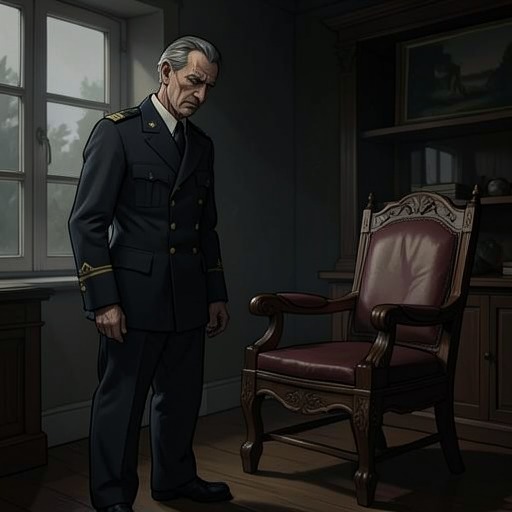
Stilwell's acute melancholia
The Caine MutinyJohn Stilwell’s acute melancholia marks the point at which the strain of life aboard the Caine becomes a medical crisis. Before his hospitalization, Stilwell had been singled out by Philip Francis Queeg and endured mounting anxiety while awaiting word about his mother; afterward, Tom Keefer reports a diagnosis of acute melancholia and describes a three-day withdrawal from ordinary duties. The narrative connects that collapse to the ship’s pressures without establishing a single cause or presenting a detailed clinical assessment of Stilwell himself.
Shipboard Pressure and Isolation
Stilwell’s distress develops within an atmosphere of close scrutiny and punishment. Queeg regarded him as a particular object of dislike, and every watch Stilwell stood at the helm within the captain’s range became a source of acute worry. He was also waiting for a response to a letter Steve Maryk had sent to the American Red Cross concerning his mother’s illness. As the weeks passed without an answer, Stilwell grew gaunt and feared that Queeg would soon punish him.
The captain’s rules shaped the crew’s response to that pressure. After finding a cigarette butt in a forecastle scupper, Queeg canceled liberty for the entire crew; in practice, sailors observed his new rules mainly within the area where he could see and hear them. Stilwell’s vulnerability sharpened the division: sailors opposed to Queeg befriended and tried to encourage him, while others kept their distance for fear the captain’s hostility would extend to his companions. The ship’s informal solidarity thus offered some support while also making Stilwell a focal point of its conflict with Queeg.
Symptoms and Hospitalization
During the return voyage, Stilwell twice asked to be relieved at the helm because of blinding headaches. Later, according to Keefer’s account to Willie Keith, he went to his bunk and remained there for three days. He did not answer musters or come up for meals, and his complaint was still a headache. The crew eventually had to carry him to the hospital. Keefer relayed that Stilwell was limp and unclean when they brought him in, details that convey the severity of his physical and functional decline without supplying a fuller medical history.
Keefer said Stilwell had been diagnosed with acute melancholia and was at the base hospital. He also reported hearing that Stilwell would receive electroshock therapy. That treatment is presented as something Keefer had heard, not as a confirmed account of what subsequently happened. The narrative offers no later update on the treatment or recovery.
Keefer’s Explanation and Its Limits
Keefer interprets Stilwell’s collapse as the convergence of several pressures: his tense temperament, lack of education, what Keefer calls a mixed-up emotional background, a year of serving under Queeg, and the burden of a pending general court connected with mutiny. In the same conversation, Keefer clarifies that Steve Maryk was to be tried on a charge of conduct prejudicial to good order and discipline rather than mutiny. His explanation is therefore an interested shipmate’s assessment, not a medical conclusion about the causes of Stilwell’s condition.
The distinction matters because the evidence establishes the diagnosis through Keefer’s report but does not show an examination of Stilwell or identify a definitive cause. It records observable changes—headaches, withdrawal from meals and musters, and the need to carry him to hospital—alongside Keefer’s interpretation of their context. The account makes the collapse legible as more than an isolated episode while leaving the relative weight of illness, personal history, command pressure, and legal anxiety unresolved.
Narrative Significance
Stilwell’s hospitalization reveals a human cost of the Caine’s strained command climate that is distinct from the formal dispute over Queeg’s fitness. The sailors’ routines already narrow into watches, paperwork, and disrupted rest; against that background, Stilwell’s withdrawal from the most basic duties signals a breakdown that shipboard discipline cannot contain. His condition also interrupts the crew’s conflict: a man whom Queeg’s opponents had rallied around is no longer aboard to take part in the unfolding proceedings.
The episode remains deliberately limited in what it can establish. It neither treats Keefer’s account as a complete clinical record nor turns Stilwell’s illness into proof of any one accusation against Queeg. Instead, it places a reported diagnosis beside concrete signs of incapacity and a shipboard history of fear, punishment, and waiting, showing how the crisis was understood by those around Stilwell while preserving uncertainty about its precise causes and outcome.