Surrender of Japan
The Caine MutinyThe Surrender of Japan marks the end of the USS Caine’s wartime service as experienced by its crew: the ship, left behind when other minesweepers are sent toward Tokyo, remains in harbor while its officers and sailors listen to the surrender ceremonies on the radio. The understated scene turns a global ending into a shipboard one. For Willie Keith, the war’s conclusion is also a difficult departure from the routines, skills, and dangers that have shaped his life at sea.
The War Seen from the USS Caine
The novel sets the ending against the long, uneven course of the Pacific War. By early 1944, major turning points including Guadalcanal had passed, and the broader strategic outlook was brightening. Willie’s view from the USS Caine was narrower and more anxious: he imagined the coming Pacific operations as a succession of coral islands, shore batteries, aircraft, and mines. That contrast between the war’s large-scale progress and a sailor’s uncertain prospects gives the eventual surrender broadcast its particular scale: history reaches the ship after months of work whose meaning was rarely visible from the deck.
In January 1944, the USS Caine sailed from Hawaii in a huge formation bound for Kwajalein Atoll. The fleet’s orderly movement across empty ocean stood far from the ship’s later, repetitive duties. After reaching Funafuti Atoll, the minesweeper was drawn into the Seventh Fleet’s escort work, shuttling between places including Nouméa and Guadalcanal. Its service consisted largely of movement, watchkeeping, and maintenance rather than decisive combat. The story thus places the ending of the war within the accumulated labor of a ship that had spent much of the conflict supporting larger operations.
The Final Sweeping and the Missed Tokyo Operation
Seventeen days before the war ended, the USS Caine finally swept a mine in the China Sea. The mine appeared in the ship’s wake; the crew marked it, and a nearby sub chaser destroyed it. Mines then began to surface along the sweep formation. The encounter was a real operational moment for a ship whose wartime work had often seemed monotonous, but it did not lead to a last major assignment.
After the USS Caine’s pumps were repaired, the Navy ordered destroyer-minesweepers in the harbor to prepare to sweep Tokyo’s approaches ahead of the victorious fleet. The USS Caine was not included. At the MinePac office, Willie and Tom Keefer tried to persuade Captain Ramsbeck that the ship was ready to go. Ramsbeck’s concern was its condition: another breakdown en route, during typhoon season, could leave it facing a storm with limited power. The decision was therefore tied to the ship’s material state, not simply to its crew’s willingness. Willie and Keefer watched the other minesweepers leave Buckner Bay, and the prospect of seeing Tokyo passed them by.
The Surrender Broadcast
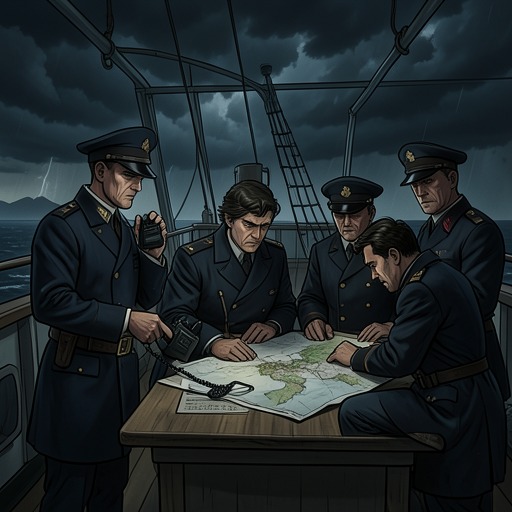
The USS Caine remained at anchor in an almost empty harbor, its anchor described as rusted and mossy, while its officers and crew listened to the surrender ceremonies over the radio. The scene gives no account of the ceremonies themselves; its focus is the ship’s stillness and the crew receiving the news at a remove from the fleet moving on to its next task. The war ends for them not in a dramatic final engagement, but in a broadcast aboard a vessel considered too worn to join the Tokyo operation.
That quiet ending follows a wartime pattern in which large events reached the crew through orders, messages, and the practical limits of their ship. The USS Caine had taken part in escort duty and, near the end, mine sweeping, but its final position was shaped by repair needs and a judgment about seaworthiness. The broadcast confirms the historical change around them; the harbor scene makes clear that the crew’s immediate experience of that change is waiting, listening, and preparing to leave the war behind.
Willie Keith’s Return from the War
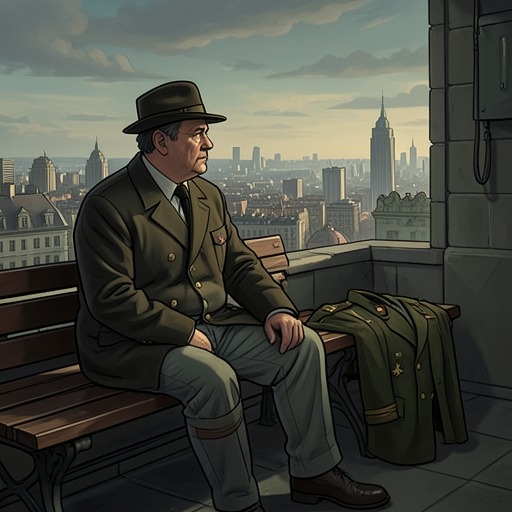
When the USS Caine later steamed away from Okinawa, Willie stood on the bridge and watched the island recede. He understood the departure as the end of the war for him: he had left home three years earlier, crossed half the globe, and reached a place that had once seemed unknown and distant. Now he was going back. The surrender broadcast and the departure from Okinawa belong to the same transition, from wartime duty toward return, though the book shows that the transition is not instantaneous.
At night, Willie remained uneasy about sailing with lights showing. He continued to follow blackout habits, covered his flashlight, and felt unsettled by the absence of familiar wartime sounds and the sight of guns covered and no longer tended. During the war, he had experienced the sea and the Japanese as inseparable parts of one danger; after the surrender, he had to remind himself that the ocean did not itself produce submarines. The routines he had learned were already becoming memories, and the familiar wheelhouse seemed to be slipping out of his life. The event therefore closes a military conflict while opening a quieter personal loss: the end of the work, vigilance, and shared world that had given his wartime years their shape.
Fictional and Historical Frame
The novel explicitly identifies itself as fiction set during World War II and warns that times, places, ship missions, and naval procedures have been altered. It states that the people and events aboard the USS Caine are imaginary and that no ship of that name existed. The surrender scene should consequently be read as the novel’s account of how the war’s ending reaches its fictional crew, not as a historical record of an actual USS Caine or its participation in the surrender ceremonies.