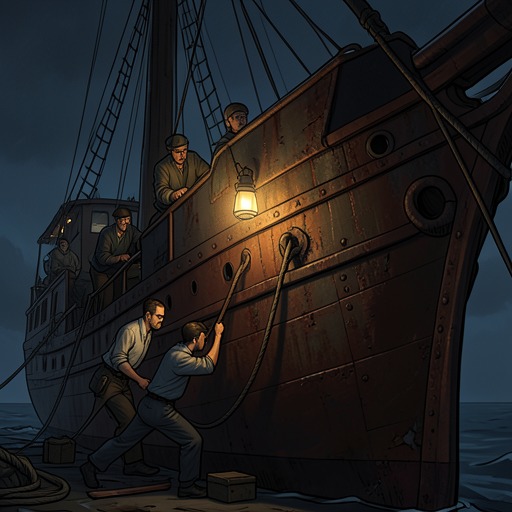
The Caine’s informal shipboard order
The Caine MutinyThe Caine’s informal shipboard order was the practical system by which an overworked crew kept an aging, poorly equipped vessel functioning when formal procedure did not fit its condition. Known as The Caine way, it depended on experience and local judgment rather than consistent adherence to Navy practice. It was neither simple disorder nor an unqualified success: it delivered results, but its improvised methods could be wasteful and precarious, and Philip Francis Queeg’s attempt to replace them exposed how little shared ground existed between the ship’s command and its crew.
Definition and Working Conditions
USS Caine’s physical state helped make its working habits. Captain de Vriess described a ship that rolled and pitched heavily, had an exhausted power plant and obsolete machinery, and crowded its men into difficult working spaces. The engine-room crews had to work under air pressure, where a blowback could be fatal. Yet, as he explained to the incoming Philip Francis Queeg, the men knew the conditions, rarely sought transfers, and had supported him in difficult situations. His description presented their unconventional habits as adaptations to the ship as it actually was, not merely as failures to meet an ideal standard.
The ship’s limitations were also present in the ordinary living arrangements. When Willie Keith first came aboard, he was shown a metal clipping shack about seven feet high, six feet long, and three feet wide. Ensign Harding slept there on a bunk welded close to the deck, amid ammunition cases and empty machine-gun ammunition belts; the temperature was about 105 degrees. Later, during a stretch of rough weather and demanding watches, Willie’s routine narrowed to bridge duty, coding, correcting publications, meals, and sleep in the shack, which was repeatedly interrupted. These details make the shipboard order tangible: its rules and customs governed a crowded workplace where even rest was provisional.
Practical Judgment and Its Limits
The Caine way appears in small acts of delegated judgment, not only in dramatic emergencies. During the noon-to-four watch, the forward fireroom requested permission to blow its tubes. Steve Maryk, the officer of the deck, checked the flag and granted the request because the wind was on the beam and would carry the soot clear. He explained that the ship sometimes had to change course to obtain the right wind, in which case the captain’s permission was needed. The moment shows a working balance: an officer could make a local decision using immediate conditions, while a change affecting the ship’s course remained subject to the captain.
The same tension surfaced over communications. After Philip Francis Queeg objected that the radio watch was copying only local harbor broadcasts, Tom Keefer answered that USS Caine was following standard Pearl Harbor procedure: the ship copied the harbor circuit, while another vessel guarded the schedules for destroyers in port. The disagreement was not simply between rules and rule-breaking. Keefer described an established procedure; Queeg expected a different form of readiness. The exchange revealed how a system grounded in shared local practice could appear inadequate or even wrong to a new commander who understood his authority through a different set of expectations.
The officers themselves recognized both the utility and the cost of informal practice. Steve Maryk observed that the work that had to be done did get done: the ship got underway, reached its destinations, fired its guns, and kept its machinery running, often by makeshift means. He also noted that USS Caine had spent less time in repair than other four-stackers he knew. Tom Keefer countered that the waste, lost motion, and dependence on luck were staggering, and argued that the Navy’s prescribed way was still the right way. Maryk’s answer made the disagreement specific: by the book, USS Caine should have been in the boneyard. A procedure designed for a serviceable ship could not simply be imposed on a vessel whose continued operation already depended on adaptation.
Queeg’s New Order and the Circle of Compliance
At his first meeting with the officers, Philip Francis Queeg declared that he expected absolute loyalty and intended the ship to follow his way and the book. He presented the book as purposeful and authoritative, while insisting that deviations would require compelling justification. His performance standard allowed no comfortable middle ground: excellent work was to be normal, while merely standard work counted as deficient. This program directly challenged a shipboard culture in which officers and sailors had long relied on judgment shaped by the vessel’s defects and established practices.
The new rules did not transform the whole ship. After a cigarette butt was found in a forecastle scupper, Queeg canceled liberty for the entire crew. For the next few days, the main deck was kept swept; once USS Caine sailed for Kwajalein, the deck returned to its previous condition except during sweeping periods. One deckhand continued to clean the small area along the captain’s route. The crew had learned where Queeg was likely to look, and compliance concentrated within what the narrative calls the Circle of Compliance: rules were observed inside the captain’s range of sight and hearing, while much of the old routine continued elsewhere. The account stresses that this pattern was not a consciously organized conspiracy. It was an accommodation that let the crew meet the captain’s visible demands without remaking the entire ship around them.
That selective order had consequences for the ship’s social life. Outside the Circle of Compliance, the crew relied on its own rough communal rules, and Maryk was among the officers whom sailors especially respected. In the wardroom, Maryk understood that enforcing every order could exact an unacceptable cost from the vessel’s narrow margin of seaworthiness; he therefore concentrated on keeping the ship functioning adequately beyond the areas where Queeg’s rules were actively enforced. The other officers, with Tom Keefer as a leading voice, increasingly bonded through ridicule of the captain. Willie Keith, whom Queeg treated more warmly than the others, joined in the mockery, while Maryk generally stayed silent or defended Queeg. Their different responses show that informal order was not a single shared attitude: it was simultaneously a survival practice, a source of resentment, and a point of divided loyalty.
Persistence and Significance
The contrast between formal command and lived routine persisted through USS Caine’s long escort assignments. Days of watches, logs, reports, audits, and repetitive voyages blurred into months. Meanwhile, Philip Francis Queeg imposed punishments and demanded investigations and written reports; Maryk continued to record incidents in his secret log. The ship’s routines therefore remained shaped both by administrative demands from above and by the crew’s practical methods for enduring its conditions. The burden of paperwork and watchkeeping did not erase informal practice; it made the tension between official order and workable life aboard more constant.
The Caine way is significant because the novel does not reduce the conflict to a choice between competent experience and foolish regulation. De Vriess’s account and Maryk’s examples show why local knowledge mattered aboard a ship in poor condition; Keefer’s criticism acknowledges that improvisation could also bring waste and dependence on luck. Queeg’s rules offered a clear formal standard, but their uneven enforcement produced a ship divided between the visible performance of compliance and the less regulated life beyond it. The result is an order that keeps USS Caine going without resolving the central question of what responsible command requires when the ship, the book, and the crew’s experience do not fit together.