The Liquor Crate
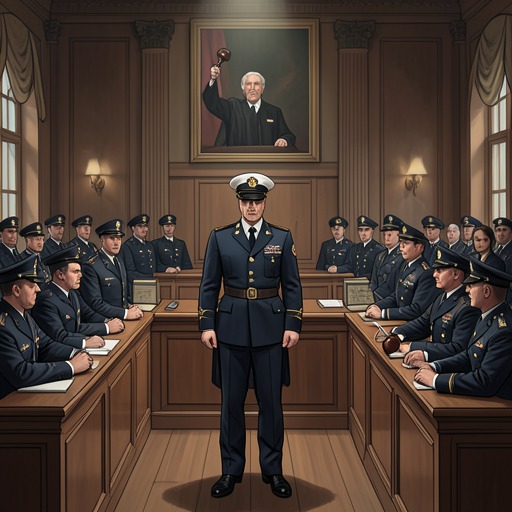
The Caine MutinyThe Liquor Crate is a wooden container commissioned by Philip Francis Queeg to transport thirty-one bottles of whisky from the USS Caine. Conceived as discreet packaging for a personal cargo, it becomes conspicuous through its excessive weight, then disappears into the water during a transfer ashore. Its loss gives Queeg a reason to hold up Willie Keith’s leave request, making the crate more than a container: it is the material link between a captain’s private errand, the crew’s labor, and an ensign’s attempt to accept blame and get away from the ship.
Commissioning and Concealment
The crate begins with a purchase organized by Queeg. At a club liquor counter, the Caine’s officers buy roughly thirty quarts of scotch and rye; Queeg directs them as they carry bottles to a jeep, then drives away with the load. The next morning, he summons Carpenter’s Mate Second Class Langhorne and asks for a crate for thirty-one bottles. His proposed cover story is that the cargo consists of medical supplies, and he instructs Langhorne to keep the bottles secret if anyone asks.
The order puts Langhorne to work on a captain’s private purpose, but Queeg treats the task as outside the carpenter’s province. He specifies a box roughly three by two and calls for protective packing between the bottles. When Langhorne reports that the available partitions are sheet lead rather than sheet tin, Queeg first objects to the weight and then tells him to leave the lead in place. He remarks that the extra heaviness will give some seamen healthy exercise later, and considers whether the lead might be useful to him at home. The finished object thus reflects not a carefully optimized shipping plan but Queeg’s changing instructions and the materials Langhorne can obtain.
A Heavy Object in the Crew’s Hands
Langhorne brings the newly made crate to Queeg’s cabin late that afternoon, carrying it on his back. The fresh-sawed white boards and lead partitions have made it so heavy that moving it requires conspicuous effort. Queeg has the bottles packed inside with excelsior, completing a container meant to protect and conceal them. The lead that he had questioned now gives the crate a physical burden that cannot be hidden by its ordinary wooden exterior.
When the USS Caine reaches the San Francisco Bay area, Queeg orders Willie to assemble a working party and load the crate into the gig; Willie is appointed boat officer. The sailors struggle to position it, while Willie stays clear of the precariously moving box and offers suggestions that are ignored. At the Oakland landing, Queeg sits in the stern with his feet on the crate. The crew’s formal appearance contrasts with the difficult manual task: the sailors have cleaned and dressed carefully because they hope for leave and fear Queeg’s displeasure. Their situation places the crate within a shipboard order in which access to liberty and the captain’s demands shape the crew’s conduct.
The Fall and Its Consequences
The transfer goes wrong when Queeg rebukes Mackenzie for standing on the dock holding the gig’s bowline and orders him to help lift. Mackenzie releases the line; the gig drifts away from the landing, opening water beneath the crate as the men struggle with it. In the ensuing confusion, the crate and Horrible fall into the water. The crate sinks, while Queeg is soaked. He directs the crew to bring out grappling irons, and the men try to recover it. The incident converts a cumbersome piece of cargo into a lost one, with both the failed transfer and the captain’s instructions part of its history.
The crate’s weight is central to this change. It is built to keep fragile bottles secure, but its construction makes it difficult to maneuver; once it drops, that same weight sends it down. It does not merely sit in the background as a symbol of Queeg’s purchase. Its material properties shape the work, narrow the crew’s options during the transfer, and determine the immediate result. The captain’s order has set the event in motion, but the crate’s bulk and the boat’s movement make the order’s practical consequences visible.
The Crate on Willie’s Record
The loss follows Willie beyond the landing. When he later asks Queeg for a seventy-two-hour pass, the captain brings up the crate fiasco as a mark against him. Willie responds by accepting responsibility for his stupidity and offering to reimburse Queeg for the loss. Queeg becomes more pleasant and grants the pass. Willie later tells May Wynn that the leave cost him one hundred and ten dollars, describing that amount as the ransom he paid to get off the USS Caine.
The episode shows how the crate acquires a second life as an item in the captain’s account of Willie’s performance. For Queeg, the lost cargo can be invoked when deciding whether to grant liberty; for Willie, taking responsibility becomes a means of securing time away. The event also informs May’s view of life aboard the ship: as Willie describes the crate and other incidents, she becomes increasingly appalled by Queeg’s conduct. The object therefore carries consequences beyond the moment it sinks, shaping a conversation ashore and exposing the distance between the captain’s authority and the ordinary needs of those serving under him.
Function in the Novel
The crate’s story depends on the contrast between its intended purpose and its actual course. It is commissioned to protect and conceal whisky, yet its construction makes it a conspicuous burden; it is carried as cargo, but the transfer becomes a test of obedience and coordination; once lost, it remains useful to Queeg as an accusation against Willie. Each change follows from a concrete feature or use of the object rather than from an abstract symbol imposed on it.
The episode also brings the USS Caine’s hierarchy into view through practical labor. Queeg can arrange the purchase, assign the packing to Langhorne, direct the loading, and later cite the loss when considering Willie’s pass. The sailors bear the physical work, while Willie, as boat officer, is responsible for the operation despite his limited influence over how it unfolds. The crate’s passage from cabin to gig to bay gives that imbalance a clear shape: a private cargo becomes a shared burden, then a lost object whose cost is charged to an ensign. In this way, the crate links Queeg’s personal errand to the ship’s system of command, discipline, and controlled leave.