The Lost Towed Target
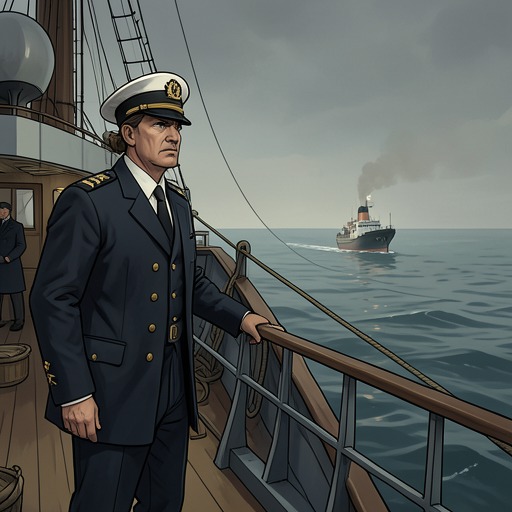
The Caine MutinyThe Lost Towed Target is the gunnery target that the USS Caine fails to recover under Philip Francis Queeg’s command. More than a missing piece of equipment, it makes an operational mistake visible: Queeg must explain why the ship abandoned an apparently manageable recovery, while his superiors weigh the incident against his fitness for command and the condition of the vessel.
The target and the failed recovery
The target’s loss is treated as the latest fiasco in a series of difficulties aboard the USS Caine. In an official message, Queeg is ordered to appear in person before the operations officer of ComServPac at 1300 on 22 October and submit a written report. The requirement to report personally underscores that the matter has moved beyond routine shipboard explanation.
At the interview, Captain Grace asks why Queeg did not recover the target. Queeg answers that the chief boatswain’s mate did not know how to proceed and that his officers had given him uncertain information. He says he judged a return to base for further orders preferable to spending an indefinite period on a complicated maneuver. The lost target is thus tied not only to the recovery itself but to Queeg’s account of his dependence on subordinates and his decision to abandon the effort.
Official scrutiny and immediate consequences
Captain Grace rejects the claim that recovery was unusually complicated: destroyer-minesweepers had performed it many times, and he estimates the work could be done in half an hour. He emphasizes that the targets cost money and that the tug sent to search for this one has been unable to find it. The object’s absence therefore has a practical consequence—the Navy has lost costly equipment—while the failed search leaves its whereabouts unresolved.
The interview does not immediately result in Queeg’s relief. Captain Grace tells the admiral that the known incidents do not yet establish grounds for removing him, and that strain in a first command might explain them. The admiral instead selects the USS Caine for return to the United States for overhaul and new radar installations, noting that it has spent twenty-two months in the forward area. The ship’s reassignment follows the target fiasco in the narrative, but is presented as an operational decision, not as a formal punishment for losing the target.
Place in the wider story
The target episode belongs to a broader contrast between the scale of the Pacific War and the Caine’s uncertain routine work. The narrative sets the lost equipment and its paperwork against the immense fleet later sailing from Hawaii toward Kwajalein; Willie Keith’s perspective remains that of a junior officer aboard one ship, amid the operation’s dense instructions and communications burdens. The target’s loss is a local failure inside a much larger military system, not a battle that changes the course of the campaign.
The ship’s later duties further complicate any simple association between its work and combat. Seventeen days before the war’s end, the Caine finally sweeps a mine; afterward, its condition prevents it from joining the destroyer-minesweepers ordered to sweep Tokyo Harbor. These later episodes do not concern the missing target, but they place its loss within the vessel’s extended movement among routine work, major operations, and repair. The author’s note identifies the people and events aboard the Caine as imaginary and explains that operational details were altered, so the lost target belongs to the novel’s fictional account rather than to a real Navy incident.