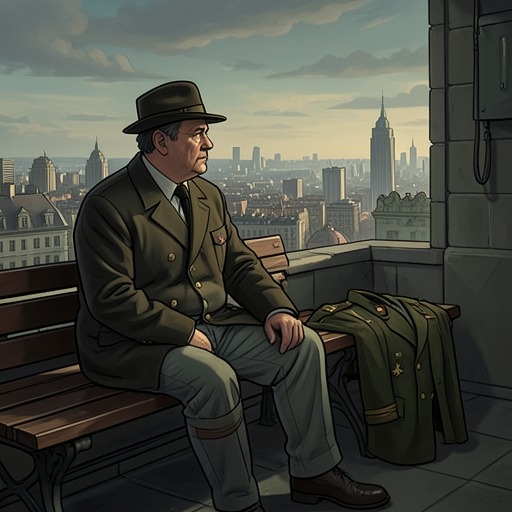
The Pacific War
The Caine MutinyThe Pacific War supplies the historical scale and chronology for the Caine’s fictional service, while the novel measures the conflict from the cramped, work-bound perspective of a single destroyer-minesweeper. Its war is at once a sequence of immense fleet movements and a succession of watches, communications, escorts, and maintenance problems. The book also explicitly cautions that its military details and events are fictionalized, not a documentary account of actual operations.
Historical Frame
The novel sets its story amid World War II and distinguishes retrospective assessments of the conflict from the experience of those still serving in it. At the beginning of 1944, a broad historical view could regard the war as effectively won: major turning points had passed, Italy had surrendered, Germany was retreating, and Allied industrial strength was increasing. Willie Keith, however, sees no such settled outcome from the Caine. On New Year’s Eve, aboard ship in the Pacific, he imagines the danger still ahead in terms of islands, shore batteries, aircraft, mines, and the possibility of going down at sea. The contrast makes historical perspective a question of position: what appears decisive in retrospect remains uncertain to the sailor who must continue the work.
The chronology reaches back through the ship’s accumulated wartime assignments rather than presenting a continuous battle narrative. A sailor describes the Caine’s earlier work around the Coral Sea, Savo Island, Rendova, Munda, and Guadalcanal: carrying aviation gasoline to Henderson Field, transporting torpedoes, moving troops, and serving as convoy escort, screen, and supply vessel. Minesweeping, despite the ship’s designation, was not the main description of its service at that point. The vessel’s worn condition is connected to this succession of varied duties, which placed routine transport and support work inside the larger campaign.
War Seen from the Caine
The ship’s everyday conditions make the conflict tangible without making combat its constant subject. When Willie first comes aboard, he is assigned to a small metal clipping shack, roughly seven feet high, six feet long, and three feet wide, where an ensign sleeps in a bunk welded close to the deck. Later, at sea, Willie’s days become a repeated circuit of bridge watches, coding, correcting publications, meals, and interrupted sleep. The sequence narrows his immediate world to shipboard tasks and weather, even as operations continue beyond his view.
Communications work links the ship’s routine directly to the larger military organization. The volume of fleet messages burdens destroyer communicators, and at Funafuti Willie visits a destroyer tender’s communication office, where messages are decoded and mimeographed. That service saves him days of work. The episode places paperwork alongside movement and supply as a necessary part of the war, while showing how support facilities can relieve the pressure on a small ship.
The novel also shows how the war’s passage is experienced as repetition. During the Caine’s later escort assignments under the Seventh Fleet, it moves among Funafuti, Nouméa, Guadalcanal, and New Guinea, accompanying slow landing craft and returning repeatedly between bases. Weeks and months blur into watches, reports, audits, heat, rain, and recurring duties. This pattern does not mean that the war has stopped; it shows how a long conflict can be lived as administrative and logistical recurrence by crews whose assignments seldom resemble decisive battle.
Fleet Operations and Campaign Time
Against this routine, the approach to the operation at Kwajalein briefly opens the narrative onto a much larger scale. On a bright January day, ships stream out of Hawaiian harbors and form a vast fleet bound for Kwajalein Atoll. The armada proceeds for days without visible contact with the enemy, maintaining its formation through radar and the work of officers of the deck. The scene shifts attention from the Caine’s worn, enclosed life to the coordinated movement of a major force, while keeping the operation legible through the practical labor required to hold that formation.
The ship’s proximity to the operation does not give Willie a complete understanding of it. He knows the operation order is secret and takes reassurance from its extensive detail, but he misreads the captain’s behavior and does not recognize that the order itself may be troubling him. The passage therefore contrasts the confidence produced by the fleet’s plans with the uncertainty of the people who receive and execute them. The larger campaign is organized on paper and across the sea; aboard the Caine, it arrives through messages, orders, and the crew’s immediate tasks.
The War’s Closing Phase
Near the end of the conflict, the Caine finally sweeps a mine in the China Sea, seventeen days before the war ends. The ship is part of a line of minesweepers advancing through a minefield. A mine rises in its wake, a warning is raised, and another vessel destroys it; mines then begin appearing across the formation. For a ship whose earlier service had included many kinds of transport and escort work, this is a rare direct encounter with the task implied by its designation.
The planned sweep of Tokyo harbor marks another transition, but not a triumphant assignment for the Caine. After its pumps are repaired, an order sends destroyer-minesweepers in the harbor to prepare for the operation, yet the Caine is excluded. At the MinePac office, Willie and Tom Keefer argue that the ship is ready to sail; the operations officer refuses, citing the risk of another breakdown and the danger of encountering a typhoon with limited power. The two watch the other minesweepers leave Buckner Bay. The war is approaching its victorious conclusion, but the Caine’s deteriorated condition determines what it can still do.
That ending preserves the novel’s distinction between the scale of the war and the uneven fortunes of an individual ship. The Pacific campaign advances toward victory through fleets, logistics, and successive operations; the Caine experiences that advance through assignments received, work repeated, repairs attempted, and opportunities lost. The author’s prefatory note cautions that the ship, its people, and its events are imaginary and that operational details were altered. The Pacific War is therefore both the story’s historical setting and a deliberately fictional frame for examining how large military events are encountered through ordinary service.