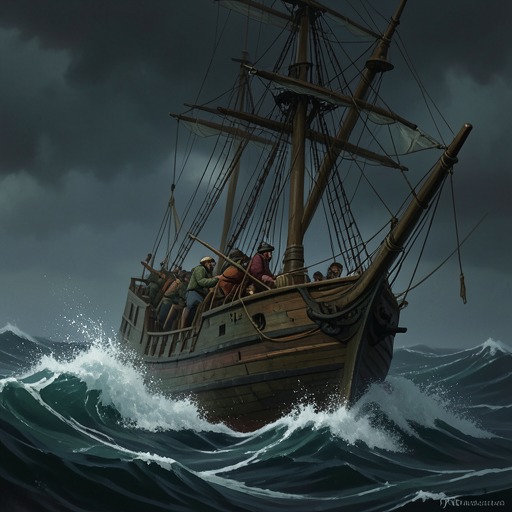
Third Fleet attempts at-sea refueling in a typhoon
The Caine MutinyThe Third Fleet’s attempt to refuel at sea during a typhoon turns a hazardous logistical operation into a test of how much a larger military plan can demand of ships and crews. From the USS Caine, the effort looks increasingly futile as fueling gear fails in the waves, but the fleet continues because the fuel is needed to support an imminent landing. The episode sets junior officers’ limited view of events against the strategic obligation driving the task force.
Strategic Context
The attempt takes place amid a wider campaign in which naval movements and supply requirements serve operations on land. The admiral has committed the fleet to an air strike supporting General MacArthur’s landing on Mindoro. The ships therefore need to refuel: without fuel, the fleet would have to deprive the Army of air cover. That connection is not known to the junior officers watching the operation, who judge it from the immediate evidence around them.
The contrast is especially sharp from the USS Caine. Willie Keith and Steve Maryk look out over a fleet struggling in heavy seas, while the rationale for continuing lies beyond their view. Their uncertainty is not simply a failure to understand the danger; they lack the operational information that would explain why the admiral accepts it.
The Attempt at Sea
In the morning, Willie and Maryk watch from the port wing of the USS Caine. The ship pitches and rolls among battleships, carriers, tankers, and destroyers, while waves repeatedly wash over its forecastle. The fueling effort is already difficult to reconcile with the conditions visible from their position.
Maryk spots a destroyer fueling from the battleship New Jersey. As the destroyer yaws beside the battleship, its fueling line parts and trails loose in the water; the fueling equipment swings free from the battleship’s deck. Willie concludes that little fueling will be accomplished. When he reports the accident to Philip Francis Queeg, Queeg treats it as another ship’s misfortune and asks for coffee, a small exchange that sets his detachment against the immediate danger and disruption.
The mishap does not end the operation. The task force continues trying until early afternoon, losing more fueling hoses and steadying lines and spilling oil. Junior officers across the ships make jokes at the fleet commander’s expense, interpreting the repeated failures as evidence of poor judgment. Their criticism rests on what they can see; they do not know that the effort is tied to the promised air support for the landing on Mindoro.
Withdrawal and Escalating Danger
At half-past one, the task force stops refueling and turns southwest to get out of the storm. The USS Caine’s ordeal continues after that decision. During the evening watch, Willie gradually recognizes the severity of the weather and feels flashes of panic as the ship rolls sharply. He keeps station by radar ranges and bearings on a nearby tanker while the other ships disappear from sight.
A storm warning reaches Willie late that night. He wakes Maryk, who checks the storm’s position on the chart; Queeg, asleep in his bunk, does not stir. Later, a huge wave crashes over the port side and floods the bridge. The USS Caine rolls almost onto its side, and its crew struggles to remain at their stations. This later crisis makes plain the danger surrounding the earlier decision to keep the fleet refueling, without establishing that the refueling attempt itself caused the storm or the ship’s later emergency.
Significance and Fictional Status
The scene draws its force from the distance between operational necessity and the view available to those carrying out the work. What looks to Willie and the other junior officers like a futile expenditure of equipment is, at the level of fleet command, bound to the requirement of supporting troops ashore. Their mockery exposes the limits of judgment based only on local evidence, while the failed hoses and wasted oil show that strategic purpose does not make a dangerous operation reliable or easy.
The episode belongs to the novel’s fictional wartime setting, not to a documentary account of an actual fleet operation. The author’s prefatory note states that the book distorts times, places, ship missions, and naval procedures, and that the Caine and its events are imaginary. The refueling attempt therefore functions as part of the novel’s depiction of wartime command and logistics rather than as a claim about a specific historical incident.