USS Moulton (DMS-21)
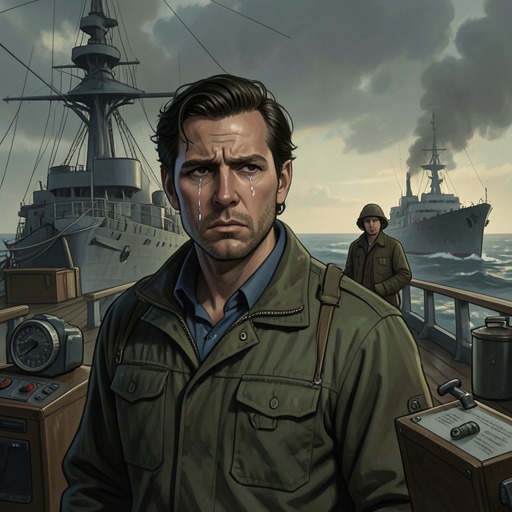
The Caine MutinyUSS Moulton (DMS-21) is the Caine’s sister destroyer-minesweeper, a ship that appears briefly but distinctly in the novel’s account of naval work. Its lost paravane delays an entire minesweeping formation, and its clean decks and ordered wardroom provide a pointed contrast to the Caine’s decay. The Moulton is not simply a background vessel: its condition and the restriction imposed after the mishap show how ships performing similar duties could embody very different forms of shipboard life.
Identity and Operational Setting
The Moulton is identified as DMS 21, one of the destroyer-minesweepers whose silhouettes Willie Keith recognizes at sea. Like the Caine, it has three stacks, a flush deck, small three-inch guns, and cranes over the stern. The ships look alike in outline, and their shared type places them in the same practical world of minesweeping equipment, formation maneuvers, and the recovery of paravanes. Their resemblance makes the contrast that follows more striking: structural similarity does not mean comparable upkeep or atmosphere.
When the signalman identifies the approaching ships, Captain de Vriess recognizes the Moulton and notes that Duke Sammis is aboard. He proposes sending a greeting to Sammis, whom he calls the Iron Duke. The exchange makes the encounter both professional and personal: this is a meeting between ships in formation, but also a reunion among naval acquaintances. The Caine then takes station behind the Moulton, placing the two vessels together before their next shared work.
The Lost Paravane
During a minesweeping exercise, the ships move into shallow water near a beach and sweep dummy mines. Seeing the yellow-painted, horned mines bobbing on the waves helps Willie understand that the cables and paravanes are working equipment, not merely part of a contest between ships. The Caine narrowly misses a mine cut by the Moulton, a close call that makes the exercise’s hazards newly tangible to him.
The final sweep is completed with time to spare for a possible return to Pearl Harbor before the submarine nets close for the night. The Moulton, with the squadron commander aboard, loses a paravane during the last moments of recovery. Its crew spends an hour fishing for the equipment while the other vessels wait. By the time the paravane is recovered, the sun is setting; the minesweepers must spend the night outside the channel entrance, steaming in circles rather than reaching harbor. The Moulton’s mishap thus has consequences beyond its own deck: a single lost piece of minesweeping gear holds up the whole group and turns a planned return into an overnight delay.
A Ship Compared with the Caine
The next morning, the Caine and Moulton share one buoy berth. Willie crosses over to visit Ed Keggs, and the difference between the ships is immediately apparent to him. Though identical in structure, the Moulton has no visible rust or green primer splashes. Its bulwarks and decks are uniformly gray; the ladder-rail cording is new and white; and the life-line leather is tightly sewn and brown, rather than frayed, loose, and coated in cracked gray paint as it is aboard the Caine. The Moulton’s sailors wear clean dungarees and tuck in their shirts. Even the officer of the deck looks exceptionally neat.
These details make the Moulton a concrete counterexample to the idea that a destroyer-minesweeper must look shabby. The contrast is not a generalized report on every aspect of either ship: it is Willie’s close observation during a visit. But the scene makes the Caine’s condition feel like the mark of its particular history and habits, not an unavoidable feature of its class. The Moulton’s orderly appearance also changes the tone of the visit. Willie has come to see an old acquaintance, yet the immaculate wardroom and the careful work underway there suggest a ship governed by a more exacting routine.
Restriction and Shipboard Atmosphere
Keggs cannot stop to talk because the Moulton is restricted for a week after losing the paravane. The restriction applies to everyone aboard, officers included, even though the equipment has been recovered. When Willie asks why responsibility extends to the whole ship, Keggs explains that everyone is considered responsible for everything aboard. The scene does not identify an individual culprit; instead, it shows the collective nature of the penalty and how far it reaches into ordinary life. A brief visit between friends is cut short by a shipwide consequence of the earlier delay.
The encounter also gives a small but revealing view of work under that restriction. Keggs is drinking coffee while operating a coding device in the wardroom. A muffled door slam prompts him to spring up, sweep the device off the table, put it in a safe, and take up a clipboard of decoded dispatches. Willie sees no clear reason for the sudden response, and the moment leaves both men uneasy. The episode links the Moulton’s neat external order with a more tense form of vigilance inside: the ship appears maintained and disciplined, but its rules and the apprehension surrounding them can interrupt even a quiet conversation.
The novel’s prefatory note cautions that it is fiction set during World War II and that military details, ship names, missions, and procedures have been altered. The Moulton’s role is therefore best understood through the narrative’s specific contrast: a sister ship sharing the Caine’s work, capable of a costly equipment mishap, and presented in a visit that reveals a markedly different standard of appearance and control.