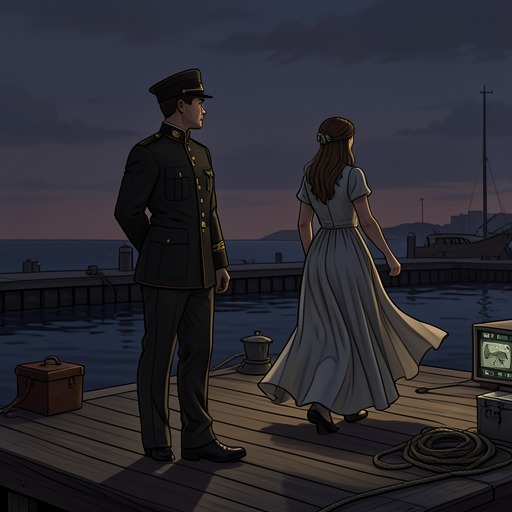
Willie Keith—May Wynn
The Caine MutinyWillie Keith—May Wynn is a relationship marked by separation, delayed self-recognition, and a renewed proposal. Willie had ended the relationship and then gone five months without writing, believing that a clean break was the honorable choice. In a letter to May, he recasts that decision as a failure of judgment: he had mistaken social status and his mother’s objections for reasons to give her up. His attempt to return does not erase the hurt or guarantee reconciliation; it makes his willingness to marry her explicit while leaving her answer uncertain.
Relationship and Separation
The relationship’s decisive rupture precedes the letter. Willie acknowledges that he stopped writing because he had decided to end things and thought continued correspondence would only prolong the separation. He now describes that reasoning as self-serving: he had treated May as not good enough for him, a judgment he recognizes as foolish and snobbish. The letter does not present the breakup as a misunderstanding that can simply be corrected. Willie accepts that he chose to withdraw and that May may no longer feel attached to him.
His recollection of their earlier intimacy nevertheless sustains his hope. He refers to the last time they kissed as a reason to believe she may still care for him, but does not treat that memory as proof that she must take him back. Instead, he acknowledges the possibility that he has become no more to her than one of the customers who looked at her at the Grotto. The contrast between his confidence in what he now feels and his uncertainty about her feelings gives the proposal its risk: he can declare his intention, but cannot decide the response.
The Return to May
Late in June 1945, the day after an encounter that remains powerful in Willie’s memory, he writes an eight-page letter asking May to marry him. The scale and timing of the letter make the proposal a turning point in their relationship. After months of silence, he does not resume contact casually or pretend that nothing happened; he asks directly for a future together and admits that he is returning to the woman he jilted.
The letter presents this return as a change in Willie himself, though he cannot identify one single cause. He says that events over the preceding five months have made him feel older and less trapped in his adolescent outlook. He now regards his earlier decision as the product of immaturity rather than sound judgment. His claim that he has changed is therefore tested by the very act of writing: he must acknowledge his responsibility, risk rejection, and state what he wants without the status-conscious qualifications that helped drive him away.
What Willie Confesses
Willie identifies his mother’s influence as part of the rupture. After the couple’s trip to Yosemite, Mrs. Keith persuaded him not to marry May by framing his attachment as sexual infatuation. In the letter, Willie recognizes that he allowed this argument to reinforce his own immature concern with appearances and a supposedly suitable family. His return reverses that hierarchy. He no longer treats family prestige as a valid reason to reject May, and says his mother’s disapproval will not determine whom he marries.
He also revises his understanding of May. He had valued her through a narrow, self-regarding view, but now describes her as more perceptive and stronger in character than he is. These judgments are part of Willie’s confession, not an independent account of May’s thoughts or an assurance that she will forgive him. He presents his admiration alongside an admission that he failed to appreciate her before. The proposal thus asks for another chance while acknowledging that the failure was his.
A Future Imagined, an Answer Awaited
Willie does not promise May a glamorous life. He imagines a future in which he works as a faculty member and recognizes that such a life may not appeal to her. He contrasts that quieter prospect with the New York and Broadway world he associates with her, and asks her to try the different life he envisions. He also hopes she would bring energy to an environment he considers comfortable but potentially dull, and encourage him to do worthwhile work. The future he offers is specific but tentative: he can describe what he hopes they might share, not guarantee how she would experience it.
The letter’s form preserves the imbalance between declaration and outcome. Willie writes rapidly, rereads and revises the draft, and recognizes that it may seem startling, abject, and disjointed. He cannot make himself appear dignified, because returning to someone he left is inherently humiliating to him. Still, he decides that polish matters less than honesty. He ends by asking May to answer quickly and waits in suspense, certain of his own desire but unable to know hers. The supplied episode therefore establishes the renewed proposal, not May’s acceptance: reconciliation remains a hope Willie has finally dared to state.