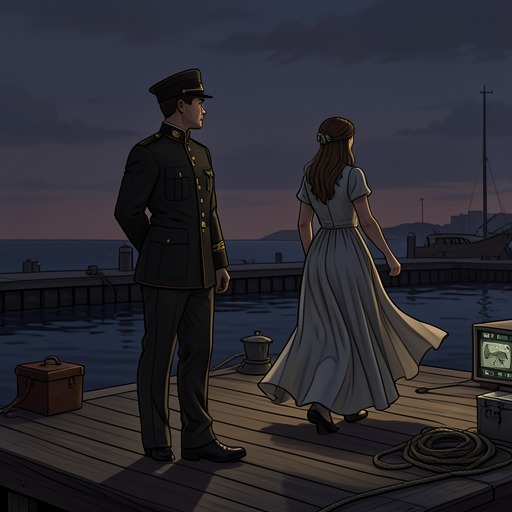
Willie Keith's marriage proposal to May Wynn
The Caine MutinyWillie Keith’s marriage proposal to May Wynn takes the form of an eight-page letter written after the kamikaze attack on the USS Caine in late June 1945. The proposal reverses Willie’s decision to end their relationship and makes explicit a change that the war has forced him to recognize: he had treated May as unworthy of his social ambitions, but now understands that his judgment was childish and that he wants to build his life with her.
Context and Reversal
The letter follows an encounter with a kamikaze pilot whose attack set the old USS Caine ablaze. Willie never saw the pilot’s face or learned his name, yet the encounter had a profound effect on him. The day after the attack, he wrote to May begging her to marry him. The proposal therefore comes not as a carefully staged courtship but in the wake of a sudden confrontation with mortality, while the ship itself was alongside the tender Pluto for repairs.
Willie had not written to May for five months. In the letter, he explains that he had thought ending the relationship cleanly was more honorable than continuing correspondence after deciding she was not good enough for him. He now sees that decision as an expression of an immature, snobbish outlook rather than a sound judgment about their future. His proposal does not erase the separation or excuse his silence: he admits that the letter may arrive as a shock and that he has no right to assume she will answer favorably.
The reversal is also bound up with his earlier trip to Yosemite and his mother’s influence. His mother had persuaded him not to marry May by encouraging him to interpret his attraction as a trap. Willie cannot give May a neat account of what changed, but says that the events of the intervening months have made him feel years older. He now intends to marry her even if his mother disapproves, rather than let her opinion determine the choice.
Writing the Letter
Willie writes late at night after closing Tom Keefer’s manuscript. He goes to the ship’s office, shuts the door, switches on the desk lamp, and begins typing without pausing. The scene gives the proposal a deliberately unceremonious setting: instead of an arranged declaration in a beautiful place, it takes shape as an urgent message composed aboard a ship under repair.
The letter is not effortless simply because Willie’s decision is firm. He rereads it perhaps twenty times, cuts phrases, inserts sentences, and types a clean copy. At four in the morning he reads that version again, recognizing that it sounds astonished, abject, and uncontrolled, but also truthful. He considers further changes and leaves them alone, accepting that no polishing can make his return to a woman he jilted seem dignified. The repeated revision records his effort to make the proposal adequate; his final decision to send it acknowledges that no wording can remove the vulnerability of asking.
What Willie Asks and Admits
Willie tells May plainly that he wants her to be his wife and that his love is not a passing impulse. He recalls first being drawn to her in Luigi’s, then recognizes that her intelligence and character exceed his own. He no longer treats the difference between them as a reason to withdraw. Instead, he describes her affection for him as extraordinary luck and accepts that his former standards of status and a respectable family had distorted what mattered.
He also attempts to imagine their shared future in concrete terms. Willie expects to become a poorly paid member of a college faculty, and he acknowledges that this prospect may not appeal to May. He contrasts the quiet, cultivated world he imagines with her experience of New York and Broadway, while hoping that she might bring energy to the academic life he anticipates. He does not present that future as a certainty or pretend that the change would be easy; he asks her to try it with him if she still believes they belong together.
His appeal includes an explicit reconsideration of his family’s place in the decision. He tells May not to be bitter toward his mother, whom he suspects may eventually accept the marriage, but insists that his mother’s response will no longer govern his choice. Willie feels sympathy for her without being willing to surrender the life he wants with May. The proposal thus marks a shift from seeking parental approval to taking responsibility for his own commitment.
War, Responsibility, and the Ending
Even as Willie asks May to marry him, his letter digresses into the lessons he has drawn from the conflict aboard the USS Caine. Looking back on the case involving Steve Maryk and Philip Francis Queeg, he concludes that a crew may have to keep serving an incompetent captain, cover mistakes, and keep the ship functioning rather than force a crisis that leads to a court-martial. He credits Barney Greenwald, Maryk’s defense counsel, with helping him arrive at this view. Willie distinguishes that hard-won judgment from Tom Keefer’s cleverness, which he doubts has become wisdom.
The same letter reports that Keefer has sold an unfinished novel, Multitudes, Multitudes, to Chapman House for a thousand dollars in advance. Willie has read part of the manuscript and thinks it is smooth and compelling despite its literary influences. This account is one of several digressions in the proposal, but it also places Willie’s declaration within the shipboard life from which he writes: a message about marriage carries news of his companions, their work, and the ordinary conversation that continues amid war.
Willie seals the finished letter, drops it in the ship’s mailbox, and goes to sleep expecting a long wait while it travels halfway around the world and an answer makes the return journey. The ending leaves May’s response unresolved in this episode. What is settled is Willie’s side of the choice: unlike his earlier break, the proposal is not a way of keeping options open. It turns his revised understanding of May, his rejection of his mother’s veto, and his reflections on duty into a direct request for a shared future.