Lord Canterville
The Canterville GhostLord Canterville is the honourable head of the family associated with Canterville Chase, and the first person to make its haunting an explicit condition of the Otis family’s purchase. He represents a hereditary world shaped by the house’s long history, yet his frankness, courtesy, and eventual settlement over Sir Simon’s jewels make him a practical intermediary between that past and the new American owners.
Identity and the Sale of Canterville Chase
When Hiram B. Otis buys Canterville Chase, Lord Canterville considers it his duty to disclose that the house is haunted. He explains that his family has not wished to live there: his grandaunt, the Dowager Duchess of Bolton, was frightened by the appearance of two skeleton hands and never fully recovered, while Lady Canterville lost sleep over mysterious sounds in the corridor and library. The family’s younger servants also refused to stay after the Duchess’s experience. These details present the haunting not as a private superstition but as a long-running domestic burden affecting the household and its staff.
Lord Canterville gives the haunting a family history as well as a practical warning. The ghost has been known for three centuries, since 1584, and, he says, appears before the death of a member of the Canterville family. He does not conceal the danger or try to improve the property’s appeal by minimizing it. His warning is part of the negotiations, and the purchase is concluded only after he has made the circumstances plain.
Candour and the American Owners
Hiram B. Otis answers the warning with confidence in money, modernity, and the possibility of treating a ghost as a museum curiosity or public spectacle. Lord Canterville replies that the ghost has resisted such enterprise and remains real, though he accepts that Otis may not mind having it in the house. Their exchange establishes a difference in outlook: Lord Canterville treats the supernatural as an inherited fact requiring disclosure, whereas Otis approaches it as a claim that modern American confidence can dismiss or manage.
The contrast does not make Lord Canterville hostile to the buyers. He is described as a man of punctilious honour, and his warning is an act of that honour rather than an attempt to prevent the sale. After Otis later reports that the ghost has apparently gone away, Lord Canterville writes back with pleasure and congratulates the Minister’s wife. The mistaken report briefly makes the haunting seem like a problem that has ended, but the ghost remains in the house; the correspondence shows that Lord Canterville continues to respond to the Otises as a courteous former owner, even when their understanding of the house is incomplete.
The Ghost’s Release and the Family Funeral
Virginia’s intervention changes the meaning of the family history Lord Canterville had described. After she returns to the house and leads her family through a hidden passage, they discover Sir Simon’s chained skeleton in a small secret room, along with the remains of the food and water that had been left beyond its reach. Virginia tells her father that the ghost is dead, regrets his past wickedness, and has given her a box of jewels. Lord Canterville is not present at this discovery, but he becomes part of its aftermath: Sir Simon’s release makes a proper funeral possible, bringing the family’s long supernatural burden to a public close.
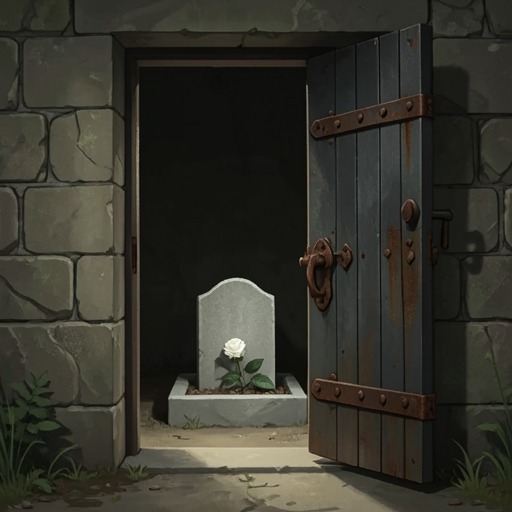
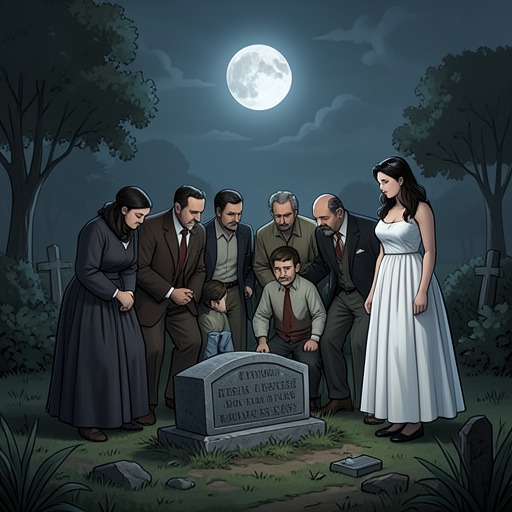
Four days later, Lord Canterville travels specially from Wales to attend the funeral and serves as chief mourner. He sits in the first carriage with Virginia, ahead of the Otis family and Mrs. Umney. The procession leaves Canterville Chase at about eleven at night; eight black horses draw the hearse, and servants walk beside the vehicles carrying torches. The burial takes place beneath the old yew tree in the churchyard, where the Reverend Augustus Dampier conducts the service. As the coffin is lowered, Virginia lays on it a cross made from white and pink almond blossoms. Lord Canterville’s attendance reconnects the newly settled Otises with the family whose history has shaped the house, while the ceremony marks a change from the ghost’s unwelcome appearances to communal mourning and burial.
The Jewels and the Question of Inheritance
The morning after the funeral, Lord Canterville meets with Hiram B. Otis to discuss the jewels Sir Simon gave Virginia. Among them is a valuable ruby necklace in an old Venetian setting, described as an outstanding example of sixteenth-century work. Otis is uneasy about allowing his daughter to keep property that might properly belong to the Canterville family. He invokes mortmain, argues that the jewels should be family heirlooms, and offers to have Lord Canterville take them to London as property restored under unusual circumstances. He also distinguishes Virginia’s wish to keep the old box as a memento from any claim to the jewels themselves.
Lord Canterville listens gravely, then refuses the proposed return. In his view, Virginia has earned the jewels by rendering his ancestor an important service, and the family has no legal title to objects whose existence was unknown and which were not identified as heirlooms in a will or other legal document. He also turns the original sale into part of his argument: Otis bought the furniture and the ghost at a valuation, so anything belonging to Sir Simon passed with the purchase. Although the ghost had been active in the house, Lord Canterville argues that he was legally dead and his property had therefore become the buyers’ through the sale.
This disagreement brings family custom, legal reasoning, and gratitude into direct contact. Otis initially appeals to inheritance and Republican simplicity, and he is distressed when Lord Canterville declines to take the jewels. Lord Canterville, however, treats Virginia’s service and the terms of the purchase as decisive. He remains firm but good-natured, eventually persuading Otis to let his daughter keep the gift. The old family’s past is thus not simply reclaimed as ancestral property: its most valuable surviving object passes to the person who helped end the haunting.
Later Significance
In the spring of 1890, Virginia, now the young Duchess of Cheshire, wears the jewels when she is presented at the Queen’s first drawing-room on the occasion of her marriage. Their public admiration gives the private settlement a visible afterlife: the objects associated with Sir Simon and the Canterville family become part of Virginia’s new married identity. Lord Canterville’s decision has enabled that outcome, while the funeral and the transfer of the jewels together show the old household’s history being carried forward in altered form rather than left as an unresolved claim.