Sir Simon’s skeleton
The Canterville GhostSir Simon’s skeleton is the concealed, material truth behind the haunting of Canterville Chase: the remains of a man chained and left to die in a secret room. Its discovery transforms the ghost story’s eerie repetitions into evidence of a specific human cruelty, and Virginia’s prayer beside it brings the revelation to a moment of forgiveness and release.
Discovery in the Secret Chamber
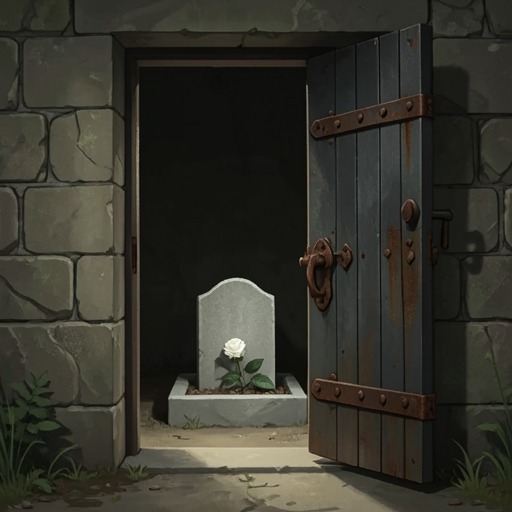
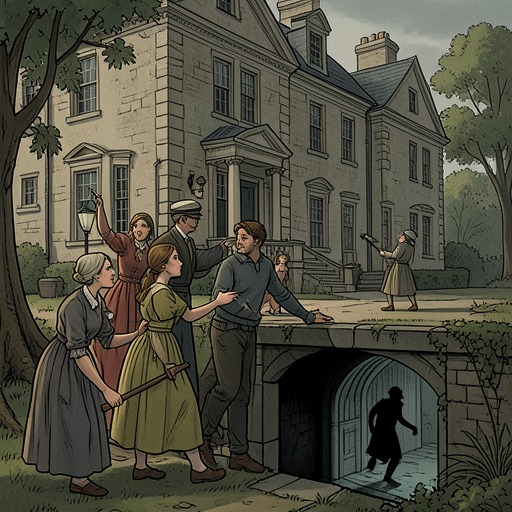
After Virginia tells her family that she has been with the Ghost and that he is dead, she leads them through an opening in the wainscoting and down a narrow secret corridor. Washington follows with a candle taken from the table. At the end stands a great oak door studded with rusty nails; when Virginia touches it, the heavy door swings open onto a low, vaulted room with a tiny grated window.
The remains are chained to a huge iron ring embedded in the wall. The gaunt skeleton lies stretched across the stone floor, its long, fleshless fingers appearing to reach for a trencher and ewer set just beyond them. The ewer is green with mould inside, as if it once held water; the trencher holds only dust. The arrangement makes the chamber more than a hiding place: it exposes a prolonged deprivation, rendered in the unreachable food and water left beside the captive.
What the Remains Reveal
The skeleton discloses the secret behind Sir Simon’s death. The family looks on in wonder at the terrible tragedy now exposed, while Virginia kneels beside the bones, folds her hands, and prays silently. Her action does not erase the physical signs of confinement; instead, it answers them with compassion at the very site where the violence becomes undeniable.
The remains also change the meaning of the haunting. The Ghost has appeared as a terrifying presence, but the chained skeleton shows that his story includes the helplessness and suffering of a prisoner. The iron ring, the chains, and the neglected vessel make that past visible to the living family, replacing an unexplained supernatural disturbance with the evidence of a concealed crime.
Prayer and Release
As Virginia rises from her prayer, she says that God has forgiven him, and a beautiful light seems to illumine her face. The sequence links her response directly to the discovery: she has heard the Ghost’s confession, seen the conditions of his death, and prayed beside his remains. Forgiveness is therefore not an abstract conclusion but the scene’s answer to the skeleton’s evidence of punishment and abandonment.
A twin, looking from the room’s window to locate the chamber within the house, suddenly notices that the old withered almond tree has blossomed in the moonlight. The new flowers provide an outward sign of change at the same moment that Virginia declares the Ghost forgiven. The skeleton itself remains in the chamber, but its discovery, Virginia’s prayer, and the tree’s unexpected flowering together mark the ending of the haunting’s unresolved history.
Narrative Significance
The chamber’s architecture gives the family secret a physical form. The concealed opening, narrow passage, barred window, iron ring, and chained body lead the family from the familiar house into the hidden consequence of its past. The revelation is starkly concrete: rusty nails in the door, mould in the ewer, dust on the trencher, and bones stretched toward what the prisoner could not reach. These details make the supernatural plot turn on the recognition of bodily suffering.
In the story’s resolution, the skeleton is both proof and threshold. It confirms what the Ghost’s death means, and it gives Virginia a place beside which she can offer the prayer associated with his release. The contrast between the remains’ confinement and the flowering almond tree does not restore the dead man’s body; instead, it signals that the secret has been brought into view and that his restless existence can end. The object at the center of a Gothic discovery thus bears the plot’s movement from concealed cruelty toward compassion and peace.