The Otis twins' imitation ghost prank
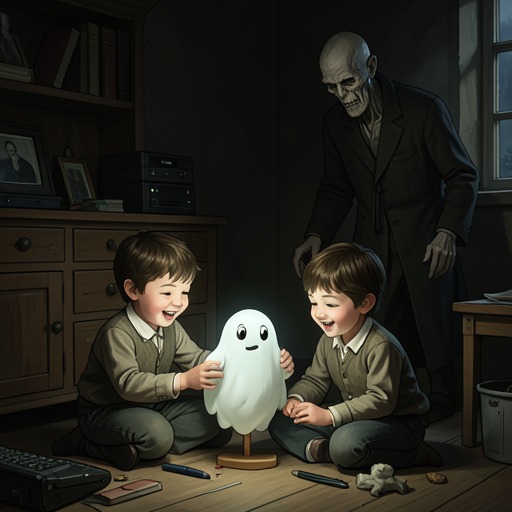
The Canterville GhostThe Otis twins’ imitation ghost prank is a turning point in the contest between the family and Sir Simon de Canterville: the supposed master of supernatural terror is frightened by a homemade figure, then learns that his apparent rival is only a staged prop. Its comedy depends on reversing the expected roles. Sir Simon has spent centuries making others fear him; faced with an imitation made from ordinary household objects, he becomes the frightened audience.
The Haunting Meets Modern Resistance
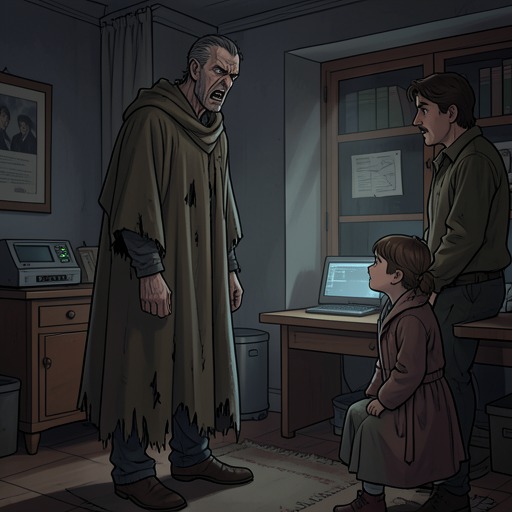
Before the prank, the family’s response to Sir Simon has repeatedly reduced supernatural menace to a practical problem. When he first approaches Hiram B. Otis at night, the Minister offers him Tammany Rising Sun Lubricator for his noisy chains instead of reacting with fear. Later, Mrs. Otis answers his demonic laughter with a remedy for indigestion. The twins, meanwhile, use their practiced aim with pea-shooters during another appearance, while their mother treats the ghost as a person who may be unwell.
These encounters establish the pattern the prank intensifies: Sir Simon’s elaborate performances meet matter-of-fact American responses, and his threats fail to produce the terror he expects. The twins’ imitation is a sharper reversal because it does not merely resist his haunting; it makes him believe that another ghost has appeared.
The Apparition in the Corridor
Sir Simon sets out at midnight to frighten the household. He passes the family arms of himself and his murdered wife and carries a rusty dagger as he makes his way toward Washington Otis’s room. At the corner of the passage, however, he stops before a motionless figure that seems to match his own ghostly appearance: it wears a shroud-like garment, bears scarlet lights for eyes, and holds a gleaming weapon. The figure’s bald, burnished head and fixed grin make it a grotesque double of the very spectacle Sir Simon has cultivated.
The change in perspective is decisive. Until then, Sir Simon has planned his performances around what he expects the family to fear. Now, having never seen a ghost before, he encounters one as an ordinary person might: the apparition is terrifying because he takes it for the real thing. He retreats to his room, trips over his winding-sheet, and drops the dagger into the Minister’s jack-boots. At dawn, he returns to the corridor, reasoning that another ghost might help him deal with the twins.
The Trick Revealed
The second encounter dissolves the illusion. The figure’s light has gone out, its weapon has fallen, and it leans awkwardly against the wall. When Sir Simon grabs it, its head rolls off and its body collapses. What he is holding is a white dimity bed-curtain; nearby lie a sweeping-brush, a kitchen cleaver, and a hollow turnip. The scene’s fright is built from familiar objects arranged to resemble the conventions of a ghost story, and the morning light exposes that construction.
A placard completes the twins’ joke by advertising “YE OTIS GHOSTE” as the “Onlie True and Originale Spook” and warning against imitations. Sir Simon understands that he has been tricked, foiled, and outwitted. The false ghost is not simply a disguise that happens to scare him: its boastful sign claims the authority and originality that he assumes belong to him, turning his own theatrical self-image into the joke.
A Vow and a Broken Payoff
Humiliated, Sir Simon swears that bloodshed and murder will follow when Chanticleer has crowed twice. The oath momentarily restores his sense of menace, but its promised outcome depends on a second cockcrow that never comes. He waits hour after hour; at half-past seven, the arriving housemaids finally make him abandon his vigil. Consulting his books of ancient chivalry, he confirms that the formula requires the bird to crow again, and curses the “naughty fowl” before withdrawing to a lead coffin until evening.
The episode thus turns a threatening declaration into another frustration. Sir Simon can still make a vow and invoke the violent conventions of his ancient world, but neither his threat nor his ghostly reputation controls what happens. His power is repeatedly undercut by practical interruptions and failures of effect.
Comic Reversal and Its Limits
The prank’s immediate victory does not end the twins’ campaign. Later, when Sir Simon tries to approach their room in another disguise, a jug of water falls on him; on a subsequent expedition, the twins leap out with a shouted “BOO!” while Washington blocks the staircase with a garden syringe. Sir Simon escapes through an unlit iron stove and returns to his room in a state of dirt, disorder, and despair. After that, he is not seen on another nocturnal expedition. The imitation prank belongs to a continuing sequence of reversals that makes the haunting increasingly difficult for him to sustain.
The comedy does not erase the history beneath the ghost story. Sir Simon is identified as the husband who murdered Lady Eleanore de Canterville, and the eventual discovery of his chained skeleton reveals the concealed conditions of his death. Against that background, the twins’ staged ghost makes the supernatural look theatrical and vulnerable, while the later disclosure restores the seriousness of the old crime. The prank’s significance lies in that contrast: it overturns Sir Simon’s authority as a performer of fear without resolving the past that keeps him haunting the house.