The haunting of Canterville Chase
The Canterville GhostThe haunting of Canterville Chase is both a family legend and the continuing presence of violence concealed within a country house. Known for centuries and associated with deaths in the Canterville family, it brings the past into the everyday life of the estate. The Otis family’s arrival turns the haunting into a contest between inherited supernatural obligations and modern practical habits; its eventual resolution depends not on force or commerce, but on Virginia’s compassion and the disclosure of what happened behind the house’s walls.
Origins and Family History
The haunting is already established when Hiram B. Otis buys Canterville Chase. Lord Canterville warns him that the house is haunted, explaining that his family has avoided living there after a frightening incident involving the Dowager Duchess of Bolton. Other members of the family and the parish rector have seen the ghost, while mysterious sounds in the corridor and library have disturbed Lady Canterville’s sleep. The estate’s reputation is thus sustained by more than a single tale: it has shaped family life, frightened a servant household, and made the house difficult for its owners to inhabit.
Lord Canterville dates the ghost’s known appearances to 1584 and says they have preceded the death of a member of his family. This association gives the haunting a grim rhythm: it is not merely a presence attached to an old building, but a sign of approaching loss within the family history. Hiram B. Otis rejects the premise that supernatural forces should receive special deference, treating the ghost as an item that can be included in the property’s valuation. The exchange sets the haunting’s inherited authority against a modern American confidence in money, reason, and practical solutions.
The house’s most visible trace of the past is the bloodstain in the library. Mrs. Umney identifies it as the blood of Lady Eleanore de Canterville, murdered there by her husband, Sir Simon de Canterville, in 1575. She says that Sir Simon survived his wife by nine years before disappearing under mysterious circumstances; his body was never found, and his guilty spirit continued to haunt the estate. The stain turns family history into a mark that can be seen in the present, while the account of the murder supplies the haunting with a specific source of guilt.
The Haunting Meets the Otis Family
The Otises answer the bloodstain not as a relic to be revered, but as a domestic nuisance. Washington Otis applies Pinkerton’s Champion Stain Remover and Paragon Detergent, and the visible mark disappears. The attempted cleaning does not erase the history attached to it: the disappearance is followed by lightning and thunder, and Mrs. Umney faints. The contrast is central to the comic unease of the episode. A household product can remove the stain from the floor, but it cannot make the buried story—or the ghost’s presence—go away.
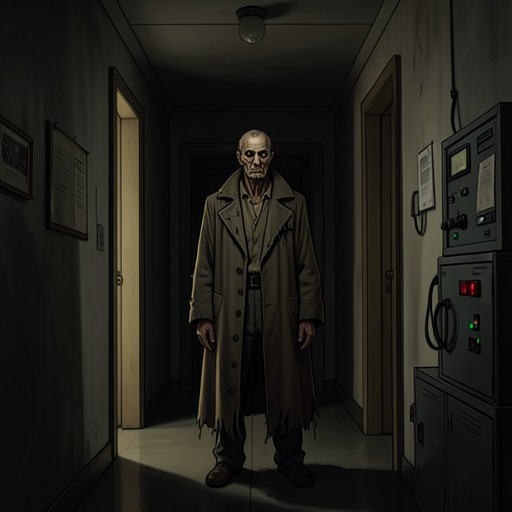
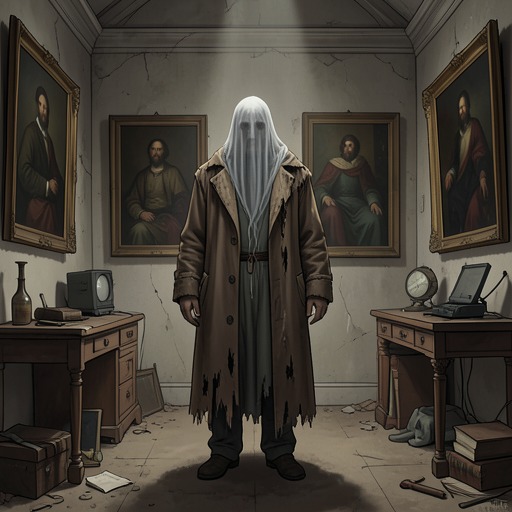
The family’s first direct encounter with the ghost makes the same clash more explicit. At one o’clock in the morning, Hiram B. Otis hears metal clanking and footsteps in the corridor. On opening his door, he finds Sir Simon de Canterville, whose antique clothing and chains announce a figure from the estate’s past. Instead of responding with fear, Hiram B. Otis offers him a bottle of Tammany Rising Sun Lubricator and recommends that he oil his chains. He leaves the bottle by the bedroom candles and returns to bed. Sir Simon throws it down and flees; the disturbance ends only after the twins appear and a pillow passes by him, prompting his escape through the wainscoting. The ghost’s established methods of creating terror meet an audience that treats his chains as a maintenance problem and his appearance as an occasion for a prank.
The disturbances nevertheless affect Sir Simon. After the strain of the preceding weeks, he is weak, tired, and nervous, and he spends five days in his room. He gives up trying to preserve the library bloodstain, judging that the family cannot appreciate its symbolic significance. But he continues to regard haunting as a duty: he believes he must appear in the corridor once a week and at the large oriel window on the first and third Wednesdays of each month. The ghost’s persistence is therefore partly institutional and habitual. Even as his attempts lose their effect, he holds to a schedule and to the obligations he associates with his supernatural role.
Recurrence, Adaptation, and Reversal
Sir Simon adapts his methods rather than abandoning the haunting. On three successive Saturdays he traverses the corridor between midnight and three in the morning, removes his boots, steps lightly over the old boards, and wears a black velvet cloak to avoid being heard or seen. He also uses the Rising Sun Lubricator, though adopting the family’s remedy humiliates him. After entering Hiram B. Otis’s bedroom while the family is at dinner, he takes the bottle for himself and comes to acknowledge that the invention is useful to a degree. The scene reverses the apparent relation between ghost and household: the intruder is made to borrow the household’s practical device to carry on his own customary work.
The household continues to frustrate him. Strings stretched across the corridor trip him in the dark, and the twins’ butter-slide causes him to fall while he is dressed as Black Isaac, the Huntsman of Hogley Woods. The incident injures his dignity more than it restores his power. In response, he decides on a final effort to assert his social position and plans to visit the young Etonians as Reckless Rupert, the Headless Earl. The cycle shows the haunting being converted from a source of inherited fear into an ongoing struggle over who controls the corridors and the household’s attention. Yet this comic defeat does not resolve the more serious secret behind the ghost’s existence.
The Secret Room and Resolution
The decisive change comes when Virginia returns after having been missing. She tells Hiram B. Otis that she has been with the ghost, that he is dead, and that he was sorry for what he had done. She also says that he gave her a box of jewels before he died. Her account leads the family through an opening in the wainscoting and down a narrow secret passage. Behind a great oak door they find a small, low room with a vaulted ceiling and a single grated window. A huge iron ring is embedded in the wall; chained to it lies Sir Simon de Canterville’s gaunt skeleton, stretched toward a trencher and ewer set beyond his reach. The ewer is coated inside with green mould, while the trencher holds only dust.
The discovery explains what the earlier haunting had left unresolved. Sir Simon’s body was not simply lost after his mysterious disappearance: he died confined in a hidden room, chained to the wall and unable to reach food and water. The secret chamber gives the house’s supernatural history a material, concealed form. The ghost’s repeated appearances and the family’s old legends had made the past present, but the remains disclose the conditions of his death and the human suffering beneath the spectacle of haunting.
Virginia kneels beside the skeleton and prays silently while her family looks on. When one of the twins notices that the old withered almond tree has blossomed in the moonlight, Virginia says that God has forgiven Sir Simon. Her statement links the discovery and her prayer to a visible change beyond the secret room: the estate’s history is no longer defined only by murder, guilt, and restless repetition. The haunting ends not through the Otises’ efforts to clean, lubricate, or outwit the ghost, but through Virginia’s encounter with him and the compassion that allows the past to reach an ending.
Narrative and Thematic Significance
The haunting carries two histories at once. In the public rooms and corridors, it appears as a succession of traditional ghostly disturbances, answered by the Otises with detergent, lubricating oil, and practical indifference. Behind the wainscoting, the secret chamber reveals the violence and deprivation that the comic encounters had obscured. This movement from visible stain and repeated apparition to hidden remains makes the house itself an archive: its architecture contains what the family’s inherited stories could name only incompletely.
The contrast between the Cantervilles’ reverence for an established supernatural reputation and the Otises’ modern habits provides much of the haunting’s comedy, but it is not its final meaning. The family can frustrate the ghost’s performance without discovering the reason he remains. That knowledge arrives through Virginia, who responds to Sir Simon not as a spectacle or inconvenience but as a guilty and remorseful person. Her prayer, the disclosed skeleton, and the almond tree’s blossom mark a transition from haunting as repeated obligation to release through forgiveness. The estate’s old history is neither erased by purchase nor settled by practical ingenuity; it is brought to rest when its secret is faced with compassion.