The persistent bloodstain in the library
The Canterville GhostThe persistent bloodstain in the library is the most visible trace of Canterville Chase’s buried history and a recurring point of contact between that history and the Otis family’s modern, practical habits. Introduced as evidence of Lady Eleanore de Canterville’s murder, it resists ordinary cleaning, becomes a source of family amusement, and ultimately proves to be not a literal supernatural stain but a deliberately renewed effect made by Sir Simon de Canterville.
Origin and Meaning
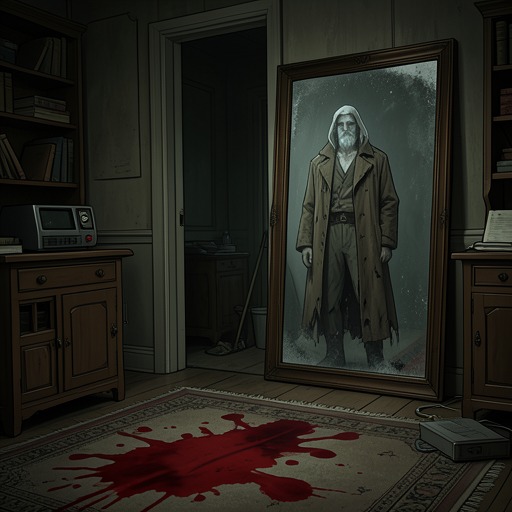
When the Otis family first enters the library, Mrs. Otis notices a dull red mark on the floor beside the fireplace and assumes that something has been spilled. Mrs. Umney identifies it as blood and relates it to the murder of Lady Eleanore de Canterville: Sir Simon de Canterville killed his wife there in 1575, survived her by nine years, and then disappeared under mysterious circumstances. His body was never found, while his spirit was said to haunt the Chase. The stain, Mrs. Umney explains, had become an attraction for tourists and was understood to be impossible to remove.
The mark therefore arrives with two meanings already attached: it is a material remnant of family violence and a piece of inherited local legend, preserved as an object of visitor interest. Its place in the library makes the past conspicuous inside the house’s everyday domestic space. Yet the Otises do not initially treat it as an ominous relic. Mrs. Otis regards it as an unwanted spill, and Washington responds by reaching for a commercial cleaning product rather than accepting the stain’s traditional authority.
Erasure and Recurrence
Washington uses Pinkerton’s Champion Stain Remover and Paragon Detergent, rubbing the floor with a small stick of the product until the mark disappears. His success is immediately celebrated as proof that the stain poses no problem. A flash of lightning and a crash of thunder coincide with the cleaning, and Mrs. Umney faints, but the Otises’ practical interpretation of the moment remains intact.
The apparent solution does not last. The stain is back on the library floor the next morning. Washington tries the detergent again, and the mark returns on the following mornings as well. The recurrence becomes harder to dismiss when it appears despite the library being locked at night by Hiram B. Otis, who takes the key upstairs, and its windows being kept barred. The repeated cycle—removal, disappearance, return—turns a simple cleaning task into the household’s first sustained evidence that the house does not obey its new occupants’ ordinary expectations.
The family responds in different ways. Washington continues to test the stain’s resistance; Hiram begins to suspect that his denial of ghosts may have been too certain; and Mrs. Otis considers joining the Psychical Society. Washington prepares a letter to Myers and Podmore about the permanence of bloodstains connected with crime. What begins as a domestic nuisance thus prompts tentative revisions in the family’s beliefs, even as the pattern’s oddness also invites their curiosity.
Colour and Household Responses
The stain does not return in a consistent shade. During the week it changes from a dull, almost Indian red to vermilion and rich purple; once, when the family comes down for prayers, it is bright emerald-green. The family treats these variations as a diverting puzzle and freely places bets on what colour it will be. The stain’s supposed historical permanence is therefore paired with an unstable, almost theatrical appearance: it remains recognizably the same mark while changing its visible character from day to day.
Virginia Otis is the exception to the family’s amusement. The sight troubles her, and she nearly cries when the stain turns emerald-green. That response gives the recurring mark a different emotional weight within the household: what the others convert into a joke and a betting subject remains distressing to her. Its colours also have a concrete explanation that is disclosed later, when Virginia confronts Sir Simon over the paints he has taken from her art box.
Sir Simon’s Method Revealed
When Virginia meets Sir Simon, she accuses him of taking her paints to refurbish the bloodstain. She recalls that he first used her reds, including vermilion, then the emerald-green and chrome-yellow, leaving her with only indigo and Chinese white for painting. Her complaint reveals the practical means behind the stain’s changing colours and the artistic materials that the family had not known were being used.
Sir Simon admits that he used the paints, explaining that real blood was difficult to obtain and that Washington had started the affair by using detergent on the mark. The confession transforms the stain’s meaning without erasing its connection to the crime: its historical association with Lady Eleanore’s murder remains part of the house’s story, but its recurring, vividly altered appearance is an effect Sir Simon actively maintains. The Otises’ intervention and the ghost’s response form a comic exchange in which modern cleaning products and household paints displace the supposedly authentic relic.
Place in the House’s History
The stain’s repeated return brings the past into the present, but its eventual explanation also unsettles the authority of the legend as Mrs. Umney first tells it. Visitors admire what they take to be the surviving blood of a murder; the household sees a cleaning challenge, then a supernatural puzzle; finally, Virginia identifies a ghost’s improvised use of her paints. Each interpretation changes what the mark can signify, while its location in the library keeps the murder and the domestic comedy joined in one object.
The later discovery of Sir Simon’s chained skeleton in a secret room supplies a separate physical revelation about his fate. It confirms the terrible history concealed within the Chase, but does not turn the coloured stain into literal blood: Sir Simon’s own explanation has already shown how its visible recurrence was produced. The mark thus stands at the intersection of inherited violence, ghostly performance, and everyday household resistance—a persistent feature of the story precisely because it keeps returning in altered form and inviting a new explanation.