Virginia Otis and Cecil, Duke of Cheshire
The Canterville GhostVirginia Otis and Cecil, Duke of Cheshire, are childhood acquaintances whose early attraction grows into a lasting love and marriage. Their relationship is marked by Cecil’s devotion to Virginia, first introduced as a boy’s impulsive proposal and later tested when she disappears. Yet their marriage does not erase the private experience that has transformed Virginia: she tells Cecil that Sir Simon de Canterville taught her what life and death mean, but she cannot disclose what happened between them. His final acceptance of her silence makes trust, rather than complete knowledge, the relationship’s closing note.
Childhood Attraction and Early Promise
Cecil’s interest in Virginia is established before either is old enough to determine their future. At fifteen, Virginia is described as a confident rider who once raced Lord Bilton around the park on her pony. Cecil, then a young Duke, was delighted by her victory and proposed to her on the spot. His guardians sent him back to Eton College that same night, weeping, so the proposal functions as a comic early sign of affection rather than an immediate engagement.
The story returns to that interrupted prospect when Virginia goes missing. Cecil is described as frantic with anxiety and begs Hiram B. Otis to let him join the search. He connects the emergency with the earlier refusal of their engagement, telling Hiram that if he had allowed them to be engaged the previous year, the present trouble would never have occurred. The claim is a boy’s desperate appeal, not an explanation of Virginia’s disappearance: its significance lies in how quickly Cecil’s concern for her overrides the ordinary expectations placed on him.
Devotion During Virginia’s Disappearance
Hiram initially refuses Cecil permission to accompany the search, fearing there may be a scuffle. But Cecil follows him anyway, riding up on his pony without a hat and insisting he cannot eat dinner while Virginia is lost. He asks Hiram not to be angry and pleads not to be sent back. Hiram is touched by the boy’s devotion, allows him to come, and says that they will have to get him a hat at Ascot.
Cecil brushes aside the practical concern about his hat: he wants to find Virginia. He and Hiram ride on to the railway station, where there is no news of her, and continue the search. The episode gives Cecil’s affection a concrete form: he does not simply declare an attachment but abandons dinner, defies the order to stay behind, and joins the effort to find her. His presence belongs to the family’s anxious search, though it does not reveal where Virginia has gone or what she is experiencing.
When Virginia is found, she explains that she has been with Sir Simon, who is dead, and says he gave her a box of jewels before he died. Cecil’s feelings surface again when he calls her an angel and puts his arm around her neck to kiss her. The gesture follows Virginia’s account of Sir Simon’s remorse and her own grave response to his fate. Cecil’s love is evident, but the story does not suggest that he knows the private details of the encounter that has brought her back.
Marriage and the Gift of the Jewels
Virginia and Cecil eventually marry when he comes of age. In the spring of 1890, Virginia is presented at the Queen’s first drawing-room as the young Duchess of Cheshire, wearing jewels that draw general admiration. The narrator describes the match as a happy one: the pair love each other, and everyone is pleased except the Marchioness of Dumbleton, who had hoped to secure the Duke for one of her seven unmarried daughters. Hiram is also an exception, though for a different reason. He likes Cecil personally but objects in principle to aristocratic titles and worries that the pleasures of aristocratic life might displace republican simplicity. His reservations do not prevent the marriage, and he is nevertheless portrayed as deeply proud when he walks Virginia down the aisle at St. George’s, Hanover Square.
The jewels Virginia wears at her presentation have a history bound up with her relationship to Sir Simon and with the older Canterville family. After Virginia says Sir Simon gave them to her, Hiram worries that the magnificent pieces, including a ruby necklace in an old Venetian setting, may properly belong to the Cantervilles as heirlooms. He argues that they have great monetary value and would be out of place in a household committed to republican simplicity. At the same time, he explains that Virginia wants to keep the box as a memento of Sir Simon.
Lord Canterville refuses to reclaim the jewels. He says that Virginia rendered his ancestor an important service and that the jewels are clearly hers; because their existence was unknown and they were not identified as heirlooms in a will or legal document, he sees no legal claim for his family. He also reasons that Hiram bought the furniture and ghost at a valuation, so Sir Simon’s property passed with the purchase. Hiram is distressed by the refusal and asks Lord Canterville to reconsider, but eventually permits Virginia to keep the gift. The exchange treats the jewels both as valuable property and as a personal remembrance: legal reasoning settles who may possess them, while Virginia’s stated wish explains why the box matters to her.
Marriage, Memory, and a Kept Secret
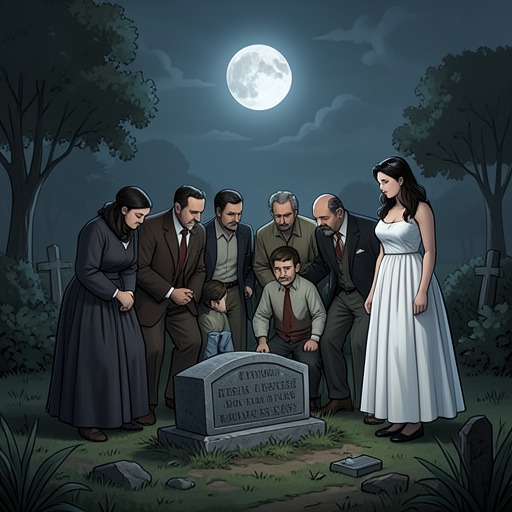
After their honeymoon, Virginia and Cecil return to Canterville Chase. They visit the churchyard and Sir Simon’s grave, where Virginia scatters roses. Later, in the ruined chancel of the old abbey, Cecil asks her what happened when she was locked up with the ghost. He knows she has never told anyone, but asks her to tell him. Virginia answers that she cannot. Her refusal is serious, and she presents it not as a withdrawal of love but as a debt of gratitude to Sir Simon.
Virginia explains that Sir Simon made her understand what life is, what death signifies, and why love is stronger than both. This is the most explicit account she gives Cecil of the experience that has shaped her; its spiritual meaning is shared, while its particular events remain undisclosed. Cecil rises and kisses his wife lovingly, then accepts the boundary she has set, telling her she may keep her secret as long as she gives him her heart. Their closing exchange brings the relationship’s central balance into focus: Cecil seeks intimacy, Virginia preserves an experience she cannot narrate, and affection allows the marriage to hold both closeness and silence without treating them as opposites.