Ye Otis Ghoste
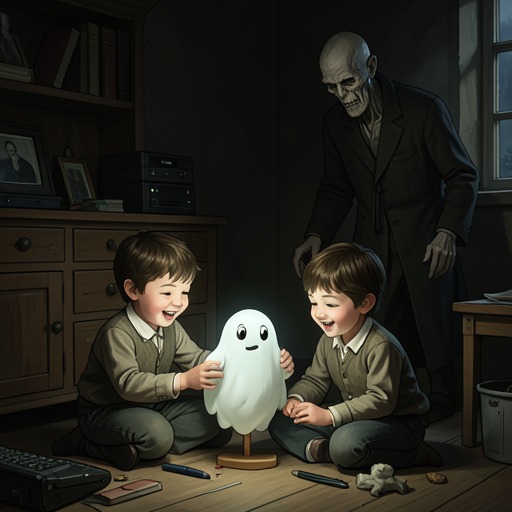
The Canterville GhostYe Otis Ghoste is a mock apparition constructed by the Otis twins to frighten Sir Simon de Canterville, reversing the expected roles of ghost and human. Its carefully staged horror succeeds for a moment: Sir Simon flees from it in terror. But the morning reveals a bed-curtain, a sweeping-brush, a kitchen cleaver, and a hollow turnip, with a placard announcing the “Ye Otis Ghoste.” The prank makes the Ghost’s supernatural performance look reproducible—and leaves him outwitted in his own house.
Construction and Appearance
Sir Simon encounters the figure while moving through the passage toward Washington Otis’s room. At first it appears motionless and monstrous: its head is bald and gleaming, its face round, fat, and white, its eyes send out scarlet rays, and its mouth resembles a well of fire. A pale garment evokes the Ghost’s own shroud, while a placard covered in strange writing and a raised falchion complete the imitation. The staged details present a counterfeit ghost as a rival spectacle, built from recognizable signs of supernatural menace.
The scene is arranged to meet the Ghost on his own terms. He has set out to terrify the Otis family with his accustomed nocturnal appearance, but the twins’ figure occupies his path and seems, in the dark, to match or exceed his performance. Its stillness and exaggerated features hold back the explanation: Sir Simon first sees an apparently real phantom, and only later learns that the horror is an assembly of household things.
Sir Simon’s Encounter and the Reveal
Sir Simon reacts with immediate fear. After a hurried second look, he runs back down the corridor, trips over his long winding-sheet, and drops his rusty dagger into the Minister’s jack-boots, where the butler finds it the next morning. In the privacy of his room, he throws himself onto a small pallet-bed and hides his face beneath the clothes. His response is consequentially comic: the experienced haunting figure is reduced to the same frightened posture he had hoped to produce in the family.
At dawn he returns to the spot, reasoning that an ally might help him deal with the twins. Instead, the apparition has lost its light and its raised weapon, and leans against the wall in an awkward position. When Sir Simon seizes it, the head comes away and rolls across the floor. What he is holding is a white dimity bed-curtain; a sweeping-brush, kitchen cleaver, and hollow turnip lie at his feet. The change from apparent monster to exposed props explains the spectacle without any supernatural transformation: it was a constructed object all along.
The Placard and the Failed Counterattack
The placard identifies the contrivance as “YE OTIS GHOSTE” and calls it “Ye Onlie True and Originale Spook,” warning against imitations and declaring all others counterfeit. Its mock-antique spelling and mock advertising turn Sir Simon’s own identity into the target of the joke. The Ghost understands the trick at once: he has been deceived, defeated, and outwitted. The object’s title claims authenticity for the imitation, while the genuine ghost is made to look like the inferior copy.
Sir Simon responds by swearing that violence will follow when Chanticleer has crowed twice. A distant cock calls once, but no second crow comes; after waiting hour upon hour, he abandons his vigil when the housemaids arrive at half-past seven. He consults books of ancient chivalry and finds that the oath has always depended on a second crow, then curses the bird and retreats to a lead coffin until evening. The prank thus does more than frighten him: it frustrates his retaliatory threat and leaves him waiting on an old-fashioned code that the morning does not fulfill.
Function in the Haunting
The fake ghost belongs to a household already defined by competing ideas of what a ghost can be. Before the Otis family moves in, Lord Canterville warns that the apparition has been known for three centuries and appears before a family member’s death. Mrs. Umney likewise explains that the persistent bloodstain marks the place where Lady Eleanore de Canterville was murdered by her husband, Sir Simon, whose guilty spirit still haunts the house. Against that inherited history, the twins’ imitation makes the ghostly image a practical prank: its signs can be assembled, displayed, and used against the haunting figure itself.
The contrast is sharpest because Sir Simon has already tried to make modern American practicality serve his haunting: when his chains disturb Hiram B. Otis, the Minister offers him a bottle of lubricant. Now the twins answer supernatural menace with another improvised household device. Ye Otis Ghoste is therefore a compact emblem of the family’s refusal to accept the traditional terms of fear. Its effect is temporary, but its exposure establishes a recurring reversal: the Ghost’s attempts to stage terror meet an American household ready to treat apparitions as problems that can be answered with ordinary objects and ingenuity.