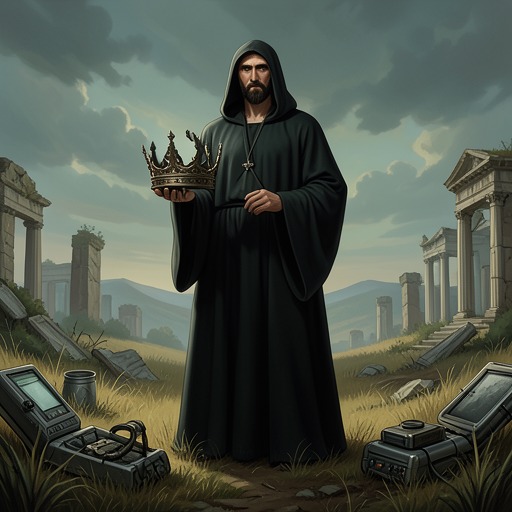
“Grown too large to inhabit the castle”
The Castle of OtrantoThe phrase “Grown too large to inhabit the castle” belongs to Saint Nicholas’s prophecy about the succession of Otranto: Ricardo’s descendants may rule until the rightful owner reaches a condition that makes the castle too small to contain him. In Manfred’s confession, the prophecy explains both the dynasty’s conditional claim and its eventual collapse, as supernatural events expose the cost of Ricardo’s usurpation and Manfred relinquishes the principality to Theodore.
The Prophecy and Ricardo’s Claim
Manfred recounts that his grandfather Ricardo succeeded Alfonso after Alfonso’s death by poison and a fictitious will declaring Ricardo the heir. During a storm on his return to Otranto, Ricardo, haunted by guilt, vowed to Saint Nicholas that he would found a church and two convents if he survived. The saint appeared to him in a dream and promised that Ricardo’s posterity would reign until the rightful owner was “grown too large to inhabit the castle,” provided a male heir of Ricardo’s line remained to enjoy the inheritance.
The prophecy therefore grants Ricardo’s descendants a reign with explicit limits, rather than establishing their right as unconditional. Its terms bind their rule both to the presence of male heirs and to the eventual arrival of the rightful owner. The castle is not merely the setting of the succession dispute: its capacity becomes the measure by which the usurped inheritance must end.
Manfred’s Crisis and Confession
The prophecy becomes decisive when Manfred’s dynasty is struck by the deaths of Conrad and Matilda. Before confessing the history of Ricardo’s usurpation, Manfred recalls that Conrad’s death had left him thinking of surrendering his dominions and withdrawing from public life. He says that he wanted a successor who would treat the people tenderly, but, believing he knew of no available heir from Alfonso’s line, he also contemplated marrying Isabella to settle the conflict between the families.
That proposed marriage reveals how Manfred mixes private and public claims: he presents taking Isabella as a way to end political enmity and serve his people, even as he seeks to secure his own succession. Elsewhere, he orders the castle’s exits guarded after Isabella disappears and asserts his sovereign authority to keep Jerome from discussing domestic affairs in Hippolita’s presence. The prophecy’s dynastic crisis unfolds amid this exercise of command over both household and principality.
At the final supernatural reckoning, Hippolita recognizes Theodore as Otranto’s true prince. Manfred accepts that judgment and publicly confesses the crimes behind his family’s title. He admits that Alfonso died by poison, that Ricardo’s will was false, and that the saint’s promise had made Ricardo’s rule conditional. With no other male or female member of Ricardo’s family remaining besides Manfred, he declares that the prophecy’s limit has been reached and resigns Otranto to Theodore.
Meaning and Fulfillment
The wording makes the prophecy’s conclusion memorable while leaving its mechanism unexplained: Manfred admits that he does not know how Theodore can be Alfonso’s heir, though he does not doubt the supernatural judgment that makes him so. The account thus links a cryptic, spatial condition to a clear political outcome without resolving every mystery of Theodore’s inheritance.
Manfred’s confession also frames the succession as inherited consequence. Ricardo’s crimes pursued him, and Manfred interprets the deaths of his children and the loss of his rule as the price of usurpation. He asks that his story serve as a warning to future tyrants. The prophecy consequently functions not just as a forecast of who will rule, but as the narrative’s terms for exposing an illegitimate dynasty and transferring power back to the rightful line.