Alfonso and Victoria’s secret marriage
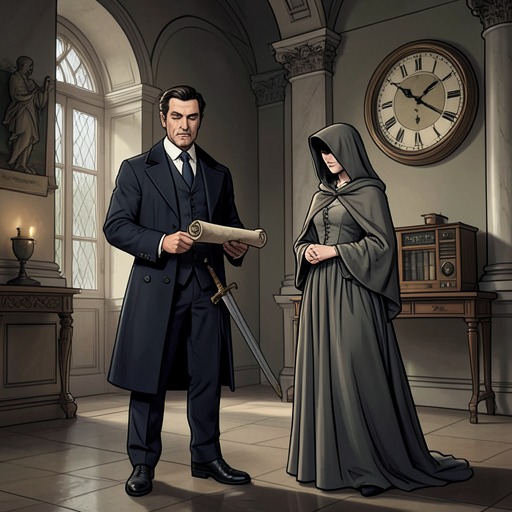
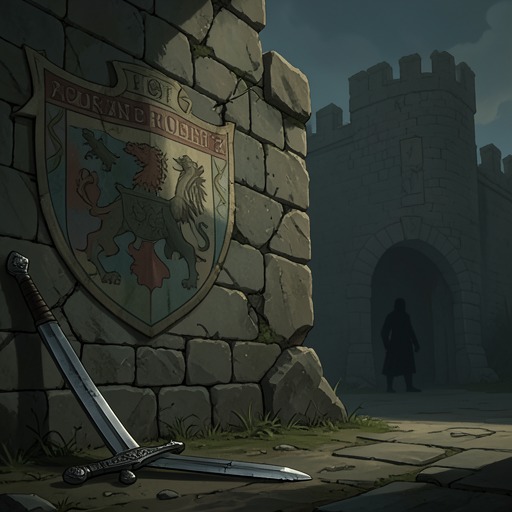
The Castle of OtrantoAlfonso and Victoria’s secret marriage is the concealed union that supplies the true line of descent behind the struggle for Otranto. Alfonso married Victoria while delayed in Sicily on his way to the Holy Land; the marriage remained unknown to the rival claimants, but their daughter’s descendants included Theodore, whose identity ultimately displaced the rule founded on Ricardo’s fraud.
The marriage in Sicily
On his voyage to the Holy Land, Alfonso was driven by a storm to Sicily, where he remained wind-bound for three months. There he fell in love with Victoria. The account emphasizes that he did not seek a relationship outside marriage: he married her, then concealed the wedding because he considered the union incompatible with the vow of arms binding him on the Crusade. He intended to acknowledge Victoria as his lawful wife after returning.
Alfonso left Victoria pregnant. During his absence, she gave birth to a daughter; soon afterward, she heard the report that Alfonso had died and that Ricardo had succeeded him. Victoria was described as friendless and without power to make her testimony effective. Her account of the marriage therefore remained private, while the political order proceeded on the assumption that Alfonso had died without an heir.
The hidden line of descent
The daughter born to Victoria eventually married Jerome. Their son Theodore is thereby connected to Alfonso through a legitimate, though long-concealed, family line. Jerome later discloses the marriage and the birth of Alfonso and Victoria’s daughter, completing the genealogy that had been absent from public claims to Otranto.
The revelation alters the meaning of Theodore’s resemblance to Alfonso, which Bianca had noticed earlier, and supplies a dynastic explanation for his claim. It also distinguishes the secret marriage from Manfred’s proposed matches: Manfred had arranged for Isabella to marry Conrad, then sought to marry Isabella himself after Conrad’s death, while Hippolita proposed Matilda’s marriage to Frederic as a means of reconciling rival houses. Those plans treated marriage as a tool for securing or redirecting succession; Alfonso and Victoria’s marriage, although concealed, is the origin of the lawful descent that overturns them.
The succession concealed by usurpation
Manfred publicly defended his title by claiming that Alfonso had died childless and bequeathed his estates to Ricardo in recognition of Ricardo’s service. He further maintained that Otranto had passed from Ricardo to his descendants. The Herald’s challenge, by contrast, identifies Frederic as the nearest blood relative of Alfonso and calls Manfred a usurper who had obtained Isabella through her guardians while Frederic was absent. Manfred acknowledges that Frederic’s claim is well founded, even as he invokes inherited possession and his ancestors’ power to retain the principality.
In his final confession, Manfred admits that Alfonso died by poison and that a fictitious will made Ricardo his heir. He links Ricardo’s guilt to the vow that led to the foundation of a church and two convents, and recounts the prophecy that Ricardo’s descendants would rule until the rightful owner grew too large to inhabit the castle. The marriage in Sicily gives that succession story its missing family connection: Alfonso did have an heir, though the line continued through a daughter whose existence and parentage had been kept secret.
Revelation and political consequence
Jerome reveals the marriage only after the catastrophe has made Manfred’s inherited account of succession untenable. Manfred accepts Jerome’s testimony without requiring the authentic writing Jerome offers, saying that the events and vision they have witnessed corroborate it. He concedes that he had not known Alfonso had an heir, resigns the dominions, and later signs his abdication. Frederic offers Isabella to Theodore, but Theodore initially remains in grief for Matilda; after repeated conversations with Isabella about her, he accepts a life with Isabella in which that grief remains part of his happiness.
The secret marriage thus does more than expose an overlooked relationship. It restores a legitimate line of descent to the center of the political conflict and reveals how the apparent certainty of inheritance rested on a poisoned death, a fictitious will, and the concealment of a lawful family. The final transfer of rule follows the disclosure of that line, while the marriage’s belated recognition turns a private union into the decisive fact of Otranto’s dynastic settlement.