Alfonso the Good
The Castle of OtrantoAlfonso the Good is the deceased prince whose poisoned death lies behind the succession crisis in Otranto. Although he is absent from the action, his image, bloodline, and concealed marriage shape the castle’s supernatural warnings and expose the fraud on which Manfred’s family rule rests. His story turns a contest over possession into a question of legitimate inheritance, and the eventual recognition of his heir ends Manfred’s rule.
Identity and Background
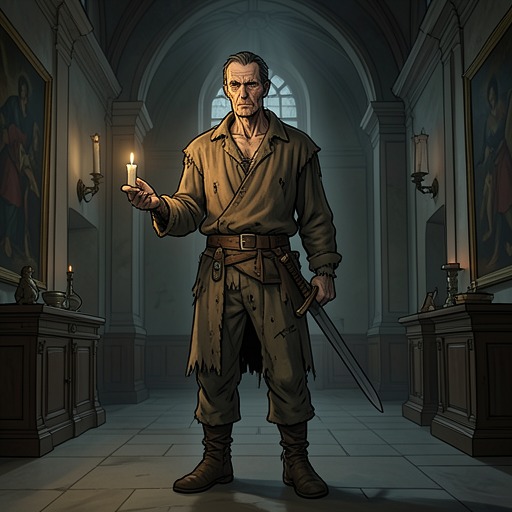
Alfonso was an earlier prince of Otranto, remembered as Alfonso the Good. A young peasant identifies the ominous helmet that has appeared in the castle courtyard as resembling the helmet worn by Alfonso’s figure in black marble at the Church of St. Nicholas. Manfred reacts with fury to the comparison, even though the peasant does not know why it provokes him. The resemblance links the unexplained apparition to the former ruler before the nature of the succession crime is publicly disclosed.
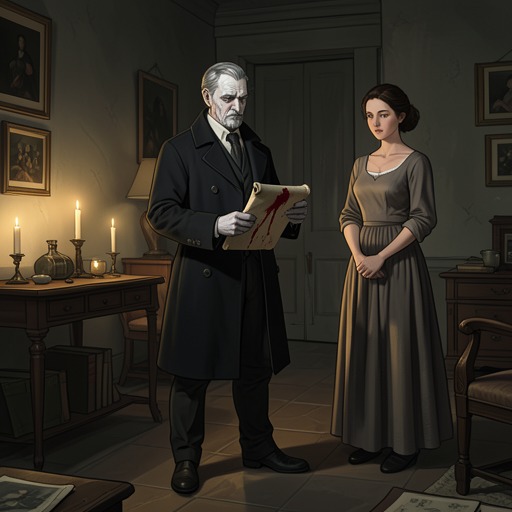
Alfonso had set sail for the Holy Land. A storm drove him to Sicily, where he remained wind-bound for three months. There he fell in love with Victoria, a young woman whom he married. Bound by a religious vow associated with his military mission, he chose to keep the marriage secret until he returned from the Crusade, when he intended to acknowledge Victoria as his lawful wife. He left her pregnant; while he was away, she gave birth to a daughter. News then reached Victoria that Alfonso had died and that Ricardo had succeeded him. She was friendless and unable to rely on her testimony alone to establish her claim, but an authentic written record of the marriage remained available.
Death and the Usurpation
Manfred publicly defends his title by claiming that Alfonso died childless in the Holy Land and bequeathed his estates to Ricardo in recognition of Ricardo’s faithful service. He presents his own principality as an inheritance passed down from his father, Don Manuel, and grandfather, Don Ricardo. In this account, possession, descent, and the supposed bequest all support his family’s right to rule.
The final confession overturns that account. Manfred acknowledges that Alfonso died by poison and that a fictitious will named Ricardo as heir. Ricardo, Alfonso’s chamberlain, therefore gained the principality through murder and fraud, not a legitimate inheritance. Manfred recognizes that his family’s long possession cannot erase the original crime: his own descendants suffer for a usurpation committed by their ancestor. His admission recasts the strange events at the castle as consequences of a suppressed dynastic wrong.
Bloodline and Supernatural Signs
Alfonso’s claim persists through his daughter by Victoria. Jerome explains that Alfonso left Victoria pregnant in Sicily; their daughter later married Jerome, and Theodore is their son. This concealed line makes Theodore Alfonso’s heir by descent, though Manfred says he had not known that Alfonso had an heir. Jerome’s account also supplies the human history behind the revelation: Victoria kept the secret, and Jerome says Theodore’s own narrative has already told the rest.
The supernatural signs repeatedly connect Alfonso’s legacy to the present crisis. When Manfred declares that Frederic accepts Matilda’s hand and will waive his claim unless Manfred has no male heir, three drops of blood fall from Alfonso’s statue. Jerome interprets the sign as proof that Alfonso’s blood will never mix with Manfred’s. Later, Jerome describes the deaths of Conrad and Matilda and Manfred’s expulsion as the fulfillment of judgment for the usurpation. The story does not treat the statue as a mere emblem: its apparent response challenges Manfred’s claims at the moment he tries to secure them through marriage and dynastic arrangement.
The Claim and Its Resolution
A herald speaking for Frederic’s knightly representative demands the return of Isabella, Alfonso’s daughter, and Manfred’s surrender of the principality. He calls Frederic the nearest blood relative to Alfonso and accuses Manfred of holding both Isabella and Otranto unlawfully. Manfred counters that Alfonso died childless and left his lands to Ricardo, then appeals to his family’s inherited possession and its force of arms. The competing claims thus rest on different accounts of Alfonso’s death and inheritance: Manfred invokes a will and long rule, while Frederic’s side invokes proximity of blood.
In the final reckoning, Alfonso’s previously unknown descendant resolves the dispute. Manfred accepts Jerome’s evidence, declares that the dominions belong to Theodore, and resigns them. The narrative does not disclose how Theodore’s claim became valid to Manfred before Jerome finishes recounting the family history; Manfred says the supernatural vision and the horrors of the preceding days corroborate the evidence. The prince’s public confession and abdication replace the fabricated will with the recovered line of descent.
Narrative Significance
Alfonso’s importance comes from the distance between public legend and suppressed history. At first, he is a former prince represented by a marble figure and invoked in competing claims. Manfred’s version makes him childless and turns Ricardo’s succession into a lawful reward; Jerome’s account reveals a secret marriage and daughter, while Manfred’s confession identifies poison and a fabricated will as the real foundation of Ricardo’s rule.
The plot’s supernatural imagery gives that buried history visible force: the helmet recalls Alfonso’s likeness, and the statue’s blood answers Manfred’s attempt to negotiate the succession. Yet the resolution also depends on testimony and lineage, not signs alone. Alfonso’s legacy is therefore both political and moral: it restores the rightful heir while exposing the cost of a dynasty built on concealed violence.