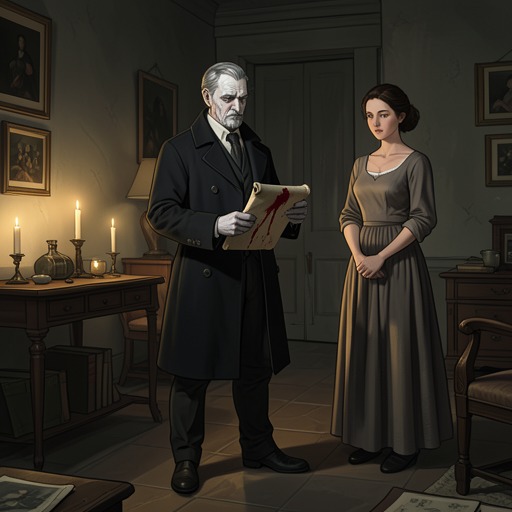
Frederic
The Castle of OtrantoFrederic, Marquis of Vicenza, enters the story as both Isabella’s absent father and the strongest living claimant against Manfred’s inherited control of Otranto. His return turns a concealed dispute over succession into an open challenge, but the evidence that accompanies him also helps uncover the deeper family history that determines the principality’s future. He arrives seeking his daughter and his hereditary rights; by the end, a revelation identifies Theodore as the true heir, and Frederic offers Isabella to the new Prince.
Identity and Claim to Otranto
Frederic is the Marquis of Vicenza and the father of Isabella. His claim to Otranto rests on his descent from the house that asserted the nearest blood relationship to Alfonso the Good, the principality’s last rightful ruler. The Herald speaking for Frederic accuses Manfred of usurping Otranto and of taking Isabella from her guardians during her father’s absence. He demands that Manfred return Isabella and surrender the principality, threatening single combat if the demands are refused.
The claim has a long political history. Frederic’s ancestors assumed the title of Princes of Otranto after Alfonso died without acknowledged issue, but Manfred’s father and grandfather had been too powerful for the Vicenza family to displace. Manfred argues that Alfonso left his estates to his grandfather Ricardo in recognition of Ricardo’s service. Frederic’s party disputes that account, and the competing claims expose the difference between hereditary proximity, an asserted grant, and possession maintained by power. Frederic is not merely seeking a personal restoration: his arrival forces the story’s longstanding uncertainty about the legitimacy of Manfred’s rule into the open.
Family History and Return
Frederic married a woman he loved, who died after giving birth to Isabella. Grief over her death led him to take the cross and travel to the Holy Land. During an engagement there he was wounded, captured, and reported dead. Manfred heard that report and bribed Isabella’s guardians to deliver her to him as a bride for Conrad. He intended the match to unite the claims of the two houses; after Conrad’s death, he redirected that dynastic plan toward marrying Isabella himself.
Frederic’s return is therefore the consequence of an absence that Manfred had treated as an opportunity. The Herald’s challenge establishes that Frederic is alive and has not abandoned his rights. Manfred recognizes that the claim is well founded and judges that provoking the Marquis would be dangerous. Rather than immediately risk a fight, he promises Frederic and his followers safe reception and seeks to settle the quarrel through negotiation. At the same time, he conceals Isabella’s flight from the arriving party, hoping to preserve his own marriage scheme and manage the succession dispute on favorable terms.
The Sword and Its Prophecy
Frederic’s party has wandered in the forest for three days when, on the third evening, they find a dying hermit in a cell. The hermit says that Saint Nicholas appeared to him more than fifty years earlier and entrusted him with a secret to be revealed only on his deathbed. Before dying, he directs the travelers to dig beneath the seventh tree on the left of the cave. They follow the instruction at daybreak and uncover an enormous sabre about six feet below ground.
The weapon becomes evidence of a supernatural design surrounding Otranto’s succession. Frederic explains that writing appeared on its blade, but hesitates to repeat the prophecy in Hippolita’s presence, believing its words would distress her. The sword’s discovery gives Frederic’s arrival a prophetic dimension: he comes as a political claimant, yet the object found by his party points beyond ordinary rivalry toward the fate of Manfred’s house. His account contributes to the atmosphere in which Hippolita concludes that heaven intends the sceptre to pass from Manfred to Frederic, and she proposes a marriage between Frederic and Matilda to avert the destruction of the rival families.
Negotiation and Marriage Alliance
Manfred presents Frederic’s claim as a contest over inherited title. He says Otranto passed through his father to him, and that Ricardo received it from Alfonso. He defends Ricardo’s reputation and invokes the church and religious foundations associated with his grandfather, while conceding that Frederic is nearer in blood. Manfred’s insistence on his family’s possession and Frederic’s hereditary claim remain in tension; neither political argument alone settles the matter.
When Manfred proposes a double marriage, Frederic agrees to consider it. He has been struck by Matilda’s beauty, sees little prospect of dispossessing Manfred by force, and calculates that marrying his daughter into Manfred’s family might make Frederic’s own succession easier if the union produced no children. His consent is therefore tied to both attraction and political calculation. He makes only a formal objection, saying he will not agree unless Hippolita consents to the divorce. Manfred takes responsibility for obtaining that consent. The negotiation shows how the characters use marriage to bind rival houses and redirect a disputed inheritance, while treating the women’s marriages as instruments of dynastic policy.
The proposed alliance does not provide the resolution Frederic expects. Manfred’s plan is interrupted by the crisis at the convent and the continuing supernatural events. Frederic’s claim remains active, but neither a negotiated marriage nor his ancestral title can account for the final revelation of Theodore’s identity.
Recognition and Outcome
In the final supernatural scene, Alfonso appears in immense form amid the ruins of the castle and declares Theodore the true heir. Frederic is among those who witness the revelation. Its force supersedes the competing human accounts of inheritance: Manfred accepts the divine judgment, confesses that Ricardo poisoned Alfonso and relied on a fictitious will, and renounces the principality. Frederic’s claim, though historically grounded in the Vicenza family’s proximity to Alfonso, is no longer the decisive one once Theodore is recognized as Alfonso’s descendant and heir.
After Manfred abdicates, Frederic offers Isabella to Theodore, the new Prince. Hippolita’s affection for Isabella supports the proposed match, but Theodore’s grief for Matilda is still too recent for him to accept another love immediately. Only after repeated conversations with Isabella about Matilda does he come to believe that he may find happiness in Isabella’s companionship while retaining his sorrow. Frederic’s final action thus echoes his earlier participation in marriage diplomacy, but the dynastic outcome has changed: the marriage is offered not as a device for securing Frederic’s own succession, but as a possible union with the ruler revealed by the supernatural judgment. Through that reversal, Frederic’s role shifts from challenger to participant in the settlement of Otranto’s rightful succession.