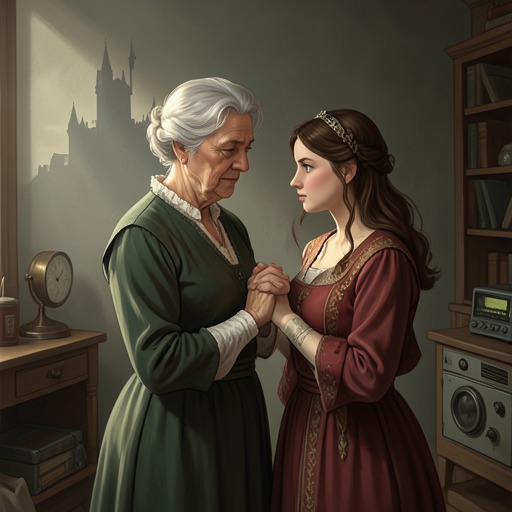
Hippolita–Isabella Mother-Daughter-Like Bond
The Castle of OtrantoHippolita and Isabella’s mother-daughter-like bond gives Isabella a genuine place in Manfred’s household, distinct from the political marriage intended to bind her to its heir. Hippolita treats her with the tenderness of a daughter, and Isabella returns that care; when Manfred tries to turn Isabella’s betrothal to Conrad into a marriage to himself, the bond becomes a source of solidarity with Hippolita and Matilda against his coercion.
A Daughter in the Household
Isabella enters the household as the daughter of the Marquis of Vicenza, delivered by her guardians into Manfred’s care so that she can marry Conrad once his frail health permits. Her place there is therefore initially defined by a dynastic arrangement. Yet the emotional relation that develops is not simply an extension of that contract: Hippolita treats Isabella like a daughter, and Isabella responds with equal duty and affection. The language of kinship describes a lived attachment, not a formal change in Isabella’s parentage.
The difference between political placement and personal belonging becomes clear after Conrad’s death. Isabella grieves for Hippolita and Matilda, tending to the distress of the family even as she feels relief at escaping a marriage she expected to bring little happiness. She has no personal sorrow for Conrad beyond commiseration, but she is deeply moved by the pain around her. Her own situation remains part of her thoughts: Manfred’s harsh treatment of his wife and daughter has made her fear the household’s ruler, even though he has shown Isabella indulgence. Affection for the women and apprehension of Manfred thus coexist from the beginning.
Care in the Aftermath of Conrad’s Death
In the immediate aftermath of the catastrophe, the women’s responses reveal the bond through action. Matilda suppresses her own grief to comfort her mother, while Isabella is nearly as assiduous in caring for Hippolita. At the same time, she tries to share and lighten the sorrow she sees Matilda struggling to conceal. The care moves across the household: Isabella tends to the woman who has treated her as a daughter, and supports the daughter whose devotion to her mother is unmistakable.
Hippolita, in turn, regards Isabella as someone able to offer comfort beyond the family’s immediate circle. When a servant summons Isabella at Manfred’s request, Hippolita hopes that she will console him and says she will smother her own anguish rather than add to his. The episode shows both the warmth and the limits of Hippolita’s trust: she understands Isabella as a beloved member of the household, but does not yet know that Manfred’s purpose is to claim her as a wife.
Manfred’s Proposal and Isabella’s Allegiance
Manfred’s proposal radically changes the meaning of Isabella’s place in the household. After Conrad’s death, he tells her that he will replace the sickly son as her husband, repudiating Hippolita and declaring that he himself must have sons. Isabella is not merely being asked to accept a new match. Manfred attempts to convert his authority over her into personal possession, while discarding the wife and mother whose tenderness has shaped Isabella’s sense of family.
Isabella rejects that conversion in the language of kinship and obligation. She recalls that Manfred is her prospective father-in-law, Conrad’s father, and Hippolita’s husband; the roles make his proposal intolerable, not acceptable. Later, when she is drawn into Hippolita and Matilda’s distress over the threatened marriage, she declares that she would rather die than consent to injure Hippolita. She also refuses to treat a father’s authority as sufficient justification for the act: even if her father commanded it, she argues, he could not make an impious deed right. Her refusal is therefore at once a defense of Hippolita, a recognition of her own attachment to Matilda, and a rejection of marriage as a command that erases moral choice.
Shared Sorrow and the Bond’s Meaning
When Isabella seeks sanctuary, Hippolita and Manfred receive her message through Jerome. Isabella commends herself to both, thanks them for their kindness, and expresses sorrow that she cannot become the daughter of such parents; she prays for their lasting union and happiness. The message preserves her gratitude toward Hippolita even while Manfred’s conduct has made return to the castle dangerous. She can still name the household’s tenderness as something real without accepting the marriage he demands.
The bond is tested again when Hippolita proposes that Matilda marry Frederic in the hope of joining rival houses and averting the family’s destruction. Isabella throws herself at Hippolita’s feet and insists that she would sooner die than consent to injure her. Hippolita answers that she does not doubt Isabella’s virtue and calls her and Matilda her children. The scene makes the relationship reciprocal: Isabella’s loyalty protects Hippolita from suspicion, while Hippolita’s trust recognizes Isabella as family. Matilda’s declaration that Hippolita is mother to them both gives that chosen kinship its clearest expression.
The final revelation that Isabella is the daughter of Victoria and Jerome changes her bloodline, but not the care that has already defined her relationship with Hippolita. Isabella had been brought to Manfred’s household as a political bride; the novel’s scenes of grief, comfort, gratitude, and refusal instead show how affection creates a familial bond that dynastic arrangements cannot dictate. In a plot where women’s marriages are repeatedly proposed as instruments of succession and alliance, Hippolita and Isabella’s attachment rests on reciprocal tenderness—and becomes most visible when Manfred’s authority threatens to break it.