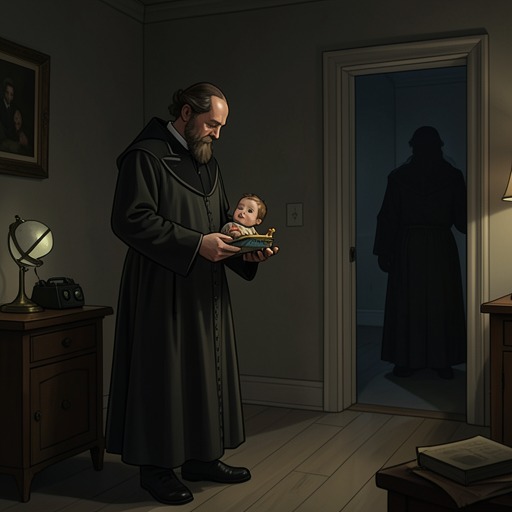
Jerome
The Castle of OtrantoJerome is a friar whose religious authority and personal loyalties place him at the center of the struggle over Manfred’s marriage plans and Otranto’s succession. He refuses to help Manfred set aside Hippolita or pursue Isabella, and his identity as Theodore’s father ultimately connects the young man to the hidden history of Alfonso and the rightful inheritance of Otranto.
Identity and Background
Jerome serves as a religious adviser and is closely associated with Hippolita’s charitable work. Manfred initially admits him expecting a conversation about Isabella, unaware of the friar’s purpose. Jerome answers that he has business with both Manfred and Hippolita, then reports that Isabella has taken refuge at the altar of Saint Nicholas. His position gives him access to the people Manfred is trying to control, but it also puts him in danger when he opposes the Prince.
Jerome is not merely a friar by birth. When a mark on Theodore’s shoulder prompts him to recognize the youth as his son, he identifies himself as the Count of Falconara and says that Theodore is his lawful child. He further explains that the house of Falconara is among the ancient houses of Sicily. Manfred initially uses the distinction between Jerome’s religious office and noble identity to challenge and belittle him, but the distinction matters less than the claims Jerome is prepared to defend: his faith, Hippolita’s safety, and his son’s life.
Opposition to Manfred
Manfred tells Jerome that he intends to marry Isabella because he believes his rule requires a male heir. He asks the friar not only to bring Isabella back, but also to persuade Hippolita to agree to the dissolution of their marriage and retire to a monastery. Manfred presents these actions as necessary for the state and offers support for a religious house. Jerome refuses to make religious authority serve Manfred’s dynastic ambitions.
Jerome instead condemns the proposed repudiation of Hippolita and the plan to marry Isabella, whom he identifies as Manfred’s contracted daughter. He argues that the Church will not sanction a marriage grounded in lust or political calculation and warns Manfred that a dynastic match cannot preserve a rule whose legitimacy is in question. His refusal is also personal: he will not betray the confidence Hippolita places in him, even under pressure or promises of patronage. By grounding his response in religious obligation, Jerome directly contests Manfred’s assertion that political necessity can override the Church’s judgment.
The conflict becomes public when Manfred insults Jerome in Hippolita’s presence. Jerome answers that the Church is not cowed by the Prince’s threats and challenges Manfred’s claim to lawful authority. The accusation is not an isolated provocation: Jerome’s challenge anticipates the formal demand soon delivered on behalf of Frederic, whose claim to Otranto is based on descent from Alfonso. In the story’s contest between princely power and religious judgment, Jerome gives voice to the possibility that Manfred’s title is invalid before the supernatural confirmation arrives.
Father of Theodore
Jerome’s recognition of Theodore transforms their relationship from a friar’s defense of a condemned young man into a father’s defense of his son. When Theodore kneels to pray, the mark of a bloody arrow on his shoulder reveals his identity to Jerome. Jerome recognizes him as Theodore and embraces him; the witnesses respond first with astonishment, while Theodore receives his father’s affection with restraint and looks toward Manfred, uncertain how the Prince will react.
Manfred’s surprise does not immediately become pardon. He questions whether the discovery is a device to save Theodore and disparages the young man’s birth. Jerome insists that Theodore is his lawful son and appeals to Manfred to spare him, offering his own life in exchange. He also makes clear that Theodore has noble ancestry, but places piety above rank as the truest measure of worth. In this confrontation, Jerome’s defense combines the claims of kinship and faith: Theodore is not an expendable prisoner but his long-lost child, and neither political authority nor suspicion cancels that bond.
That bond becomes a vulnerability when a herald arrives from the Knight of the Gigantic Sabre, acting for Frederic. The herald calls Manfred a usurper and demands both Isabella’s return and the surrender of Otranto. Manfred responds by ordering Jerome out of the castle and Theodore confined in the Black Tower, allowing father and son only a brief embrace as they part. He makes Theodore a hostage for Jerome’s obedience. Jerome is thus forced to weigh his son’s safety against the danger of returning Isabella to Manfred; his fears for Theodore do not erase his opposition to the proposed marriage.
The Hidden Descent and the Succession
Jerome’s final account explains how Theodore’s family history links him to Alfonso. He relates that Alfonso, sailing toward the Holy Land, was driven to Sicily by a storm and remained there for three months. During that time Alfonso fell in love with Victoria. Because he considered his military and religious vow incompatible with pursuing a forbidden relationship, he married her, intending to keep the marriage secret until his return from the Crusade and then acknowledge her publicly as his lawful wife.
Alfonso left Victoria pregnant. She gave birth to a daughter while he was away, and news of his supposed death and Ricardo’s succession reached her before she could establish her claim. Jerome explains that this daughter later married him; Victoria’s death left the secret in his keeping. Theodore’s own account, he says, has already supplied the rest of the history, while Manfred accepts the supernatural events he has witnessed as corroboration rather than demanding the authentic writing Jerome mentions.
The revelation clarifies why Theodore can be declared Alfonso’s heir even though he is Jerome’s son. Jerome’s narrative supplies the missing links: Alfonso’s secret marriage, the birth of a daughter, and that daughter’s marriage to Jerome. The inheritance is therefore not established by Manfred’s permission or by a new political bargain. At the climax, Alfonso’s apparition identifies Theodore as his true heir, and the supernatural judgment confirms the lineage Jerome has disclosed.
Final Role and Significance
After Alfonso’s apparition appears amid the destruction of the castle wall and names Theodore as the rightful heir, Jerome says that it is his part to explain what remains. His account resolves the concealed genealogy behind the succession crisis, while his earlier defense of church authority has already exposed the limits of Manfred’s claim. The friar’s testimony and the apparition work together: one gives the history of the family line, the other confirms its political consequence.
Manfred abdicates the following morning, and Jerome’s account is followed by the end of Manfred’s rule and the withdrawal of Manfred and Hippolita to religious life. Jerome’s role is consequently both familial and political. He protects Theodore as a father, resists Manfred as a representative of the Church, and discloses the inheritance that returns Otranto to Alfonso’s line. His faith is not a means of smoothing over the conflict: it is the ground from which he refuses complicity and the framework through which the novel’s final judgment of legitimacy is understood.