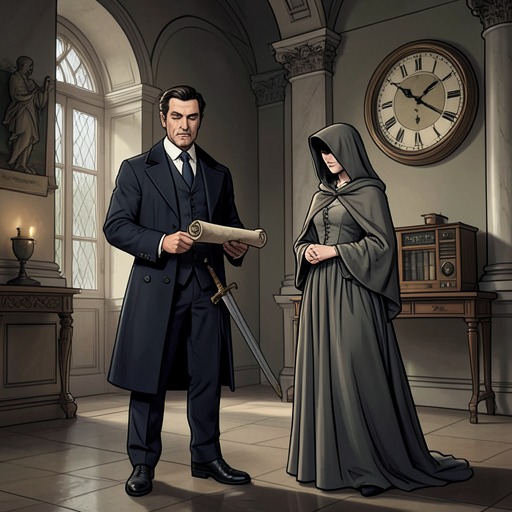
Ricardo’s usurpation of Otranto
The Castle of OtrantoRicardo’s usurpation of Otranto is the concealed crime behind the principality’s disputed succession: Ricardo poisoned Alfonso the Good, then relied on a fictitious will to claim his estates. The seizure became an inherited political order, defended by Ricardo’s descendants but ultimately overturned when Alfonso’s legitimate line was revealed and Manfred abdicated.
The Seizure and Its Justification
Alfonso the Good died while away in the Holy Land. As Manfred later confesses, Ricardo had been Alfonso’s chamberlain and secured the succession through poisoning and a false testament. The confession distinguishes the dynasty’s public basis—a purported bequest—from the violence that actually produced Ricardo’s title. Manfred’s account does not describe a lawful transfer: it identifies the will as fictitious and names Ricardo’s crime as the origin of his family’s rule.
Manfred had earlier defended the inherited claim in political terms. He told the knights that Alfonso had died childless in the Holy Land and bequeathed his estates to Ricardo in recognition of faithful service. He also invoked Ricardo’s reputation for piety and valor, the favor of Saint Nicholas, and the fact that Ricardo and Manfred’s father had held the principality before him. Yet Manfred acknowledged that Frederic was nearer in blood to Alfonso. His defense thus exposes the tension between established possession and hereditary proximity: the family had ruled for generations, but its asserted legal foundation concealed a forged instrument and a poisoned predecessor.
The Claim Reopened
The challenge to Manfred’s rule becomes explicit when Frederic’s herald demands that he return Isabella, Frederic’s daughter, and surrender Otranto. The herald calls Manfred a usurper and identifies Frederic as the nearest blood relation to Alfonso the Good. The demand ties Isabella’s custody to the territorial dispute: both her return and the principality’s transfer are presented as remedies for Manfred’s wrongful control.
Manfred answers the challenge by repeating the account of Alfonso’s bequest to Ricardo, while admitting Frederic’s closer blood claim. He argues that Ricardo’s line had been favored by Alfonso’s will and that he had believed Frederic dead or captive. That defense is later undone by Manfred’s own confession: the supposed will was fictitious, and Alfonso was poisoned. The change is not simply a new claimant appearing; it is the collapse of the story that had made Ricardo’s seizure appear legitimate.
The Hidden Line and the Succession’s Reversal
Jerome’s final account supplies the family history that the public succession had concealed. During a storm, Alfonso reached Sicily, where he married Victoria before continuing on the Crusade. He left her pregnant, and she bore a daughter after hearing the report of his death and Ricardo’s accession. That daughter later married Jerome and became the mother of Theodore. The disclosure establishes Theodore’s descent from Alfonso and gives substance to the claim that the principality belongs to Alfonso’s heir rather than Ricardo’s descendants.
The revelation also clarifies the difference between bloodline and possession. Ricardo’s family had occupied Otranto for generations, but its authority began with a poisoned death and false testament; Alfonso’s line survived outside the visible succession. After the supernatural judgment and Matilda’s death, Manfred accepts that Theodore is Alfonso’s heir, resigns the dominions, and signs his abdication the next morning. Frederic offers Isabella in marriage to Theodore, but Theodore’s grief delays any new union. Ricardo’s seizure therefore ends not with another defense of inherited possession, but with the relinquishment of rule once the concealed genealogy is disclosed.
Legacy of the Usurpation
Manfred interprets the calamities that have overtaken his family as the consequence of Ricardo’s original crime. He admits that the events have brought judgment upon his house and calls his confession a warning to future tyrants. The succession prophecy, which had promised Ricardo’s descendants rule only until the rightful owner grew too large to inhabit the castle, gives the political reversal a supernatural frame: the family’s authority was conditional, not secure.
The episode makes title depend on more than continuous rule or an asserted testament. Ricardo’s possession passed down through his male descendants, but the final account separates dynastic continuity from legitimacy by exposing the poisoned origin of that possession and restoring Alfonso’s hidden heir to the succession. Manfred’s abdication closes the conflict in public action, while his confession makes the founding deception part of the record of the defeated dynasty.