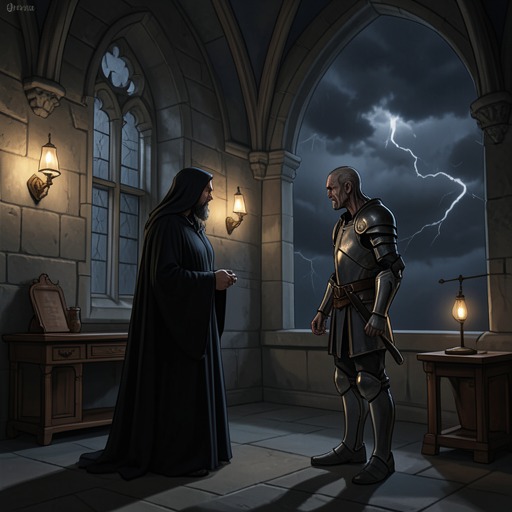
Right of Sanctuary
The Castle of OtrantoRight of Sanctuary is the protection Isabella seeks in the church of St. Nicholas after fleeing Manfred. It offers a refuge beyond the castle’s immediate control and gives Jerome grounds to resist Manfred’s demand that she return, making sacred space a practical check on the ruler’s power.
The Route to Sanctuary
After leaving Manfred, Isabella knows that the castle gates are locked and guarded, so escape by the ordinary route is unavailable. She recalls a subterranean passage connecting the castle vaults with the church of St. Nicholas. Carrying a lamp, she makes for the passage, hoping to reach the altar before Manfred can overtake her; if necessary, she is prepared to remain in the adjoining convent.
The route is difficult to navigate. The lower castle consists of intricate underground passages, where Isabella pauses at sounds that might signal pursuit. When she finds the trapdoor, she uses a key to release its spring and reveals steps descending into a dark vault. She explains that the way leads directly to the church. The sanctuary is therefore not merely an abstract claim: access depends on a concealed passage and Isabella’s knowledge of how to open it.
Protection and Church Authority
Isabella’s expectation is that Manfred will not dare violate the sacredness of the church. That expectation shapes her choice: the church promises a place where his pursuit may be checked, while the convent offers the possibility of permanent refuge. Her flight turns the boundary between castle and church into a boundary between Manfred’s household authority and a religious institution with its own protections.
Jerome gives that protection an explicit institutional defense. He tells Manfred that Isabella is safest among orphans and virgins and that nothing but a parent’s authority can remove her from the convent. Manfred claims that authority, but Jerome answers that Heaven has forbidden the connection Manfred seeks and dissolved any ties that would make his demand legitimate. Sanctuary thus becomes entangled with the dispute over Manfred’s attempt to marry Isabella: the question is not simply where she is, but whether the Prince can command her return and overrule the Church’s judgment.
Limits and Consequences
The Church’s protection does not end the conflict. Manfred continues to seek control over Isabella and challenges Jerome’s authority, while Jerome invokes the Church’s power to oppose Manfred’s plans. At the altar, Jerome warns that the Church’s condemnation will stand above the Prince’s threats if he persists in pursuing a divorce. The sacred precinct provides a basis for resistance, though the surrounding political crisis continues beyond it.
The novel’s ending places sanctuary within a broader reversal of earthly power. After a supernatural vision identifies Theodore as Alfonso’s true heir, Manfred accepts that his rule has been rejected, relinquishes the principality, and enters religious life with Hippolita. The conclusion does not make the earlier refuge a simple resolution to Isabella’s danger; rather, it confirms the larger principle that Manfred’s authority is limited by religious judgment and by the rightful order he had tried to displace.