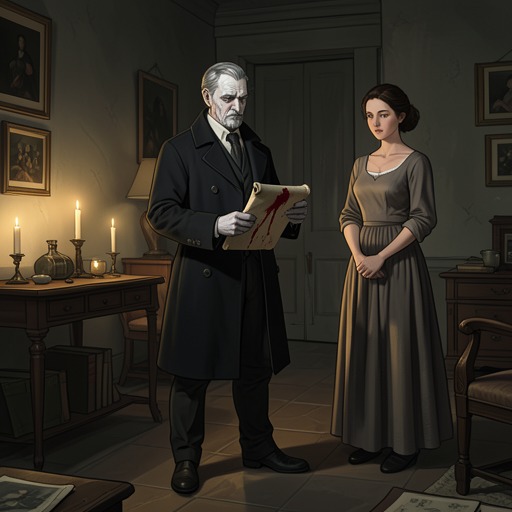
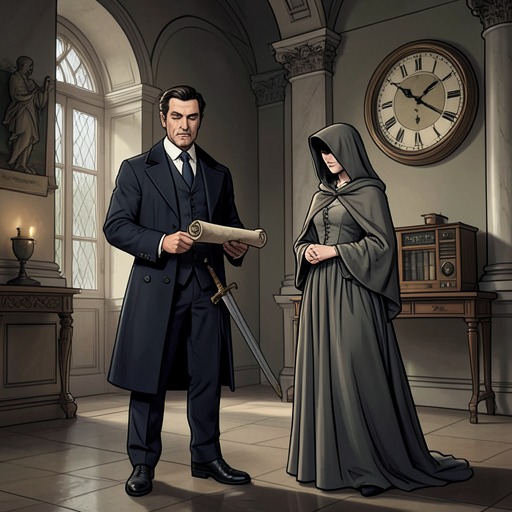
The Herald's Challenge to Manfred
The Castle of OtrantoThe Herald's Challenge to Manfred is the formal confrontation in which Frederic’s representative demands that Manfred return Isabella and relinquish Otranto. The challenge brings the succession dispute out of private calculation and into public, chivalric terms: Manfred is named as a usurper, and his authority is set against the claim of the nearest blood heir to Alfonso. His guarded welcome to the challenger cannot settle that conflict; it instead gives the rival claim a ceremonial presence within the castle as ominous signs gather around them.
The Challenge and Its Claims
Jerome learns that a herald is waiting and asks whom he represents. The answer identifies the sender as the Knight of the Gigantic Sabre, who has come to speak with the ruler of Otranto. Jerome repeats the message to Manfred exactly. The title “usurper” first terrifies Manfred, then provokes his anger and restores his courage: he dismisses the challenge as an insult and insists that he will meet the stranger himself.
The herald speaks in the name of Frederic, Marquis of Vicenza, and demands two things. Manfred must return Isabella, Frederic’s daughter, whom the herald says was placed in Manfred’s power through the bribery of her guardians while Frederic was absent; he must also resign Otranto to Frederic, described as the nearest blood relation to its last rightful lord, Alfonso the Good. If Manfred refuses, the Knight challenges him to single combat. The demands therefore join Isabella’s personal fate to the larger question of who has a legitimate right to rule.
The challenge has force because Manfred knows Frederic’s claim is well founded and not new. Frederic’s ancestors had styled themselves princes of Otranto after Alfonso died without issue, but Manfred’s family had been too powerful for the house of Vicenza to displace. Frederic’s apparent death in captivity created the opportunity Manfred used: he bribed Isabella’s guardians and arranged her as a bride for Conrad, hoping to unite the rival houses’ claims through marriage. After Conrad’s death, Manfred decided to marry Isabella himself. The herald’s demand thus confronts Manfred with the political design behind both marriages, rather than treating his actions as an isolated response to the challenge.
Manfred’s Response and the Castle Reception
Manfred restrains his immediate impulse to provoke Frederic. Instead, he tells the herald that he wishes to confer with his master before settling their differences by the sword. He invites the party into the castle, promises courteous reception and security for the Knight and his followers, and swears that they may depart safely if negotiation fails. The pledge presents Manfred as a ruler bound by chivalric hospitality even as he knows the rival’s claim cannot be dismissed on its merits.
The reception makes that tension visible. The Knight arrives with an extensive procession of attendants, guards, heralds, and armed companions. His banner bears the arms of Vicenza and Otranto quartered together, a display that offends Manfred, though he suppresses his resentment. A hundred gentlemen carry an enormous sword, while the Knight himself remains fully armed and conceals his face behind his visor. At the castle gate, the herald repeats the challenge; Manfred, his attention drawn to the sword, also sees the enchanted helmet’s plumes move in an extraordinary wind.
Manfred welcomes the unknown Knight despite the omens, declaring his confidence in the justice of his cause and in Saint Nicholas, whom he believes has protected his house. The Knight does not answer. He dismounts, pauses to pray before the miraculous helmet, and refuses Manfred’s proposal that he disarm. Manfred accepts the refusal and gives him his ring as a pledge of safe conduct. Soon afterward, as the Knight’s followers cross the courtyard, the gigantic sword breaks from its supports and falls opposite the helmet, where it remains immovable. The reception therefore places the rival’s formal challenge beside the supernatural signs that have already unsettled Manfred’s confidence.
Negotiation and the Disputed Right to Rule
Once the three Knights have entered an inner chamber, Manfred frames the dispute in his own terms. He acknowledges that Frederic’s party has come to reclaim Isabella and demand Otranto, but argues that his family received the principality through its succession from his father, Don Manuel, and grandfather, Don Ricardo. He says Alfonso died childless in the Holy Land and left his estates to Ricardo in recognition of Ricardo’s faithful service. The stranger shakes his head, refusing to accept that account as sufficient.
Manfred then defends Ricardo’s character and invokes both his grandfather’s sword and the favour of Saint Nicholas as supports for his family’s possession. Yet he also concedes that Frederic is nearer in blood and says he has agreed to submit his title to the outcome of combat. His defence exposes the difference between holding power across generations and possessing a rightful title: Manfred treats inherited rule and force as evidence, while the challenger’s case rests on descent from Alfonso. The herald’s demand makes that unresolved contradiction the central issue of the encounter.
Consequences and Retrospective Significance
The challenge does not end with a settled agreement. It opens a negotiation under the protection of Manfred’s pledge, while his effort to control what Frederic’s party learns about Isabella’s flight shows that hospitality coexists with concealment. His decision to invite the champion into the castle is calculated to keep the visitor from discovering her absence, even as Manfred offers security and promises a fair contest if talks fail. The episode makes his courtesy real but limited: he accepts the public forms of chivalry without abandoning the private effort to preserve his position.
The later revelations confirm that the herald’s accusation points toward a deeper history than Manfred’s family account allows. Manfred eventually confesses that Alfonso died by poison and that Ricardo’s succession rested on a fictitious will. Jerome reveals that Alfonso had secretly married Victoria after reaching Sicily and left her pregnant; their daughter became Jerome’s wife and the mother of Theodore. These disclosures establish a line of descent that Manfred had not recognized when the herald demanded Otranto for Frederic. In the final settlement, Manfred abdicates and Theodore is accepted as the true Prince of Otranto. The challenge is therefore a turning point not because the herald immediately wins the principality, but because it states the legitimacy question that the disclosures, supernatural judgments, and eventual renunciation resolve.