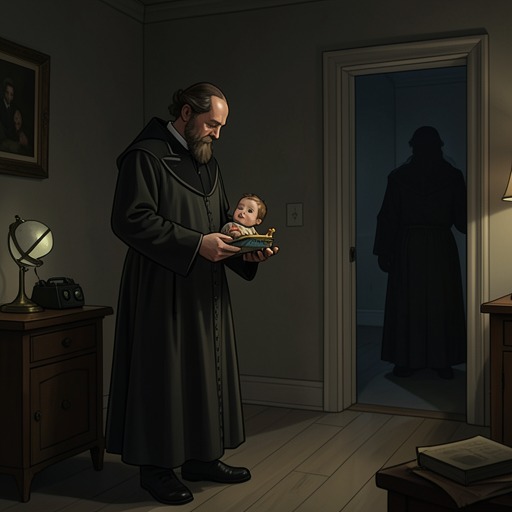
Theodore–Jerome Father-Son Relationship
The Castle of OtrantoTheodore–Jerome Father-Son Relationship is at once a reunion between a father and his long-lost son and a revelation that unsettles the apparent order of inheritance at Otranto. Jerome recognizes Theodore when the young man is about to be executed, and the account of their separation confirms their kinship; their bond then becomes a source of both urgent protection and painful disagreement. Its importance lies in the way private family history intersects with the political and dynastic crises surrounding Manfred’s household.
Identity and Hidden Kinship
Jerome is Theodore’s father, but that relationship is not known when Theodore first faces Manfred’s judgment. In the court, Jerome has been called to hear Theodore’s confession, and Manfred hopes that the priest may disclose the prisoner’s history. Jerome instead falls to his knees to oppose the execution, accuses himself of having helped bring Theodore into danger, and tries to persuade Manfred that the young man is innocent. His appeal makes their relationship appear emotionally urgent before it is publicly established.
The recognition comes when Theodore kneels and his clothing shifts, revealing a mark left by a bloody arrow. Jerome identifies the mark and cries that Theodore is his child. The scene changes the meaning of the threatened execution: Jerome is no longer only the religious official asked to prepare a prisoner, but a father confronting the possible loss of his long-lost son. Theodore receives Jerome’s tears and embrace with modest submission, though he still looks toward Manfred, uncertain whether this recognition can alter the Prince’s decision.
Jerome confirms that Theodore is his lawful son and identifies himself as the Count of Falconara. The revelation gives Theodore a noble lineage, but Jerome immediately resists treating rank as the most important fact about them. He speaks instead of human frailty and piety, shifting the exchange from social standing to moral obligation. When he begs Manfred to spare his only, long-lost child, his argument is explicitly paternal: he offers himself in Theodore’s place and asks that the son be allowed to live.
Separation and Recognition
Theodore later recounts how the separation began. When he was five, corsairs carried him and his mother from the coast of Sicily to Algiers. His mother died of grief within less than a year. Before her death, she bound a written account around his arm beneath his clothes; it stated that he was the son of the Count of Falconara. Theodore’s identity thus survived through a concealed document and the bodily mark that Jerome recognized, two different traces of a family history hidden from the people around him.
The two forms of recognition work together. The mark prompts Jerome’s immediate response in the court, while Theodore’s account explains the childhood displacement and the writing his mother left with him. Jerome confirms that the story is true and acknowledges himself as the father named in it. What had seemed a sudden claim of kinship becomes a history with a specific origin: the child was taken away at five, grew up without his father, and carried evidence of his parentage without knowing the full family story.
The reunion does not erase the years of separation. Jerome’s distress is sharpened by the memory of Theodore’s mother, whom he asks whether Theodore believes to be dead. The question links the father-son bond to the absent mother and to the loss through which their family history has reached the present. The account does not provide a reunion with her; instead, her death and the writing she left explain both the separation and Theodore’s eventual identification.
Protection and Conflict
Jerome’s first sustained action as Theodore’s father is to try to save him. When Manfred orders the execution to proceed, Jerome pleads for his son’s life, asks that his own life be taken instead, and appeals to the natural bond between parent and child. Manfred turns the plea back upon him, asking whether Jerome can feel what it means to lose an only son. The exchange makes paternal grief part of the political confrontation: Jerome’s private appeal is met by a ruler whose own fear of losing his line has shaped his decisions.
Their relationship also places Jerome in a moral and practical conflict. Theodore had accused him of being involved in his escape in order to keep Manfred’s suspicion from falling on Matilda. He reasoned that Jerome’s holiness and reputation would protect him from the Prince’s anger. Jerome is heartily grieved to discover that his son loves Matilda, and he promises to explain important reasons for Theodore to overcome that attachment. The same father who risks himself to preserve Theodore’s life therefore seeks to govern the young man’s choices.
Theodore does not readily accept this authority. Jerome asks why he is late to meet him at Alfonso’s tomb and sternly questions what occupied his dreams. Theodore blushes, but challenges Jerome’s description of his love for Matilda as sinful, arguing that her beauty and modesty are innocent. Jerome’s response is shaped by his belief that heaven has doomed Manfred’s line and that the tyrant’s descendants are to be swept away. Father and son therefore differ over the consequences of Theodore’s attachment: Theodore sees the virtue of the person he loves; Jerome sees the danger of loving someone within a doomed family.
Inheritance and Narrative Significance
Theodore’s parentage carries implications beyond the private reunion. Jerome’s confirmation establishes him as the son of the Count of Falconara, while Theodore’s resemblance to Alfonso is noticed in Manfred’s household. When Bianca remarks that Theodore is the very image of good Alfonso, Manfred becomes unsettled and urgently asks when Theodore first became acquainted with Isabella. These details place Theodore’s identity amid the novel’s competing genealogies and claims, even as the family relation at issue here is specifically his bond with Jerome.
Jerome’s own account at the close supplies a further link in that history. He explains that Victoria’s daughter was given in marriage to him when she came of age, and that Victoria’s death left the secret locked in his breast; Theodore’s account, he says, has told the rest. The disclosure confirms that the family story contains information kept hidden well beyond Theodore’s childhood separation. The text presents the recognition of Theodore as Jerome’s son not as an isolated domestic revelation, but as one piece of a larger unmasking of the relationships behind Otranto’s succession crisis.
The bond ends in recognition, but not in uncomplicated reconciliation. Jerome has recovered a son whose life he tried to protect and whose love he fears will bring further danger. Theodore has found his father and learned the history carried in his mother’s writing, yet resists the paternal command to abandon Matilda. Their relationship thus joins tenderness to authority: Jerome’s love takes the form of rescue and counsel, while Theodore’s filial connection does not extinguish his independent attachment. In the broader plot, their reunion turns concealed descent into consequential knowledge, while its unresolved emotional tension shows that discovering kinship does not settle what a son should choose.