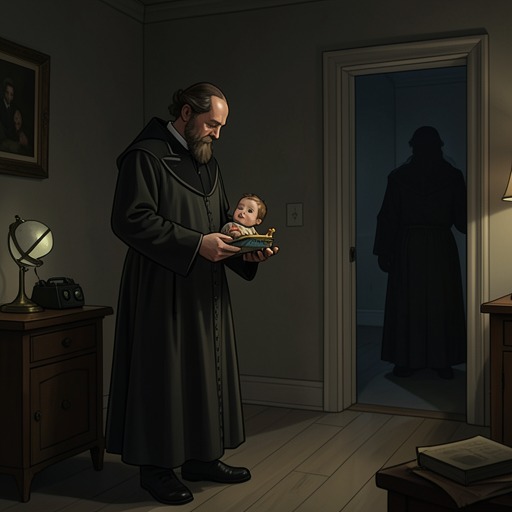
Theodore's Recognition as Jerome's Son
The Castle of OtrantoTheodore's Recognition as Jerome's Son is the turning point in a scene that begins with Manfred ordering Theodore's execution and ends with Jerome pleading for his newly recognized son. A mark on Theodore's shoulder identifies him as Jerome's child; the revelation transforms the imprisoned young peasant into the Friar's long-lost son and shifts the immediate conflict from confession and punishment to a father's appeal for mercy.
From Sentence to Confession
Manfred has ordered Theodore taken into the courtyard, where he intends to have him executed. The sentence follows Theodore's refusal to speak, and Manfred's suspicion and anger leave little room for appeal. When Matilda faints and Bianca cries out that the Princess is dead, Manfred pauses long enough to investigate the alarm, then orders Theodore brought forward and made ready for the fatal blow.
Theodore receives the sentence with composure, though he wants to understand what he has heard about the Princess. He chooses not to press the question, fearing that doing so could worsen her danger. His sole request is to have a confessor and make peace with heaven. Manfred grants it because he hopes the confessor can uncover the young man's history, and sends for Father Jerome, believing the Friar is now acting in his interest.
Jerome, who had not foreseen that his earlier imprudence would bring Theodore to this crisis, falls to his knees and urges Manfred not to shed innocent blood. He blames himself and tries to defend the prisoner, but his appeal only increases Manfred's suspicions. Manfred insists that Jerome perform his duty and gives Theodore little time. Theodore answers that he has not much to confess, urges Jerome not to weep, and accepts that he is about to die.
The Mark and the Recognition
Before the confession can proceed, Theodore asks whether his fate has caused the distress he heard and whether the Princess is again in Manfred's power. Manfred treats the question as a provocation and repeats that Theodore's last moment is at hand. Theodore suppresses his rising indignation, removes his doublet, loosens his collar, and kneels to pray. As he bends, his shirt slips below his shoulder, exposing a mark of a bloody arrow.
Jerome recognizes the mark and cries out that Theodore is his child. The recognition makes the scene's intended execution suddenly a reunion: those present, who had been moved by Theodore's calm acceptance of death, are now held in astonishment. The narrative describes surprise, doubt, tenderness, and respect appearing in succession on Theodore's face. He submits modestly to the old man's tears and embraces, but looks toward Manfred with apprehension, uncertain whether the Prince can be moved by the discovery.
Manfred is briefly affected. His anger gives way to astonishment, yet pride prevents him from acknowledging the force of the scene, and he suspects that Jerome may have invented the relationship to save Theodore. He challenges Jerome's account by questioning how a Friar could have a peasant's son. Jerome answers that Theodore's blood is noble and identifies himself as the Count of Falconara, while insisting that piety, not noble birth, distinguishes people. Manfred dismisses the moral reflection and demands the Friar's history.
A Father's Plea and Manfred's Bargain
Jerome pleads for his only, long-lost child, offering his own life and accepting humiliation if Theodore can be spared. Manfred answers by invoking the pain of losing an only son, contrasting his own threatened family with Jerome's appeal. Jerome then explains that it is not family pride but nature and the memory of Theodore's mother that move him. When he asks whether she is dead, Theodore confirms that she has long been among the blessed.
Jerome returns to the urgent question of Theodore's life. Manfred promises to spare him, but attaches a condition: Jerome must return to the convent, bring the Princess to him, and obey his further commands. The recognition therefore secures no unconditional freedom. It gives Jerome leverage to ask for mercy while allowing Manfred to turn paternal love into pressure for compliance.
Theodore immediately resists that exchange. He would rather die than stain Jerome's conscience and urges him to protect the Princess instead, asking that Manfred's anger fall on him. The scene thus places two forms of obligation against one another: Jerome's new claim as Theodore's father and Theodore's concern for the Princess's safety. Recognition changes who Theodore is to Jerome, but it does not make him abandon the danger facing someone else.
Dramatic Function
The birthmark supplies the decisive evidence at the instant when Theodore is preparing for death. A bodily sign that had not been explained becomes the means of recognition, reversing the scene's direction without removing its danger. The movement from execution order to filial embrace is immediate, but Manfred's suspicion and conditional promise prevent the reunion from resolving the larger conflict.
The episode also changes Jerome's position from confessor and intercessor to father pleading for his son. His earlier remorse over having contributed to the crisis now becomes personal anguish, while Theodore's calmness at the prospect of death gives way to a relationship disclosed before witnesses. The recognition's consequence is therefore both intimate and political: it exposes Theodore's identity and makes his survival part of Manfred's attempt to control Jerome and the Princess.