
From Suspicion to Cooperation
The Caves of SteelThe central partnership and political settlement show cooperation emerging not from shared assumptions but from sustained disagreement and tested reliance.
increasing Bearing strength in each event
 decreasing
Bearing strength in each eventdecreasingTerms Set by Spacetown

Terms Set by Spacetown
A partner imposed
The Spacers require one of their agents to join the investigation. Baley accepts because the case is too important to refuse, while Enderby asks him to host the robot.
Cooperation compromised
Enderby privately tells Baley to work with Daneel but ensure that Earth solves the case first. The arrangement begins with institutional distrust on both sides.
The partnership is necessary before it is welcome.
A Partner’s Competence
A Partner’s Competence
Crisis handled
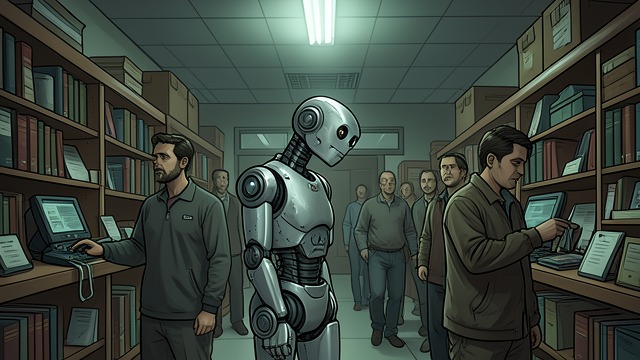
Daneel prevents violence at the shoe store and later identifies watchers in a crowd. Baley sees the robot’s value while resenting the threat that competence poses to human authority.
Dependence admitted indirectly
Baley accepts Daneel’s reports and uses his memory in planning the escape. Cooperation occurs before Baley is ready to describe it as trust.
Practical success begins to alter the emotional arrangement.
The Culprit Dispute

The Culprit Dispute
A theory challenges doctrine
Baley accuses Enderby of killing Sarton, while Daneel objects that Cerebroanalysis proves the Commissioner incapable of deliberate murder. Baley insists on a distinction between intention and accident.
Reasoning under disagreement
Neither partner simply yields. Daneel’s constraint forces Baley to revise his explanation toward an attempted destruction of a robot rather than planned human murder.
Disagreement sharpens the final reconstruction.
Truth Shared with Fastolfe
Truth Shared with Fastolfe
A remote witness
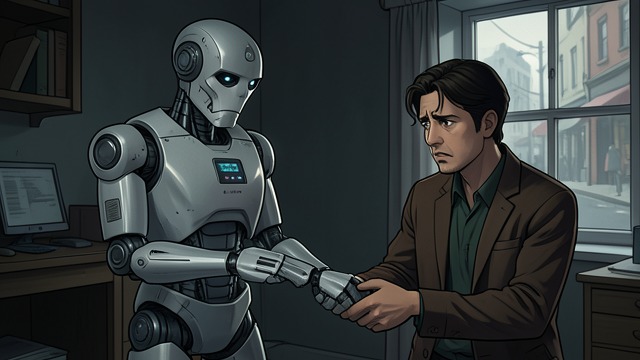
Daneel contacts Han Fastolfe while Baley accuses Enderby. The connection ensures that the truth cannot be contained within the Department or erased by a local arrest.
Cooperation protects the speaker
Daneel restrains Baley’s wrist but also argues that Enderby should hear him out. The robot balances the First Law with the investigative need to let Baley present the case.
The partnership protects both safety and truth.
A Common Direction

A Common Direction
Trust spoken aloud
Baley tells Daneel that he trusts and admires him, and asks him to remain on Earth. Their cooperation has survived accusations, ideological conflict, and the revelation that Daneel’s purpose was partly experimental.
A shared future proposed
Baley imagines the robot helping Bentley and future emigrants. Their partnership now points toward a task larger than the crime that brought them together.
Cooperation remains a choice made across difference.
At the first meeting in Enderby’s office
During the first night’s disturbances
During the last investigation meeting
At the climax, as Daneel contacts Spacetown
At the ending, after the case is settled
