
The Final Choice of the Case
The Caves of SteelAfter solving the murder, Baley must choose whether the result will serve only punishment or also the possibility of changing the forces that produced the crime.
increasing Bearing strength in each event
 decreasing
Bearing strength in each eventdecreasingA Solved Crime Is Not Enough

A Solved Crime Is Not Enough
The culprit known
Baley identifies Enderby as the person who killed Sarton by mistake and later destroyed R. Sammy. The investigative mystery has an answer.
Consequences remain open
The answer does not determine whether Enderby will be prosecuted, whether Spacetown will leave, or whether Earth will face new political conflict. Solving the case opens rather than closes the moral problem.
Truth requires a decision about what to do next.
The Commissioner’s Collapse
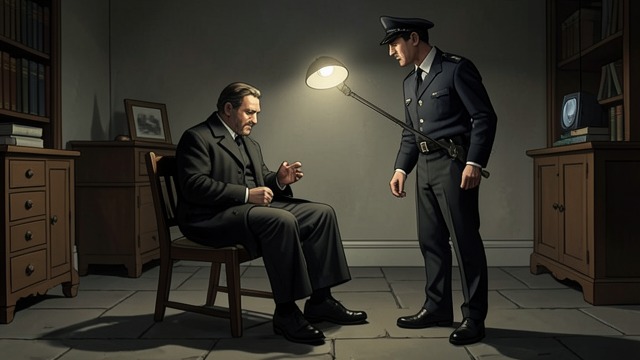
The Commissioner’s Collapse
Confession under pressure
Enderby admits that the killing was a mistake and collapses after Baley reconstructs the evidence. The emotional shock confirms the human cost of his actions.
No easy verdict
Baley has forced a confession without a full public process. Enderby’s guilt is clear to those present, but the future consequences remain negotiable.
The climax turns from proof to responsibility.
Daneel’s Greater Good

Daneel’s Greater Good
A larger purpose invoked
Daneel argues that Spacetown must prioritize humanity’s future over the prosecution of one individual. He believes the colonization project may justify leaving the murder unresolved in court.
Baley resists abstraction
Baley objects that Sarton’s family and the truth matter. He will not accept a grand social purpose without considering the individuals who bear its cost.
The disagreement tests whether the greater good can be measured without human compassion.
The Conditional Offer

The Conditional Offer
Punishment deferred
Baley offers Enderby a chance to cooperate with the colonization effort and redirect the Medievalists. The choice is not absolution, since Spacetown retains knowledge of his guilt.
Repair made practical
The bargain turns Enderby’s political position into a possible instrument for change. Baley acts on the belief that a former enemy can help prevent future harm.
Justice becomes a conditional path toward repair.
A New Meaning of Justice

A New Meaning of Justice
Evil transformed
Daneel reflects that eliminating what is evil may be less desirable than converting it into good. His thought grows from the treatment of Enderby and the language of mercy Baley introduced.
An unresolved ethic
The bargain may preserve peace and enable colonization, but it also leaves wrongdoing without ordinary punishment. The narrative offers transformation as a possibility, not a formula without risk.
The case closes on moral uncertainty made purposeful.
Immediately after Baley identifies Enderby
At midnight, after the glasses are removed
Immediately after Enderby wakes
At the end of the confrontation
In the final words before Baley and Daneel leave
