“He that is without sin among you, let him first cast a stone at her”
The Caves of Steel“He that is without sin among you, let him first cast a stone at her” is the moral hinge of the biblical story Elijah Baley tells R. Daneel Olivaw. In the scene, the sentence interrupts a demand for punishment by making the accusers confront their own capacity for wrongdoing; in Baley’s explanation, it names a human impulse toward mercy that justice alone cannot account for.
The sentence within the story
Baley recounts the episode from the Modern Revision, speaking almost casually, as if telling a story of contemporary life rather than retrieving one from humanity’s distant past. The setting is the temple: Jesus has returned there at dawn, and the people gather to hear him. Scribes and Pharisees bring before him a woman caught in adultery and invoke the law of Moses, which they say commands that such offenders be stoned. They ask what he says, hoping to trap him and find grounds for accusing him.
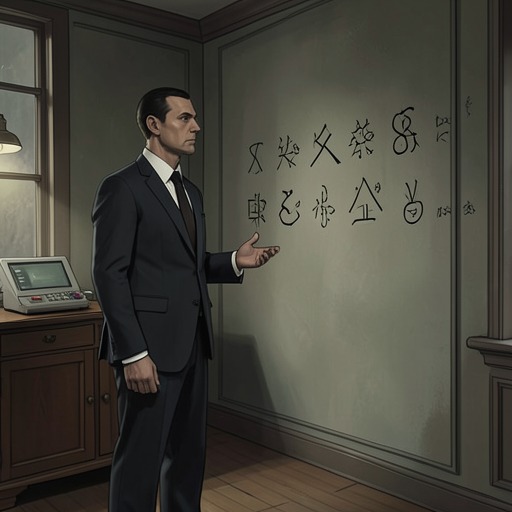
The sentence arrives after Jesus first stoops and writes on the ground as though he has not heard them. When the questioners persist, he stands and answers that the one among them without sin should cast the first stone. He then stoops again to write. The sequence matters: the reply does not argue that the woman is innocent or dispute the law directly. Instead, it turns the accusers’ demand into a test of their own fitness to carry it out.
Judgment turned back on the judges
Those who hear the answer are convicted by their own consciences. They leave one by one, beginning with the oldest and continuing to the last, until Jesus is alone with the woman. Their departure makes the sentence effective without a counter-sentence: the accusers withdraw rather than proceed with the punishment they had demanded. The woman’s guilt is not erased by their retreat; what changes is the position from which judgment can be delivered.
When Jesus asks where her accusers are and whether anyone has condemned her, she answers that no one has. He tells her that he does not condemn her and sends her away with the instruction to sin no more. The ending holds mercy and moral responsibility together. The woman is neither declared innocent nor stoned; release from condemnation is paired with a call to change.
Baley’s explanation to Daneel
Daneel asks whether the woman was guilty, and Baley confirms that she was. Daneel then asks why she was not stoned. Baley answers that none of the accusers felt able to do so after hearing Jesus’s statement. He explains the episode as showing that something stands higher than the justice with which Daneel has been filled: a human impulse called mercy and a human act called forgiveness.
Daneel says he is not acquainted with those words. Baley replies that he knows. The exchange gives the biblical sentence a second role beyond its place in the story: it becomes a means by which Baley tries to communicate a moral distinction to his robotic partner. The account offers no indication that Daneel understands the concepts; its immediate significance is the boundary Baley identifies between enforcing justice and responding with mercy.
A remembered human text
Before speaking, Baley stops the car and sits with his eyes closed for a few moments, remembering. He would have preferred the sonorous Middle English of the Medieval Bible, but recognizes that it would be gibberish to Daneel. He therefore chooses the Modern Revision, adapting the language so that the old story can be heard as intelligible speech in the present.
That choice frames the episode as more than a quotation from the past. Baley translates an inherited human story across both historical and cultural distance, then explains its ethical point to someone unfamiliar with the very words for mercy and forgiveness. The sentence’s force in their conversation comes from this contrast: a rule of punishment is readily stated, while the human reluctance to condemn another person requires a story—and an explanation.