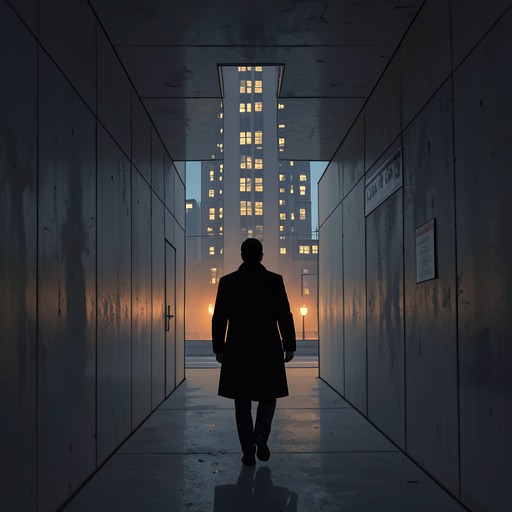
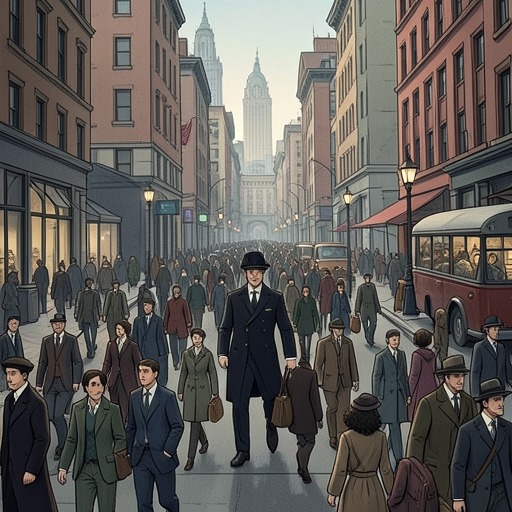
“The City smells.”
The Caves of Steel“The City smells.” names a small but decisive shift in Elijah Baley’s perception: returning to the city after breathing outdoor air, he notices its faint pungence and recognizes the human density that his familiar surroundings had allowed him not to smell. The thought turns the city from an unquestioned home into a physical environment he can briefly experience from outside, without dissolving the attachment that draws him back into it.
The Return to Familiar Ground
The realization occurs as a squad car rolls slowly down the vehicular lane. Baley has just been thinking, without reaching a conclusion, about the prospect of forcing Earthmen to emigrate and about what the Spacers might really want. Against that political uncertainty, the car’s movement brings him back into contact with the immediate world around him: the blaster at his hip feels warm and comfortable, and so do the City’s noise and vivid life. The city is not merely a setting he observes; it is the familiar surroundings in which his body feels at ease.
That comfort makes the sensory break more striking. As the City closes in around the moving car, Baley’s nose tingles with a slight, fugitive pungence. The sensation is neither overpowering nor lasting. Its briefness matters: it interrupts his habitual experience just long enough to make the familiar environment perceptible in a new way, then gives way to the roar of the city around him.
Air, Crowding, and a Newly Strange City
The thought that the City smells follows directly from the change in Baley’s own sensory condition. He imagines the twenty million human beings enclosed within the great cave of its steel walls and, for the first time in his life, smells them with nostrils washed clean by outdoor air. The city’s odor is thus connected to the human multitude packed into its enclosed spaces. The experience does not reveal a new condition of the City so much as a new capacity in Baley to notice one.
His brief question about another world extends that perception into comparison: might there be fewer people and more air-cleaner elsewhere? The possibility makes the crowded city seem contingent rather than inevitable. Yet the thought remains speculative; Baley reaches no settled conclusion about emigration or about what life beyond Earth would be like. The phrase concentrates this tension in a sensory fact instead of resolving it as an argument.
Comfort and Discomfort in One Moment
The passage does not turn Baley’s discovery into a simple rejection of city life. The noise and vibrant life around him remain as comforting as the blaster’s familiar weight, even while the pungence makes the crowded environment momentarily strange. Attachment and discomfort coexist: the city can be home and a place whose bodily conditions become newly noticeable when seen, or smelled, from a different standpoint.
When the afternoon roar surrounds him again, the odor fades and is gone. Baley feels a little ashamed of himself, a reaction that closes the sensory interruption without undoing it. The city resumes its familiar dominance, but his perception has briefly crossed a threshold: what he had lived among all his life has become something he can notice and compare. He then eases the drive rod forward, takes a larger share of the beamed power, and accelerates into the empty motorway. The return to movement carries him onward, while the brief recognition remains a measure of how outdoor air has altered his experience of home.
Significance of the Expression
The force of “The City smells.” lies in its plainness. It reduces a vast, crowded urban civilization to an immediate bodily perception, and the full moment gives that perception its scale: twenty million people enclosed within steel walls, a fleeting smell, and the noise that soon overwhelms it. The statement is not a general condemnation of the City. Its significance rests on the contrast between the environment’s persistence and Baley’s changed senses.
The episode also brings an abstract question about emigration down to the level of air and bodies. Baley has no answer to what the Spacers are after, and his speculation about another world does not become a decision. Instead, the City’s faint odor offers a concrete point of comparison: enclosed human density on one side, the possibility of fewer people and more air-cleaner on the other. The city remains both comfort and constraint, newly perceptible but not abandoned.