Aurora
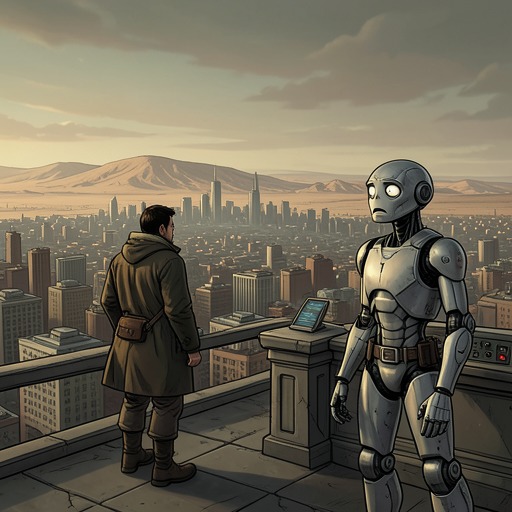
The Caves of SteelAurora, the home planet of Roj Nemennuh Sarton, is presented as a society shaped by underpopulation rather than Earth’s overcrowding. Its long life expectancy and controlled population offer a pointed contrast with Earth and help explain the social assumptions surrounding the murder investigation: on Aurora, individual life is treated as exceptionally precious, while comfort and social order are managed through deliberate demographic and technological policies.
Identity and Setting
When Elijah Baley begins discussing the case, Sarton is identified as a citizen of Aurora and a resident of Spacetown. The Spacers connect his murder to what they regard as broader attempts to sabotage a project promoting an integrated human–robot society on the Outer Worlds’ model. Aurora thus enters the investigation not only as Sarton’s home, but as the distant society whose values and political project are implicated in the conflict.
Population and Longevity
Aurora’s demographic condition is explicitly contrasted with Earth’s: its central problem is underpopulation. A Spacer interlocutor illustrates the difference in life expectancy by saying that he is 163 years old, with men on Aurora known to live for more than 350 years. He says that, if he avoids disease on Earth and takes care of himself, he may live twice as long. The comparison makes longevity more than a biological distinction; it is a social priority made possible by Aurora’s different population pressures.
The explanation is practical as well as cultural. Because Aurora is underpopulated, it can concentrate research on gerontology and the aging process. By contrast, the same extension of life expectancy would be disastrous on an overpopulated Earth, where it would further increase population. The discussion makes Aurora’s long lives a consequence of the conditions and choices of its society, not an unexplained marvel.
Social Organization
The value placed on individual life follows from the gap in expected lifespan. The Spacer argues that, if he died, he would lose perhaps 150 years or more, whereas Baley might lose roughly forty years, probably less. In a culture where a person may live for centuries, each individual life carries correspondingly greater weight.
Aurora’s birth rate is low, and population increase is rigidly controlled. Its society also maintains a definite robot-to-human ratio, designed to provide individuals with the greatest comfort. Children are carefully screened for physical and mental defects before being allowed to mature. Together, these policies show how Aurora’s underpopulation informs both its treatment of individual welfare and its management of reproduction and labor. The account presents those arrangements as part of the same social logic, while leaving their full implications for the screened children unstated.
Narrative Significance
Aurora’s social model supplies the contrast through which the book frames the relationship between Earth and the Outer Worlds. Its long-lived population, controlled growth, and robot-assisted comfort differ fundamentally from Earth’s overcrowded conditions. That difference helps clarify why an integrated human–robot society modeled on the Outer Worlds can be both a proposed solution and a source of suspicion on Earth. Aurora’s importance in the investigation therefore extends beyond geography: its way of organizing life is part of what the murder, and the conflict surrounding it, places under scrutiny.