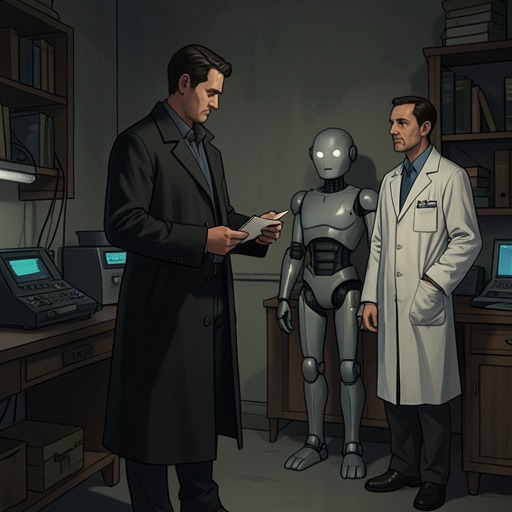
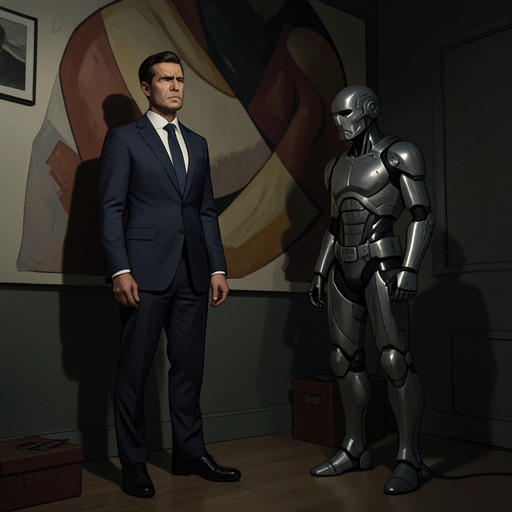
Baley assigned to investigate the Sarton case
The Caves of SteelBaley’s appointment to investigate Dr. Sarton’s murder turns a stalled case into a test of Earth’s authority and of the uneasy terms on which the Spacers permit the inquiry to proceed. He accepts the job knowing that a Spacer will share it—and that the investigation’s eventual findings will have to withstand political as well as legal scrutiny.
Causes and Stakes
When Baley challenges the Commissioner over the lack of progress, the Commissioner explains that he has spent the three days since the murder conferring with the Mayor, visiting Spacetown, and speaking in Washington with the Terrestrial Bureau of Investigation. The bureau considers the case Earth’s responsibility because Spacetown lies within New York’s city limits, even though the Spacers possess extraterritorial rights there.
That divided authority makes the investigation dangerous. The Spacers could insist on conducting their own inquiry and report their conclusions to their home governments; the Outer Worlds could then use the murder as a basis for imposing indemnity charges. The Commissioner warns that paying could be political suicide for the White House, while refusing to pay could bring a different kind of catastrophe. The question of who investigates therefore cannot be separated from who can impose consequences.
Appointment and Conditions
The Commissioner names Baley the operative in charge, despite Baley’s objection that his C-5 rating does not qualify him for the responsibility. The prospect of a C-6 rating is part of the appeal, but the Commissioner also frames the appointment as a matter of friendship and asks Baley to accept a condition imposed by the Spacers.
They have agreed not to report the murder and to leave the investigation in Earth’s hands, provided one of their own agents participates throughout. The Commissioner acknowledges their concern: if the case is mishandled, Spacer officials could face trouble with their own governments. Baley agrees to take a Spacer partner, even as he recognizes that the arrangement reflects a lack of complete trust.
The condition proves more intimate than a shared investigation: the partner will have to live with Baley. When Baley asks for the agent’s name, the Commissioner identifies him as R. Daneel Olivaw. Baley insists on naming the fact he finds most consequential: the partner is a robot. The assignment thus begins not simply with a division of investigative responsibility, but with Baley’s reluctance to work alongside a machine in the private space of his home.
What the Investigation Reveals
Later, in confronting Han Fastolfe, Baley describes a suspected deception involving two impersonations: a robot built to resemble Dr. Sarton was destroyed and presented to Commissioner Enderby as Sarton’s remains; R. Daneel then impersonated Sarton in the staged murder, while Sarton was made to impersonate R. Daneel in the supposed investigation. Fastolfe confirms Baley’s account of the arrangement, but challenges the conclusion Baley draws from it.
The confrontation exposes a further limit on the investigation’s power to establish truth. Baley argues that R. Daneel’s testimony would carry no standing in an Earth court: a robot, he says, cannot serve as a witness there. Even if the agent can identify the faces involved, that ability cannot straightforwardly become admissible proof. The case therefore places the practical authority to investigate and the legal authority to testify on separate tracks.
Significance
The assignment binds Baley to a case in which jurisdiction, diplomatic pressure, and evidence rules overlap without neatly coinciding. Earth retains responsibility for investigating a murder inside New York’s limits, but the Spacer condition gives an Outer Worlds representative access to the inquiry; meanwhile, a robot partner can help uncover what happened while lacking recognized status as a witness in an Earth court.
That tension shapes the partnership from its outset. Baley’s acceptance secures the investigation on the terms available to him, but it does not erase his distrust of R. Daneel or resolve the legal and political conflicts surrounding the case. The appointment makes the murder investigation a contest over not only what can be discovered, but whose account of the truth can count.