Barrier Riots
The Caves of SteelThe Barrier Riots were a mass protest against the separation of Spacetown from the City and the restrictions imposed on people seeking entry. Remembered by Elijah Baley as both a participant’s experience and a lesson in the limits of collective action, the riots ended without the Spacers abandoning their isolation: the City quelled the crowd, and only after a delay did the Spacers ease the controls that had provoked it.
Origins and Grievances
When Spacetown was established, crowds from the City were initially drawn to it as a possible showplace. The Spacers ended that access by erecting a force barrier and establishing a combined Immigration Service and Customs Inspection. Visitors with legitimate business had to identify themselves, submit to a search and medical examination, and undergo routine disinfection. The procedures reflected the Spacers’ conviction that Earth’s inhabitants were diseased, a judgment that made the controls an especially charged source of resentment.
The restrictions generated dissatisfaction well beyond what the Spacers considered warranted, but their effect extended beyond the entrance itself: they became a serious obstacle to the City’s program of modernization. For Earth residents, the barrier embodied an unequal relationship in which the Spacers could control contact and impose humiliating conditions. The protests’ slogans turned that grievance back on the people imposing the examination, repeating an accusation of dirtiness rather than accepting the Spacers’ view of Earthmen as uniquely contaminated.
The Protest and Its Suppression
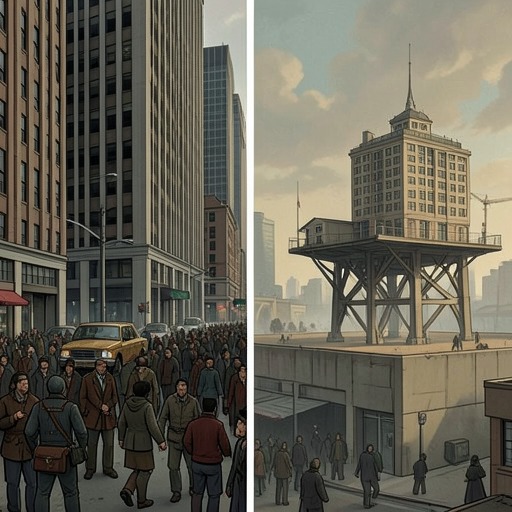
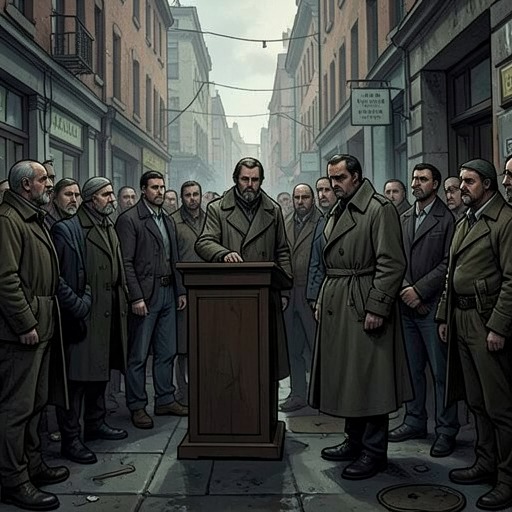
Baley remembered joining the mob that gathered outside the barrier. Protesters hung from expressway rails, crowded into seats without regard for rating privileges, ran along and across the moving strips, and spent two days outside Spacetown shouting slogans and damaging City property. His recollection makes the disturbance more than a confrontation at a gate: the crowd carried its protest into the tightly regulated circulation of the City, disrupting rules and routines as well as property.
The chants gave that anger a shared language. Baley could still recall one slogan, set to an old folk tune, and its nonsensical refrain; the song accumulated hundreds of verses, ranging from witty to stupid and obscene. Every verse returned to the same insult directed at the Spacers. The refrain’s repetition turned a policy dispute into a public answer to the medical stigma behind the barrier, although the slogans could express anger more readily than they could alter the balance of power.
That balance was stark. The Spacers remained behind a barrier made possible by their advanced science, one that Earth had no way to break. Earth’s obsolete fleet could not safely approach an Outer World ship, and planes that had ventured over Spacetown early in its history had disappeared. The Spacers did not need to use their weapons against the demonstrators: they waited while the City dispersed the crowd with somno vapor and retch gas. Below-level penitentiaries then held ringleaders, malcontents, and people detained simply because they happened to be nearby; eventually, all were released.
Political Significance and Later Echoes
The riots became a precedent in later reasoning about the possibility of an attack on Spacetown. The Spacers distinguished the earlier mass uprising from a later hypothetical organized assault: in the Great Riot, they said, Earthmen had attacked only the guarded entrance, and no one had left the City. That distinction depended on the difference between a crowd following the obvious route and a small group deliberately exploiting an unguarded point. The remembered riot therefore served as evidence of what collective anger had and had not done, not as proof that every later threat would follow the same pattern.
The episode also anticipated a broader pattern of political resentment. In the City, Baley connects pressure from declassification—the loss of social rating and its associated privileges after years of effort—with hostility toward robots and the growth of the Medievalist movement. When frustration spills toward destruction, the memory of the Barrier Riots is his immediate point of reference. The riots show how a tightly ordered society can contain discontent for a time without resolving its causes, and how an identifiable target can stand in for larger policies that people cannot directly confront.
The form of organization matters to that comparison. Jessie describes local Medievalist meetings of roughly sixty or seventy people, with folding chairs, refreshments, repeated speeches, oaths, and secret greetings. Baley does not treat those social gatherings as equivalent to an operational conspiracy: he hypothesizes a broad ground-level constituency that could supply mass support and a much smaller elite with a planned program of action. Against that distinction, the riots remain a model of overt mass action, while a deliberate strike by an organized group would have different aims and methods.
The Spacers eventually changed the arrangements that had made the barrier a daily emblem of exclusion. After a suitable interval, they removed it and relied on the City Police to protect Spacetown’s isolation; the medical examination also became less conspicuous. These concessions followed the suppression of the protest rather than a Spacer defeat at the barrier. The riots’ legacy is thus double: their demands produced some easing of restrictions, but the decisive power to control access remained with the Spacers, and the episode continued to frame later fears of unrest, anti-Spacer action, and political exploitation of popular anger.