Closed-city life
The Caves of SteelClosed-city life is both the ordinary framework of Earth society and a source of its deepest anxieties. It coordinates food, language, transit, and status across vast urban regions, while narrowing experience to managed indoor spaces and making access to comfort dependent on civic rating. The novel sets that organized security against memories of exclusion and the prospect of a different life outdoors, showing how a system that keeps people alive can also make its privileges difficult to relinquish and its limits difficult to challenge.
A standardized urban routine
Section kitchens make the scale and uniformity of city life tangible. Their yeast products are much the same from Shanghai to Tashkent and from Winnipeg to Buenos Aires; English, too, has become a shared contemporary language across the continents, with some variation on the Outer Worlds. The commonality is more than a matter of diet and speech: people wait in a triple line that converges at the entrance and divides into three, amid the rumble of conversation and the clatter of plastic utensils. Long tables, polished simulated wood, glass, and steam complete a routine repeated throughout the City and, Baley notes, in cities he has visited, including Washington, Toronto, Los Angeles, London, and Budapest.
This uniformity is not presented as a mere backdrop. It gives daily life a dependable rhythm and makes the City’s organization legible in small acts of waiting and eating. Even when meal hours are staggered, a wait of at least ten minutes is nearly unavoidable. Common provisions and procedures bind far-flung populations into one urban order, but the very regularity that makes the system function also marks how little of ordinary life occurs outside its managed patterns.
Mobility, access, and civic rating
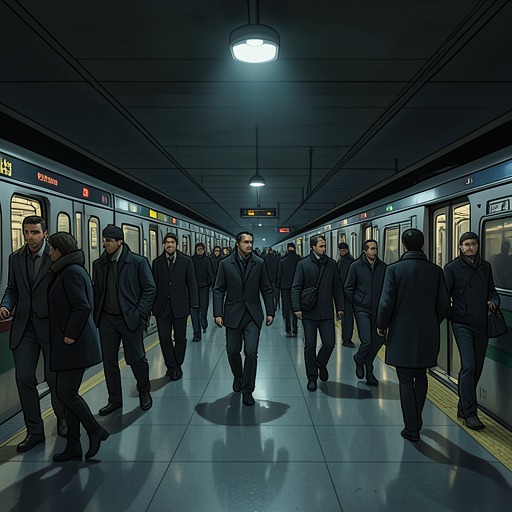
Movement through the City is organized around rapid-transit strips, but familiarity with them is also a popular skill. Children play “running the strips,” a game whose rules vary slightly from City to City while remaining recognizable from San Francisco to Cairo. One player leads followers from one point to another by changing strips, pausing, and leaping unexpectedly; success belongs either to a leader who reaches the destination alone or to a follower who stays with the leader. The game is commonly played in the evening rush hour, when commuter density makes the route more hazardous and complex. A system built to move crowds efficiently thus also provides the setting for a test of agility and pursuit.
Yet transit access is not equal. Baley’s C-5 rating does not automatically entitle him to the same conveniences as a C-6. A higher rating would permit him to use an expressway seat during rush hour rather than only between ten and four, improve his position on the Section-kitchen list of choice, and perhaps bring a better apartment and a quota ticket for Jessie to visit the Solarium levels. These are modest-seeming advantages, but together they show how civic standing sorts access to time, food, housing, and recreation.
The difference between bare existence and a more comfortable life is central to the system. Even people who are entirely declassified retain the bare possibility of living in a modern City; status adds the better seat, the better cut of meat, and the shorter wait. Such benefits are small in isolation and consequential in accumulation. Once acquired, they are hard to give up, so the rating structure sustains attachment to the order that distributes them even when it produces sharp insecurity.
Declassification and the fear beneath security
Baley’s own family history makes that insecurity concrete. His father had been a nuclear physicist with a rating in the City’s top percentile, but after an accident at the power plant he was held responsible and declassified. Baley was only a year old when it happened and did not know the details. He remembered the barracks of his childhood and the communal existence there, while his father appeared in memory as a broken, morose man who sometimes spoke of the past. His mother did not survive long, and his father died while still declassified when Baley was eight. Baley and his two older sisters then entered the Section orphanage, called Children’s Level; their uncle Boris was too poor to prevent it.
The loss of his father’s status continued to shape Baley’s prospects through school, where he lacked the privileges that family standing might have supplied. Later, when a promotion to C-6 is raised, he can immediately imagine its practical benefits for himself and Jessie. The connection between childhood deprivation and adult ambition is not abstract: a rating governs the small protections that help keep a family from slipping toward hardship. The threat of declassification therefore reaches beyond a formal change in rank. It is a fear of losing the conditions that make a life tolerable, and of seeing those one loves exposed to the same loss.
That fear also gives Baley a complicated perspective on popular anger. During the Barrier Riots, he had been part of a crowd that gathered outside Spacetown after the Spacers established a force barrier and required visitors to identify themselves, submit to searches, and undergo medical examination and disinfection. The crowd disregarded rating privileges on the expressways, ran across the strips, and spent two days outside the barrier shouting slogans and damaging City property. Later, during anti-robot hostility, Baley recognizes that people threatened by the declassification process are not simply figures to be dismissed: they fear for themselves and those they love, as he does. The system’s promise of security can turn exclusion into resentment, and resentment into collective action.
Confinement and the contested outside
The City’s enclosed routines stand in contrast to the open land that opponents of urban life imagine. When Baley challenges Francis Clousarr’s appeal to return to the soil, he asks how soil could feed eight billion people. Clousarr does not call for an overnight reversal; he argues for beginning gradually, getting out of the “caves” of city life, and making space for children, air, and sunlight. His proposal is a political aspiration rather than a demonstrated solution to Earth’s population and food needs, but it gives the conflict a material and generational focus: what kind of environment should be available to those not yet grown?
The novel also considers the possibility that technology might preserve Earth’s capacity to support enormous numbers of people without abandoning the urban system. Baley imagines unlimited energy enabling yeast farms to expand and hydroponic cultivation to intensify, with minerals brought from uninhabited rocks and water transported from Jupiter’s moons. He even considers using Earth’s oceans as ice moonlets and replenishing carbon and oxygen through resources from Titan and Umbriel. In this vision, population could rise far beyond the current eight billion. But the imagined abundance carries a counterweight: dependence on imported air and water and on complex energy systems far from Earth would leave the planet vulnerable to a failure anywhere in the chain. The choice is not simply between city and countryside; it is also between the restrictions of present urban life and a technological expansion whose apparent plenty could conceal systemic fragility.
Social anger and organized opposition
The strain of city life has a political expression in the Medievalist movement, which expands alongside declassification. The narrative links this growth to desperation and warns that the boundary between frustration and destructive crowd action can be crossed quickly. The Barrier Riots and the later possibility of anti-robot violence show that urban order is not free of instability; it is maintained amid grievances over access, status, and the presence of robots and Spacers.
Jessie’s account reveals that opposition has more than one organizational level. A local gathering she attended included roughly sixty or seventy people, folding chairs, refreshments, and repetitive speeches praising life in the past and imagining a future without robots or Spacers. Its members took oaths and used secret greetings, and the pleasure of meeting and feeling important mattered alongside the speeches. Jessie says that the group discussed applying pressure to the government through strikes and work stoppages, with the aim of banning robots and sending the Spacers away. When talk of action became immediate and turned toward making an example of Baley and Daneel, she understood that the threat implicated her husband.
Baley consequently distinguishes the broad membership from a smaller, more purposeful elite. He treats Jessie’s local group as a source of mass support rather than the central operational force, and argues that the investigators must find the elite with a planned program. This distinction prevents the novel from treating resentment as a single, uniform movement: sociable meetings, political aims, and the possibility of organized action are related but not identical. Closed-city life generates both the ordinary routines that bind residents together and the divisions through which those routines can be challenged.
Significance
Across these details, the City is at once infrastructure, privilege system, and contested idea of home. Its standardized kitchens and transit connect people across immense distances; its ratings distribute comfort unevenly; declassification threatens the continuity of family life; and the world outside becomes the focus of both protest and speculative planning. The same order that prevents everyday existence from collapsing into scarcity also gives people reasons to fear losing their position within it.
The contrast is not resolved by a simple celebration of either urban organization or life beyond the City. Clousarr’s appeal to open space speaks to a real dissatisfaction, while Baley’s calculations expose the practical demands of feeding Earth’s population and the risks of dependence on vast technological systems. Closed-city life therefore signifies more than enclosure: it is a social settlement whose routines feel universal, whose benefits are graded, and whose future remains disputed by those who experience its security as both necessary and confining.