Declassification
The Caves of SteelDeclassification is the condition of losing one’s social rating and the practical protections associated with it. In the city, status is not an ornament added to life but a system of access: it affects transport, food, housing, and employment, while the prospect of losing it turns technological change and professional failure into threats to a whole family’s future. Elijah Baley understands that danger not as an abstraction but as a childhood inheritance, and later confronts it as a risk held over his own household.
Status and the city’s hierarchy
A city rating governs small, repeated advantages that together make daily life more secure and comfortable. Baley knows that a higher C-6 rating could mean a seat on the expressway during rush hour rather than only between ten and four, a better position on the Section kitchens’ list of choice, and perhaps a better apartment and a quota ticket to the Solarium levels for Jessie Baley. These benefits are modest when itemized, but they are precisely the sort of ordinary privileges that become precious through use and difficult to surrender.
The contrast between rated and declassified life is therefore not simply between luxury and poverty. Even a person who has lost status retains the bare possibility of existence in the modern city; what disappears is the margin of comfort and choice that makes that existence tolerable. Baley reflects on how an activated washbasin can seem like a trivial convenience after years of automatic use, yet its deactivation would make each trip to Personal humiliating and burdensome. The privilege is most powerful when it can pass unnoticed, and its loss makes the hierarchy visible.
Family history and lived consequences
Baley’s understanding of declassification begins with his father, once a nuclear physicist whose rating placed him in the City’s top percentile. An accident at the power plant brought blame upon his father and resulted in his declassification. Baley was only a year old when it happened and never learned the details, but he remembers the consequences that followed. His childhood was spent in barracks, in a communal existence that offered little security; his mother did not survive long, and his father, whom he remembered as despondent and isolated, died while still declassified when Baley was eight.
After his father’s death, Baley and his two older sisters entered the Section orphanage, known as Children’s Level. Their uncle Boris was too poor to keep them out of it. The loss of his father’s inherited status also meant that school offered no status-derived advantages to smooth the way. Declassification thus reaches Baley not only through his father’s fall but through the altered course of his own childhood: housing, family support, and educational opportunity all narrowed around the family’s diminished position.
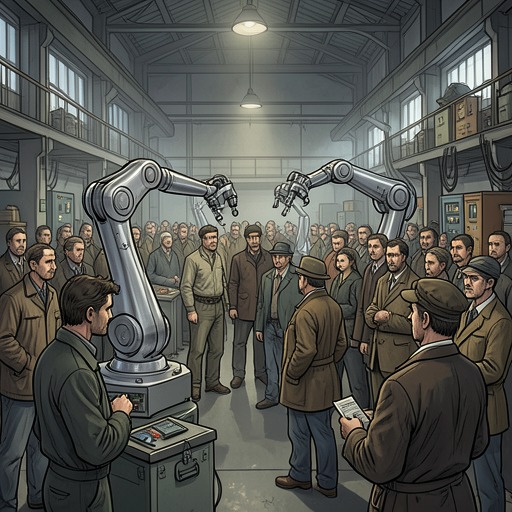
That history explains why the subject returns whenever Baley faces the possibility of losing his own standing. At a shoe store where Earthmade robot clerks contribute to a growing disturbance, he recognizes that the people protesting are afraid of declassification for themselves and those they love. He does not reduce their fear to hostility toward machines: he knows, from his own family, what status loss can set in motion. At the same time, he is a police officer expected to contain the disturbance, making him responsible for enforcing order among people whose fear he can share.
Labor displacement and institutional pressure
The threat is also linked to the spread of robots into work once done by humans. Commissioner Julius Enderby warns Baley that R. Sammy is only a beginning: robots can run errands, patrol expressways, and eventually do the work of people like Baley and the Commissioner. If human workers are replaced, they may be pushed into the labor pool and lose status. Enderby presents the process as already underway over the twenty-five years since the Spacers arrived, and argues that a failed investigation into the murder of a Spacer could accelerate it, while a successful one might postpone the danger. The case is consequently framed not only as police work but as a matter of Baley’s livelihood and rating.
Baley’s promotion is made part of that pressure. Enderby asks whether he wants a C-6 rating, and Baley admits that he does, while asking what would happen if he failed to solve the case. The promotion would bring specific benefits for him and Jessie, but the offer also binds professional success to his family’s material security. Declassification hangs over the investigation as both a possible consequence of broader labor change and a personal penalty should Baley’s career collapse.
The pressure becomes especially immediate when Jessie suggests that Baley could leave the case and return to other work. Baley refuses: resigning in the middle of an important investigation could mean declassification for cause. He explains that the Civil Service would not take men declassified for that reason, leaving manual labor as the only work available to him—and, in turn, to Jessie. Bentley would lose inherited status as well. Jessie says she is not afraid, but Baley’s fear is rooted in the memory of his father’s decline, and he cannot treat the threat as a reversible setback or an easy career change.
A political economy of displacement
The novel connects the city’s hierarchy to the political project of introducing robots on Earth. Han Fastolfe explains that the effort to introduce robots is intended to unsettle the city economy and create a group of displaced, declassified people who might become a nucleus for colonization. He compares them to the men drawn from prisons for the ships that helped settle ancient America: people with little to lose on Earth might find worlds to gain by leaving it. Fastolfe acknowledges, however, that the plan is not working as intended. Earthmen’s resentment of robots obstructs the transition, although robots could also help humans adjust to unfamiliar worlds and make colonization practical.
This proposal gives declassification a double political meaning. For the people who undergo it, it is an immediate loss of security and status; in Fastolfe’s account, it is also a means by which a larger population might be redirected away from Earth. The rationale does not cancel the human cost. It sharpens the conflict between a long-range colonial scheme and the lives of people whose existing place in the city is being made less secure in order to produce candidates for departure.
Dependence, rights, and significance
The declassified are not wholly outside the city’s systems: they remain subject to the conditions of urban life, but with reduced access to its protections and conveniences. Their existence is described as a bare possibility, while status determines the increments that make daily survival more comfortable. This gap between continued inclusion and diminished security gives declassification its force: people can remain within the city while being pushed toward the edges of work, opportunity, and material ease.
Status loss can also affect whether a person’s word counts. Baley points out that a robot cannot serve as a witness in an Earth court because robots have no legal status there. That distinction is not identical to declassification, but it places rating within a broader world where formal standing determines whose evidence and claims receive recognition. The novel’s treatment of declassification likewise makes status more than a label: it is a practical framework for distributing opportunity and a source of fear whose effects pass from one generation to the next.
For Baley, the possibility of declassification links the political debate over robots to his father’s history, his own police career, and his family’s future. Its meaning emerges through concrete thresholds—an expressway seat, a place in the food queue, an apartment, a school path, an eligible job—rather than through rank alone. The system’s ordinary comforts are also instruments of pressure: once people and families depend on them, losing status becomes a danger that can shape choices long before the loss actually occurs.