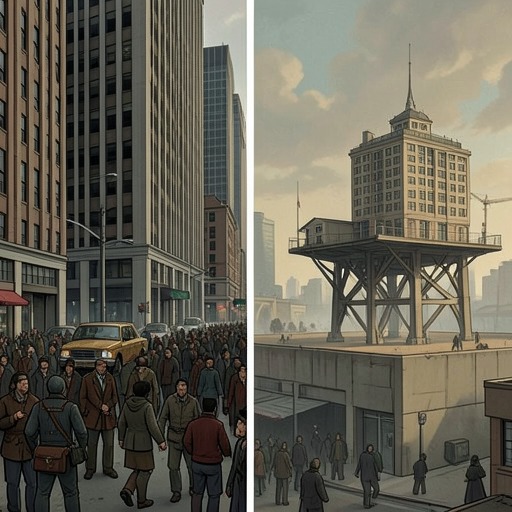
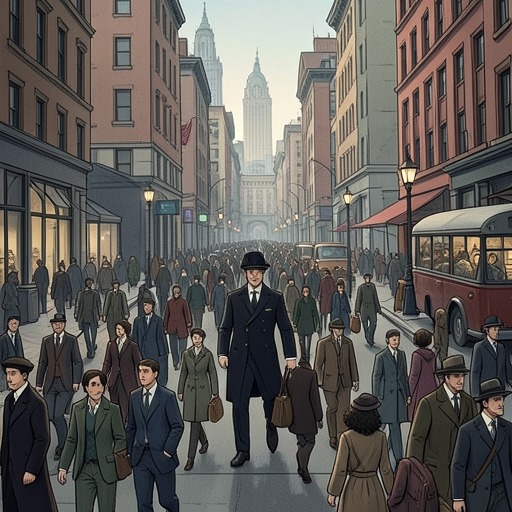
Disease differences between Earth and the outside world
The Caves of SteelThe disease divide between Earth and the Outer Worlds is both a consequence of radically different microbial environments and a force shaping political and social relations. Spacers’ distance from Earth people is not simply disdain: they fear infections to which they have little or no resistance. Yet admitting that fear could weaken the prestige on which their position among Earth’s hostile population depends, so a practical health precaution becomes entangled with an unequal and mistrustful relationship.
Biological Origins of the Divide
The Outer Worlds became free of the disease agents that had shaped life on Earth. The first Earth colonists brought microbes with them, but they also possessed advanced medical and microbiological techniques. Their communities had relatively few microorganisms to contend with and no intermediate hosts, while the absence of mosquitoes and snails prevented the spread of diseases such as malaria and schistosomiasis. Disease agents were eliminated, and symbiotic bacteria were allowed to grow. As the Outer Worlds became disease-free, their entry requirements for Earth immigrants grew increasingly rigorous: the less the populations could endure an introduced infection, the more carefully they had to control contact.
That history left Spacers biologically vulnerable in a way Earth people were not. They remained susceptible to degenerative illnesses such as atherosclerosis, but Dr. Han Fastolfe explained that he had never had what an Earth person would call a cold. Without the antibodies built up through ordinary exposure to Earth’s microbes, he could be at risk of dying from an infection that an Earth resident’s body usually kept under control. Baley, for his part, was understood to carry germs associated with almost every known disease, even though his developed antibodies generally kept them in check. The contrast is therefore not between health and sickness in the abstract, but between populations whose bodies have adapted to sharply different disease environments.
Precautions at the Border
The difference is enforced through procedures at the boundary of Spacetown. Before entering, Baley is expected to shower; R. Daneel explains that this is customary for City dwellers and that Spacetown has no facilities for their personal hygiene. The instruction is practical rather than ceremonial: it reduces the chance that a visitor will introduce disease into a community with little defense against it. Baley also undergoes a blood analysis during the admission process, a measure that makes the boundary’s scrutiny bodily and specific rather than merely symbolic.
Fastolfe describes the protections he observes even while meeting Baley: he lives in Spacetown, avoids entering the City, meets City dwellers only in a strictly limited fashion, and wears filters in his nostrils and gloves on his hands when exposed to the open air. He is determined to come no closer to Baley than necessary. These details give visible form to a risk that would otherwise be mistaken for social coldness. The precautions govern where a Spacer can go, how close he can stand to an Earthman, and what forms of contact are considered safe.
Fear, Prestige, and Misunderstanding
Baley recognizes that disease helps explain why Spacers would not willingly enter a City. Their anxiety is compounded by the City’s size and crowds, but the physical danger of infection offers a separate and decisive reason to avoid it. R. Daneel acknowledges that fear of an unknown disease is itself powerful, while explaining that Dr. Roj Nemennuh Sarton nevertheless believed he needed intimate knowledge of Earth people and their way of life. Sarton’s effort to overcome the division placed him in tension with the biological and psychological barriers that kept Spacers apart.
The precautions are not openly explained to Earth people. Fastolfe says that Spacers are few and already disliked as foreigners. Their safety depends in part on a precarious prestige as a superior class; openly admitting that they are afraid to approach Earthmen could cost them that standing. He therefore presents their aloofness as self-defense while recognizing the political cost of concealment. Baley points to the resulting contradiction: Earth people resent the supposed superiority that Spacers rely on to protect their position. Fastolfe calls it a dilemma, because honest disclosure might lessen misunderstanding but could also damage the status that allows the small Spacer population to maintain its safety.
Humanoid Robots as an Attempted Bridge
Disease is part of a larger obstacle to direct Spacer participation in City life. Fastolfe says that noise and crowds would have a terrible effect on Spacers, and that for a human Spacer to enter the City would be equivalent to a death sentence. Sarton’s humanoid-robot project arose in response: the robots were designed as substitute men who could enter the City in place of their creators. Their role connects the biological divide to the question of how a Spacer presence can be made possible without exposing human Spacers to the conditions they fear.
The disease boundary also sharpens the novel’s distinctions between bodies and categories. Admission procedures classify the Earth visitor as a potential source of infection; gloves and filters regulate contact; the robot is proposed as a substitute for the human Spacer who cannot safely cross into the City. Yet the precautions have a double meaning in social life. They respond to a real biological danger, but their secrecy lets Earth people read distance as evidence of contempt. The gulf between Earth and the Outer Worlds thus persists not only because their populations have different defenses against disease, but because material vulnerability, political prestige, and incomplete understanding reinforce one another.