Dr. Sarton murder case
The Caves of SteelThe Dr. Sarton murder case is both a murder investigation and a test of authority between Earth and the Outer Worlds. Its apparent clues are difficult to reconcile: no weapon is recovered, an early suspect is cleared, and the investigation eventually turns on what a robot could have done. At the same time, the case places New York’s jurisdiction, Spacetown’s special rights, and the political consequences of any official finding in direct conflict.
Jurisdiction and political stakes
When the Commissioner explains the case to Elijah Baley, he says that the Terrestrial Bureau of Investigation considers it a local matter because Spacetown lies within New York’s city limits. That claim is complicated by Spacetown’s extraterritorial rights. The Spacers can insist on their own investigation and issue whatever report they choose to their home governments, even as Earth authorities regard the case as falling within their jurisdiction.
The disagreement carries diplomatic and domestic consequences. The Outer Worlds could use the murder to demand indemnity payments, while refusing to pay would also risk grave political fallout for Earth’s government. The Commissioner describes the case as a three-day nightmare and says he has conferred with the Mayor, visited Spacetown, and spoken with the federal investigators. The case is therefore not simply a local police inquiry: the power to investigate and the power to make a finding politically consequential do not belong neatly to the same authority.
The missing weapon and the suspect question
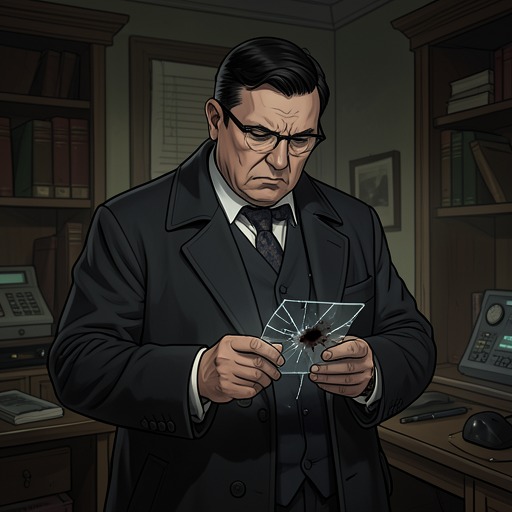
An early City-dweller suspect is quickly cleared. He entered Spacetown through the usual process, under which blasters were removed, and had no blaster in his possession. Investigators also checked every blaster in Spacetown and found that none had been fired for weeks; their examination of the radiation chambers supported that conclusion. The killing weapon is not found, and the investigation establishes that it could not have been concealed somewhere in Spacetown.
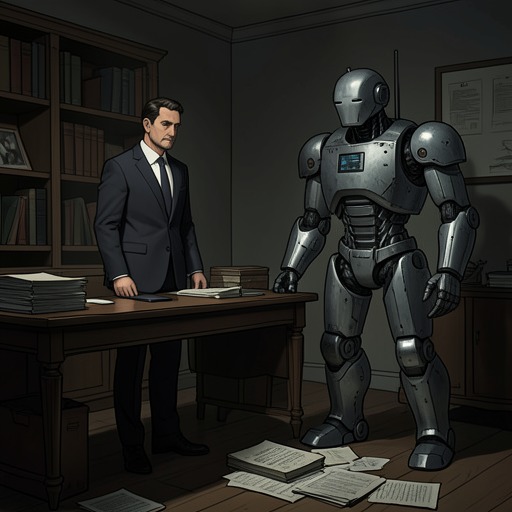
That absence becomes a central clue rather than a resolution. Later, Elijah Baley argues that, among those present at the murder scene, R. Daneel Olivaw alone could have hidden the weapon unless an Earthman had crossed open country carrying it. Baley notes that the scene had been searched minutely and reasons that the blaster must have been somewhere investigators would not think to look. The weapon’s disappearance thus shifts suspicion toward the robot and makes the circumstances of the scene, rather than possession of a recovered firearm, decisive to Baley’s theory.
A murder within a larger design
The case’s apparent premise is later challenged by Han Fastolfe’s account of an elaborate deception. Fastolfe says that a robot built to resemble Dr. Sarton was destroyed and its remains shown to Commissioner Julius Enderby. In the same scheme, R. Daneel Olivaw impersonated Dr. Sarton in the false murder, while the real Dr. Sarton was made to impersonate R. Daneel in the supposed investigation of that false murder. Fastolfe describes Baley as a witness whose account cannot simply be erased and says the Earth government could report the scheme to the Outer Worlds if necessary.
This account makes the case’s central uncertainty more radical than a question of who fired a weapon: it calls into question what the supposed victim and the apparent evidence actually were. Fastolfe disputes Baley’s deductions by asking him to suppose that R. Daneel is genuinely a robot and that the corpse seen by Enderby was really Dr. Sarton. Baley answers that Enderby is not a robotics expert and could not rule out the possibility of multiple robots. The competing accounts make identity, observation, and the credibility of witnesses part of the case’s evidence problem.
Evidence, law, and the City
Baley points out that R. Daneel’s testimony would have no standing in an Earth court if the robot’s nature were disclosed: a robot has no legal status there as a witness. That limitation matters even if R. Daneel can recognize individuals whom a human witness might fail to distinguish. What can be known and what can be admitted as proof are not the same; the case turns on evidence whose most capable observer might be disqualified by the very fact that makes the observation possible.
The conflict unfolds in a society organized around immense, self-contained Cities. New York covers more than two thousand square miles and has a population exceeding twenty million; Earth has roughly eight hundred Cities, averaging ten million people each. Each City concentrates administration, residential Sections, transport, factories, hydroponics, yeast production, power, water, and communications within a vast steel-and-concrete enclosure. Its apparent self-sufficiency conceals a growing dependence on continuous inputs and outputs: New York needs water and waste to keep moving, uranium for its nuclear plants, wood pulp for yeast vats, minerals for hydroponics, and uninterrupted air circulation. Against this background, Fastolfe says that Spacetown’s attempt to introduce robots deliberately disrupts the City economy, producing displaced and declassified people who might form a nucleus for colonization. The murder case therefore sits within a larger dispute over Earth’s economic stability, robotization, and humanity’s future beyond Earth.
Consequences and significance
The case brings several kinds of authority into collision: New York’s jurisdiction, Spacetown’s extraterritorial rights, the Outer Worlds’ capacity to impose diplomatic costs, and Earth’s rules about who may testify. Its unsolved-looking physical clue—the missing blaster—does not stand apart from those pressures. It becomes meaningful only through competing accounts of who was present, who could have moved it, and whether the apparent murder and its witnesses can be trusted.
By connecting a single killing to legal exclusion, interplanetary leverage, and the precarious workings of City life, the case makes investigation inseparable from the systems that determine whose account counts. A verdict would do more than name a culprit: it could validate one political authority, expose a deception, and intensify the conflict over whether Earth should preserve its existing order or accept changes intended to make outward migration possible.