Earth
The Caves of SteelEarth is not simply humanity’s home world in The Caves of Steel: it is a crowded, enclosed civilization whose reliance on robots and suspicion of cultural difference have become matters of interplanetary politics. Its eight billion inhabitants, mostly concentrated in Cities, are set against the far smaller populations and different traditions of the fifty Outer Worlds. The strain between those societies gives the planet’s physical organization a political meaning: breaking Earth’s shell is presented as a way to push its people toward renewed expansion and colonization.
A world organized around the Cities
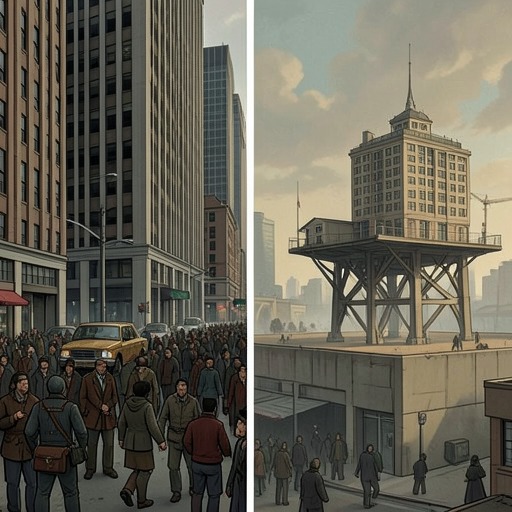
The City represents humanity’s mastery of its environment more decisively than space travel or the colonization of fifty worlds. Almost none of Earth’s population lives outside the Cities. Beyond them lie open wilderness and sky, spaces that few people can face with equanimity; the exterior is not an inviting alternative to urban life but a difficult and unsettling domain.
Yet the land beyond the Cities remains indispensable. It holds the water people need, the coal and wood used as raw materials for plastics and for the continually expanding yeast industry, and the mines that supply other resources. Petroleum is gone, but oil-rich yeast strains serve as a substitute. Farms and grazing land also remain in use more extensively than most people realize. Their production is inefficient, and beef, pork, and grain have become luxury goods with export markets, but the open country has not ceased to sustain the urban order.
The work of extracting and moving those resources requires relatively few people. Mines, ranches, farms, and water-piping operations are supervised at long distance, while robots do the labor more effectively and with fewer demands. Earth’s cities therefore depend on an exterior landscape that most inhabitants rarely occupy, and on mechanical workers that complicate the planet’s relationship with its own technological history.
Population, robots, and the Outer Worlds
Earth’s population is eight billion, a scale that makes its social arrangements difficult to compare with those of the Outer Worlds. In a conversation with the Commissioner, Elijah Baley argues that eight billion people cannot be spread across Earth in small domes and that the Spacers, with room on their own worlds, should be allowed to live according to their own customs. The exchange frames cultural difference as a practical condition of life on an overcrowded planet, not merely an abstract disagreement.
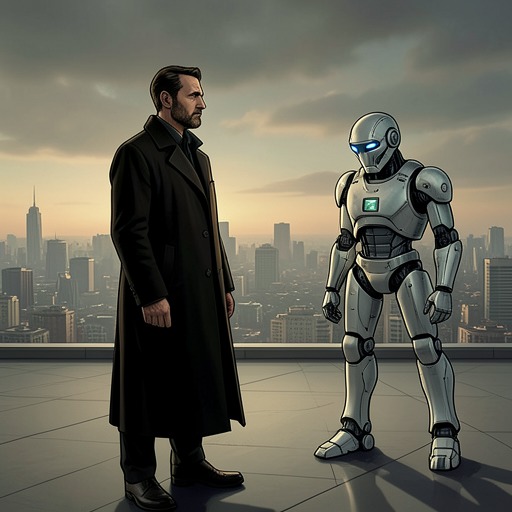
The imbalance is also a source of political anxiety beyond Earth. R. Daneel Olivaw explains that continuing failure on Earth has strengthened Nationalist parties on the Outer Worlds. Their argument is that Earthmen differ from Spacers and cannot be fitted into the same traditions; they warn that imposing robots on Earth by superior force would bring destruction to the Galaxy. Daneel emphasizes the demographic disparity behind that warning: Earth alone has eight billion people, while the fifty Outer Worlds together have scarcely more than five and a half billion.
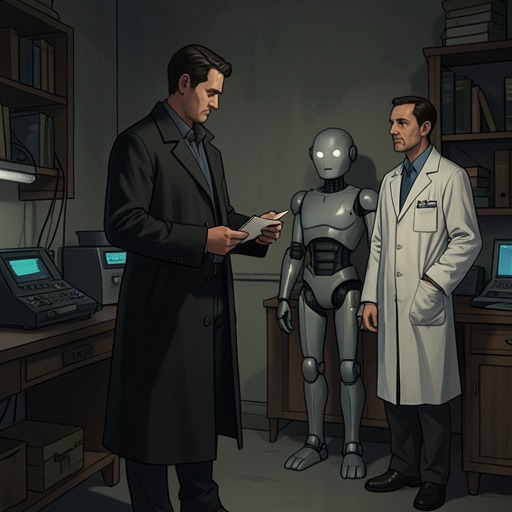
Earth’s position in the history of robotics sharpens the irony. The positronic brain was invented there, and robots were first put to productive use there, yet robots now perform work that leaves relatively few humans needed in the mines, fields, and other resource operations. The technology is both a product of Earth and a source of tension over Earth’s future. In Baley’s discussion with Dr. Gerrigel, the distinction between conditions on Earth and those on the Outer Worlds becomes explicit: Gerrigel can speak to the terrestrial situation, but says he cannot claim firsthand knowledge of whether non-Asenion positronic brains have been designed or their mathematical theory worked out elsewhere.
Cultural hostility and political power
The conflict between Earth and the Spacers is not only a debate about numbers, labor, or custom. It is also expressed through mutual judgments of bodily difference. Earth’s mockery of the Spacers takes the form of hundreds of verses, ranging from witty to stupid and obscene, but all ending with the refrain “Dirty Spacer, do you hear?” The taunt throws back at the Spacers the insult most keenly felt by Earth’s people: the Spacers’ insistence that Earth’s natives are disgustingly diseased.
That verbal hostility is backed by a stark imbalance in power. The Spacers do not leave in response to the abuse, and they need not bring their offensive weapons into play. Earth’s outmoded fleet has learned that approaching an Outer World ship means suicide; aircraft that ventured over the Spacetown area in its early days disappeared, sometimes leaving only a shredded wing tip to fall back to Earth. The memory of subetheric hand disruptors, used against Earthmen in wars a century earlier, also places a limit on what an enraged mob can do. Earth’s hostility is therefore neither evidence of military strength nor a path to removing the Spacers: it is a public expression of resentment under conditions of overwhelming strategic disadvantage.
Spacetown and the pressure to expand
R. Daneel states the purpose of Spacetown in direct political terms: its people are there to break the shell surrounding Earth and force its inhabitants into new expansion and colonization. The phrase identifies Earth’s enclosure as more than a physical arrangement. It is a condition that Spacetown’s representatives believe must be changed, even if Earth’s people do not share that objective.
The investigation of Dr. Sarton’s murder is entangled with this larger contest. Daneel tells Baley that the Spacers’ desire to exact punishment is not an attempt to bring Sarton back to life. Failure to pursue the matter, he explains, would strengthen politicians on their home planet who oppose the very idea of Spacetown. The murder case consequently bears a political burden beyond establishing responsibility for a death: its handling may affect whether the Outer Worlds’ project of engaging Earth can continue.
Earth’s defining contrasts converge here. Its enormous population makes its circumstances unlike those of the Outer Worlds; its Cities shelter most of its people from an exterior landscape that nevertheless supplies essential materials; and its robots make daily production possible even as their imposition becomes a disputed political proposal. The effort to break Earth’s shell is thus a struggle over more than geography. It is a confrontation between ways of life, with Earth’s scale and isolation shaping both the objections to change and the consequences of leaving the existing order intact.