Earth city rating and declassification system
The Caves of SteelThe Earth city rating and declassification system turns social status into a daily allocation of access and security. Ratings determine practical advantages such as transport seats, food choices, housing prospects, and family opportunities; declassification can strip those advantages away and leave a person exposed to precarious work and reduced standing. Through Elijah Baley’s family history and the threat of robot replacement, the system links intimate fear to the organization of the City and the future of human labor.
Ratings and Everyday Privilege
A rating is not merely a mark of prestige: it changes the conditions of ordinary life. Elijah Baley is a C-5, and the prospect of reaching C-6 matters because it could give him an expressway seat during rush hour rather than only between ten and four, improve his position on the Section kitchens’ list of choice, and perhaps bring a better apartment and a quota ticket for Jessie Baley to visit the Solarium levels. These are modest privileges in isolation, but together they make status tangible in the daily routines through which the City distributes comfort and opportunity.
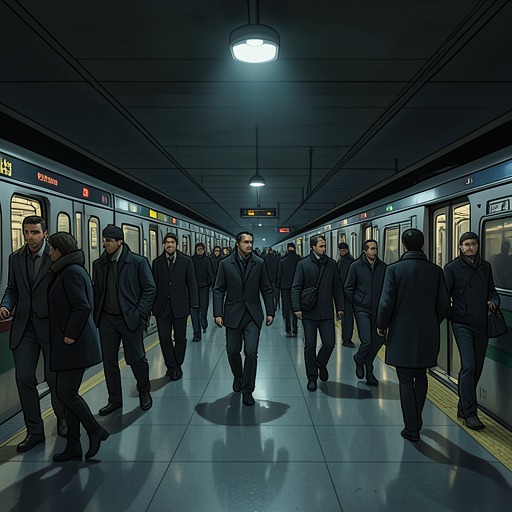
The rules are enforced in ordinary public space. On the expressway, a C-5 has no right to a seat east of the Hudson and west of Long Island; a way guard could remove Baley even when seats were available. Baley recognizes that people can become petty about these distinctions and includes himself among them. The episode shows how the rating system works not only through official decisions but through routine expectations about who may occupy a scarce convenience.
Status also sets the boundary between a bare minimum of survival and a more comfortable life. Even a person entirely declassified retains the bare possibility of existence in a modern City, but rating brings the small advantages that make existence less burdensome: a more comfortable seat, a better cut of meat, or a shorter wait. The system’s power lies partly in the scale of these benefits. Each may seem too slight to justify great effort, yet surrendering privileges already acquired still carries a real cost.
Declassification and Family History
Baley’s fear of falling in status is grounded in his childhood. His father, once a highly rated nuclear physicist, was blamed after an accident at a power plant and declassified. Baley was only a year old when the incident occurred, and he does not know its details, but he remembers the circumstances that followed: his father’s lost status, the family’s difficult life in the barracks, and his father’s death while still declassified when Baley was eight.
After his father’s death, Baley and his two older sisters entered the Section orphanage, known as Children’s Level. Their maternal uncle, Boris, was too poor to prevent it. Baley later had to make his way through school without the status privileges that might have come from his father. The system therefore appears in the novel not as an abstract ladder alone, but as a force that can alter a family’s living conditions and shape a child’s prospects across years.
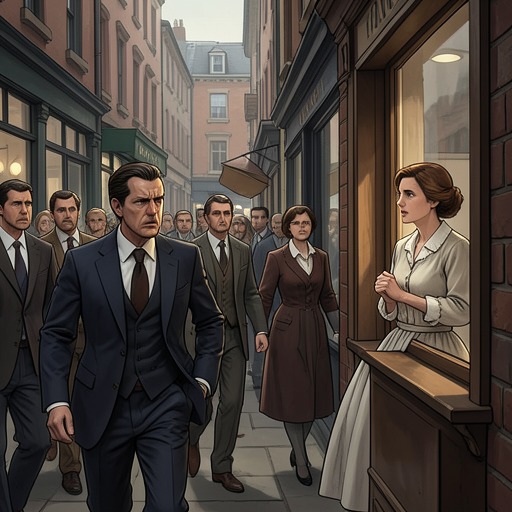
That history informs Baley’s response to people who fear declassification for themselves and their loved ones. During a growing disturbance, he must try to prevent the crowd from harming clerks, while recognizing that the people confronting them fear the same loss that once marked his family. His authority in that moment does not erase his identification with those at risk: he understands the fear from personal experience even as he has to act against the crowd.
Work, Robotization, and the Threat of Loss
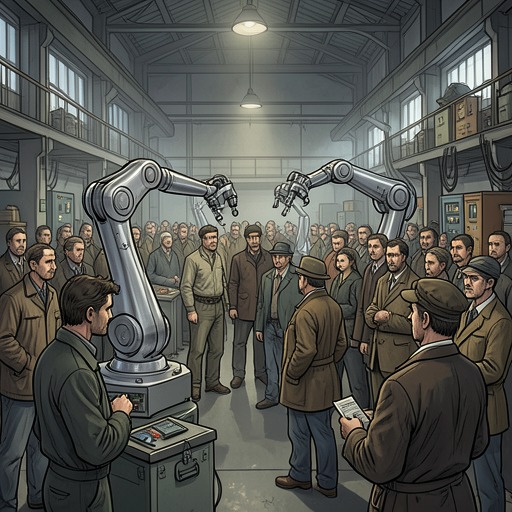
The rating system becomes especially consequential when the Commissioner explains that robots may replace human police workers. R. Sammy already runs errands, the Commissioner says, and other robots could patrol the expressways; there are robots capable of doing the work of Baley and his superior. If that process advances, human officers could be declassified and pushed into the labor pool. The Commissioner warns that the replacement trend has been developing for twenty-five years, since the Spacers arrived, and is only now beginning to reach higher-status work.
The case Baley is assigned thus carries a personal stake alongside its investigative duty. The Commissioner argues that mishandling it could bring the point at which officers lose their pension-tab booklets closer, while handling it well might postpone that outcome. He presents the assignment as a chance for Baley to prove himself and seek a C-6 rating. Baley wants the promotion, but asks what he would receive if he failed to solve the case; his ambition is inseparable from the risk that a professional setback could become a loss of status and security.
This pressure is part of a wider argument about the City’s future. New York City covers more than two thousand square miles and has a population of well over twenty million; Earth has about eight hundred Cities, averaging ten million people each. These largely self-sufficient urban units depend on organized flows of water, waste disposal, nuclear power, wood pulp for yeast vats, minerals for hydroponics, and continuously circulated air. The City’s capacity to distribute food and sustain its population is formidable, but its dependence on uninterrupted inputs makes that capacity fragile. Against this background, robotization is not only a question of who holds a particular job: it is bound up with the social order that allocates work, status, and security in a system under strain.
Status, Classification, and Exclusion
The novel also connects ratings to distinctions between people and other beings. At Spacetown, admission procedures treat City dwellers as requiring special precautions: R. Daneel Olivaw tells Baley that visitors should shower before entering and that there are no personal-hygiene facilities for City dwellers inside. Baley’s blood is then analyzed as part of the examination process. These procedures make classification concrete through regulated access and bodily inspection, marking the boundary between the City population and the Spacers.
That boundary has consequences beyond entry. During Baley’s confrontation with Han Fastolfe, Fastolfe points out that Baley has not tested whether R. Daneel is a robot, suggesting practical ways to distinguish a humanoid robot from a human. Later, Baley objects that R. Daneel would have no standing as a witness in an Earth court if his identity as a robot were disclosed. The contrast is pointed: a system that assigns human beings different levels of civic privilege also withholds legal credibility from a robot, making formal identity a determinant of what evidence can count.
The rating system’s broader significance emerges from these linked distinctions. It orders access within the City, makes the threat of downward mobility part of employment and family life, and operates alongside other boundaries that govern entry and legal recognition. Its privileges are small enough to pass as routine, yet consequential enough that Baley’s family history and his investigation are shaped by the possibility of losing them.