Earth—Spacer Worlds relations
The Caves of SteelEarth—Spacer Worlds relations are marked by an unstable mixture of dependence, intervention, and resistance. Earth’s Cities represent an immense achievement in environmental control, yet their intricate infrastructure leaves them vulnerable to interruption. Spacetown’s effort to alter Earth’s economy through robots is therefore more than a technological program: it is also a contested attempt to redirect human society toward colonization. The debate turns on whether that intervention offers a way out of Earth’s constraints or threatens people whose lives and status are bound to the City system.
Earth’s City System and Its Dependencies
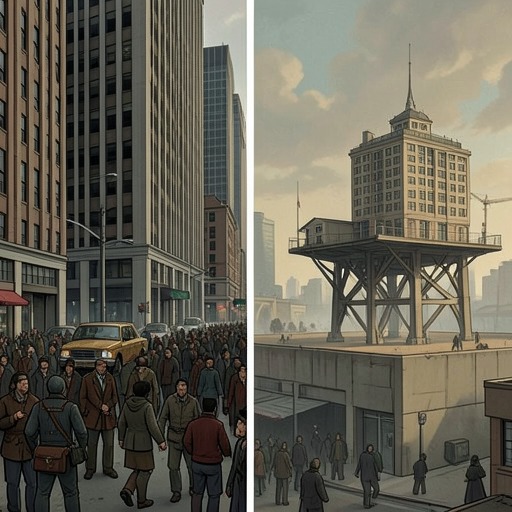
City culture transformed Earth by drawing villages and towns into vast urban centers. New York City covered more than two thousand square miles and had a population well above twenty million; Earth contained about eight hundred Cities, averaging ten million inhabitants each. Each City was nearly self-sufficient in economic organization and could roof itself, fortify its perimeter, and burrow underground, becoming a self-contained structure of steel and concrete.
That apparent autonomy rested on dense internal coordination. Administrative offices occupied the center, residential Sections were linked by expressways and local ways, and factories, hydroponic plants, yeast-culture vats, and power plants tended toward the outskirts. Water pipes and sewage ducts, schools, prisons, shops, power lines, and communication beams ran through the whole. The City was celebrated as humanity’s culmination in mastering its environment, even above space travel and the fifty colonies that had become independent. But mastery came through interconnection, not freedom from external supply.
The precariousness of that arrangement is made explicit in the account of New York’s daily needs. Water must continuously enter and waste leave; nuclear plants require uranium, increasingly difficult to obtain even from other planets in the same system; yeast vats need wood pulp, and hydroponic plants need minerals. Air must circulate without pause. These inputs form a delicate balance, and a disruption of the City’s flows for even an hour is posed as a threat to its survival. The historical comparison sharpens the change: older population centers could rely on neighboring farms, and even large open cities in Medieval times could last at least a week on stores and emergency supplies. New York, once able to live on itself for a day, can no longer do so for an hour. Urban achievement and systemic exposure have grown together.
Spacetown’s Economic Intervention
Spacetown explains its policy toward Earth as an effort to introduce robots and thereby disturb the balance of the City economy. Baley identifies the immediate social consequence: the creation of displaced men who may lose their social rating and standing. The response is not that such displacement is harmless, but that it serves a larger project. Spacetown regards these men as a potential nucleus for colonization, reasoning that people with little to lose on Earth may have worlds to gain by leaving it.
This argument makes the relationship more complicated than a simple conflict between a technologically advanced power and an unwilling planet. The robot program acts on Earth’s employment and status structures, while colonization is offered as the destination for people those structures displace. The rationale treats the City as having failed those men by leaving them without prospects, but it also makes their economic vulnerability useful to a plan devised with Spacetown’s aims in view. The prospect of a new life is therefore inseparable from a deliberate disruption of life at home.
The policy has also been pursued through cooperation with Earth’s planetary and City governments. Later, R. Daneel Olivaw explains that Spacetown has tried for twenty-five years to change Earth by changing its economy and to introduce its C/Fe culture. Earth governments cooperated because doing so was expedient. Yet the harder Spacetown pressed, the stronger the opposing Medievalist movement became. The failure is not merely a shortfall in implementation: the intervention itself has helped intensify the resistance it was meant to overcome.
Conflict, Opposition, and Political Misunderstanding
The social costs of the policy are visible in the crowds Baley recalls: people who had once screamed at dirty Spacers, and the threatening crowd outside a shoe store. Thinking that millions might be capable of violence, he also reflects on Julius Enderby as a suspect. His thoughts join broad hostility toward Spacers to the immediate pressures of the investigation, showing how political antagonism can turn suspicion into a personal and institutional crisis.
That hostility is not presented as an abstract disagreement alone. It is attached to the prospect of technological change in a society where people fear displacement and loss of status. At the same time, the City’s dependence on resources supplied from beyond itself makes the claim of complete independence difficult to sustain. The relationship is thus shaped by opposing vulnerabilities: Earth resists outside efforts to reorganize it, while the Cities depend on continuing flows of material and energy they cannot produce alone.
The possibility of cooperation is further complicated by disagreement over how much either side can know about the other. When Baley asks Dr. Gerrigel what is possible in the Outer Worlds, the doctor concedes that he cannot speak from personal knowledge about whether non-Asenion positronic brains have been designed or whether the relevant mathematical theory has been worked out. His uncertainty marks a limit to Earth’s technical knowledge even within an investigation focused on robots. Political relations are therefore also relations of unequal information: claims about the other worlds cannot simply be verified by those who remain on Earth.
Competing Visions of the Future
The argument over colonization becomes a contest over optimism as well as policy. Enderby insists that Earth can continue without robots, declaring confidence in human ingenuity, the possibility of importing uranium or discovering other nuclear processes, and the potential of solar power. He imagines energy-collecting stations inside Mercury’s orbit transmitting power to Earth by directed beam. Baley recognizes the proposal as an old speculative idea, while noting the technical obstacle that a beam could not yet be kept sufficiently tight across fifty million miles. Hope, in this account, is real but does not erase the engineering and resource problems on which the Cities depend.
Spacetown’s final assessment changes the emphasis. R. Daneel Olivaw says that its project is concluded and that it is satisfied Earth will colonize. He describes a shift in tactics proposed by Dr. Sarton: rather than continue trying to change Earth from outside by altering its economy, Spacetown should find a segment of Earth’s population that already wanted the same future, or could be persuaded to want it. Supporting a native movement, instead of imposing a foreign one, might make the project locally rooted. Baley himself had been an experiment in identifying a suitable native element.
This reversal gives the relation its decisive tension. Spacetown’s earlier approach treats economic disruption as a lever for change; its revised approach seeks people on Earth who can carry the desired change themselves. The acknowledgment that the first strategy strengthened the Medievalists makes the shift an admission of political failure, while the prediction of Earth’s eventual colonization preserves the larger objective. Earth is not simply a passive recipient of Spacer policy, nor is it materially independent of the wider system. Its future becomes the ground on which external planning, internal resistance, and the possibility of a locally chosen direction contend.