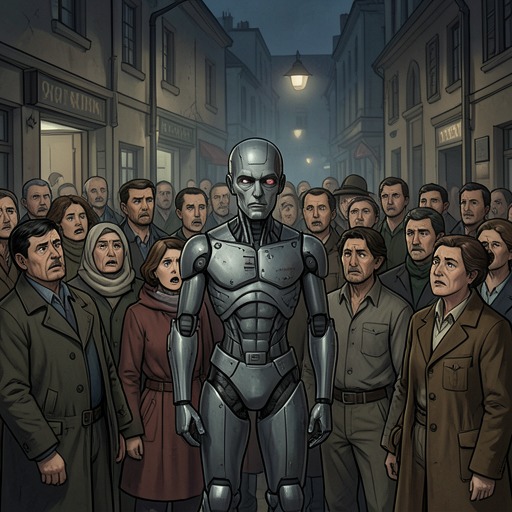
Earth’s anti-robot sentiment
The Caves of SteelEarth’s anti-robot sentiment is both a genuine social hostility and a political instrument: in the investigation of Dr. Roj Nemennuh Sarton’s murder, the Medievalists use the City’s fear of robots to make a deliberate operation look like spontaneous public reaction, redirecting suspicion from its organizers and toward the population at large.
Public Prejudice and Misread Evidence
Elijah Baley challenges the Commissioner’s explanation that people at the shoe counter recognized R. Daneel Olivaw as a robot during the incident there. Baley points to a test that makes that explanation unlikely: Anthony Gerrigel, Earth’s greatest robot expert, met and shook hands with Daneel without recognizing what he was. Gerrigel realized Daneel’s nature only after the conversation turned to humanoid robots. If even an expert failed to identify him without prompting, Baley argues, a crowd caught up in confusion and tension could hardly have been so certain on sight that it would mobilize an entire underground organization.
That discrepancy changes the meaning of the shoe-counter incident. Baley concludes that the Medievalists knew Daneel was a robot before the incident began. The public hostility was not simply discovered in the commotion; the commotion was designed to display anti-robot feeling in the City and, through Daneel, to show Spacetown how strong that feeling was. In Baley’s reconstruction, staging hostility made it possible to blame a broad social mood rather than investigate particular people.
A Weapon in the Sarton Investigation
Baley’s account connects anti-robot feeling to a more specific political aim. He says Julius Enderby, a committed Medievalist who had worked with Dr. Sarton, knew the purpose for which Daneel had been designed and feared that it might eventually draw Earthmen away from Earth. Enderby, Baley argues, sought to destroy Daneel because the robot embodied a challenge to the Medievalist commitment to Earth. A public demonstration of determined opposition could also encourage Spacers to abandon the Spacetown project, especially since opinion in the Outer Worlds already favored ending it.
The prejudice therefore operates on two levels: it can motivate opposition to robots, and it can be cultivated as evidence of a supposedly irresistible popular will. Baley’s reconstruction makes the shoe-counter disturbance part of a strategy to influence Spacetown, not merely an eruption of public anger. The larger target was the future Daneel represented, while the visible target was a robot whose human appearance could draw attention, confusion, and hostility.
Narrative Significance
The investigation distinguishes genuine anti-robot sentiment from its deliberate political staging without treating either as harmless. The incident matters precisely because a recognizable public fear can serve as cover: apparent mass spontaneity obscures foreknowledge, organization, and an individual plan. Baley’s deduction turns the crowd’s reaction from an explanation of events into something requiring explanation itself, exposing how prejudice can be manipulated to redirect blame and pressure political decision-makers.