Earth’s yeast economy
The Caves of SteelEarth’s yeast economy is the industrial food system that sustains Earth’s Cities, converting vast quantities of plant material and chemical additives into staple nutrition and specialized products. It is woven into the routine sameness of city life, the work of millions, and the survival of billions; its efficiency is also inseparable from a fragile dependence on continuous supplies and carefully managed production. The yeast vats are not a marginal industry beneath the City’s surface but one of the structures that make the City possible.
Scale and Urban Setting
The economy belongs to a world organized around enormous, largely self-contained Cities. New York City covers more than two thousand square miles and has a population exceeding twenty million; Earth has roughly eight hundred Cities, averaging ten million people each. These urban units distribute food through centralized systems and make extensive use of yeast and hydroponics. Their built environments place factories, hydroponic plants, yeast-culture vats, and power plants toward the outskirts, connected to residential Sections and administrative centers by expressways and localways.
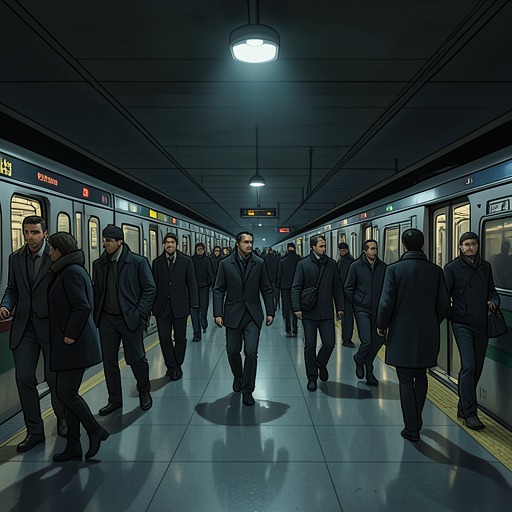
The City is described as a “steel cave,” a roofed and enclosed complex of steel and concrete that can extend above, around, and below its inhabitants. That architecture expresses a promise of comprehensive environmental control, but it also gathers essential services into a tightly interdependent system. Food production is part of that system alongside water, sewage, power, air circulation, transport, schools, and communications. The City’s apparent self-sufficiency therefore depends on the reliable coordination of specialized processes and the arrival of necessary materials.
Production and Dependence
Yeast production begins with bulky supplies of wood and coarse cellulose brought from the forests of the Alleghenies. Acid vats hydrolyze the cellulose into glucose; shipments of niter and phosphate rock provide important additives, while chemical laboratories supply organic compounds. The chain culminates in the cultivation and processing of yeast on a scale measured not merely by factories but by the City’s ability to feed its population.
The labor force reflects that scale. One fifth of the City’s population works on yeast farms, and another fifth in related industries. In a New York Yeast laboratory, cultures of every company strain grow continuously in kettles, with specialists checking and adjusting nutritional requirements, maintaining stable breeding, developing new strains, and eliminating or reshaping others. This work makes the system more than mass production: it is also sustained biological experimentation and quality control.
The resulting products can imitate foods not ordinarily available in their natural form. The laboratory developed the high-sugar yeast culture that gave New Yorkers the appearance and flavor of out-of-season strawberries. It also improved a strain once known for its unpleasant, tallow-like taste, raising its fat content from about 1 percent to 87 percent. That same strain, Saccharomyces olei Benedictae, Strain AG-7, greases the expressway. Yeast thus serves as food, a basis for engineered food substitutes, and an industrial material embedded in the City’s infrastructure.
Everyday Culture and Personal Memory
The economic system has an ordinary, repetitive face. Section kitchens in New York, Washington, Toronto, Los Angeles, London, and Budapest share the same foods and institutional routines. Yeast products are described as much the same from Shanghai to Tashkent and from Winnipeg to Buenos Aires; English, too, has become a common language across the continents, with some variation on the Outer Worlds. Local differences in diet and language have been narrowed by a standardized urban civilization.
That sameness does not make the food culturally empty. For Elijah Baley, the smell of raw yeast carries personal memory. As a child visiting his uncle, a yeast farmer, he was given small yeast confections: chocolate-like cookies with sweet centers and hard candies shaped like cats and dogs. Because his uncle was not supposed to give them away, Baley ate them quietly in a corner, turning the illicit treat into a childhood pleasure. Years later, the aroma of raw yeast still brings the memory back, even though the romantic explanation he once attached to his uncle’s death proved false. The food system’s distinctive smell links large-scale production to private recollection.
Yeast-town and Its Workforce
Yeast-town is a popular name, not an official district. It appears in no gazetteer or official map; administratively, the area is the boroughs of Newark, New Brunswick, and Trenton. Across what was once New Jersey, residential areas—particularly Newark Center and Trenton Center—are interspersed with the many-layered farms where hundreds of varieties of yeast grow and multiply. The name gives a distinct identity to a working landscape that official geography treats as ordinary urban territory.
Its workforce includes people whose expertise is essential to keeping the food system operating. Francis Clousarr identifies himself as a zymologist, not a chemist, and describes the laboratory’s continuous work on New York Yeast cultures. His account emphasizes the precision and responsibility behind everyday products: cultures must breed true, their food-factor requirements must be checked, and strains must be developed, sorted, and reshaped. Baley’s response is to retreat, despite himself, before Clousarr’s fierce professional pride. The exchange briefly makes visible the skill and self-understanding concealed behind the City’s standardized food supply.
Fragility and Political Stakes
The Cities’ food system depends on a continuous flow of resources. New York must keep water entering and waste leaving; its nuclear power plants require uranium supplies that are becoming harder to obtain, while their needs continue to grow. The yeast vats require incoming wood pulp, and hydroponic plants need minerals; air must circulate without interruption. The balance among these systems grows more delicate each year. A City that now cannot sustain itself for even an hour is less resilient than earlier settlements that could draw on local farms or keep emergency stores.
The dependence gives yeast production an importance far beyond dietary preference. Six of Earth’s eight billion people would starve within a year without it. That fact changes the meaning of the farms, laboratories, transport routes, and supply chains: disruption is not simply a decline in convenience or variety but a threat to mass survival. The City’s food abundance rests on repeated, coordinated inputs rather than on an independent natural reserve.
This dependence also enters the conflict over robots and employment. Spacetown’s effort to introduce robots on Earth is described as an attempt to upset the balance of the City economy. The resulting displacement is defended as a means of creating a nucleus for colonization: people with little to lose on Earth might have worlds to gain elsewhere. At the same time, Baley’s own family history makes the threat of lost status concrete. His father, once a highly rated nuclear physicist, was declassified after an accident at a power plant and died still declassified; Baley and his sisters then grew up in an orphanage. In a society where status governs access to better food, transport, housing, and other advantages, technological change threatens not only employment but a precarious structure of everyday security.
The yeast economy therefore embodies both the City’s achievement and its dilemma. It makes food available to a vast population through centralized expertise and engineered biological production, while binding that population to delicate networks of energy, raw materials, labor, and transport. Its abundance is real, but it is maintained rather than guaranteed: the City can feed billions only so long as the system keeps running.