Elijah Baley
The Caves of SteelElijah Baley is a New York City plainclothes police officer whose investigation of Roj Nemennuh Sarton’s death places him at the intersection of local policing, Spacer jurisdiction, and Earth’s political future. A practical, tenacious investigator wary of robots and the Outer Worlds, he comes to rely on R. Daneel Olivaw as a partner; by the end, he has not only identified the murderer but argued that cooperation with Spacetown is essential to Earth’s survival.
Identity and Assignment
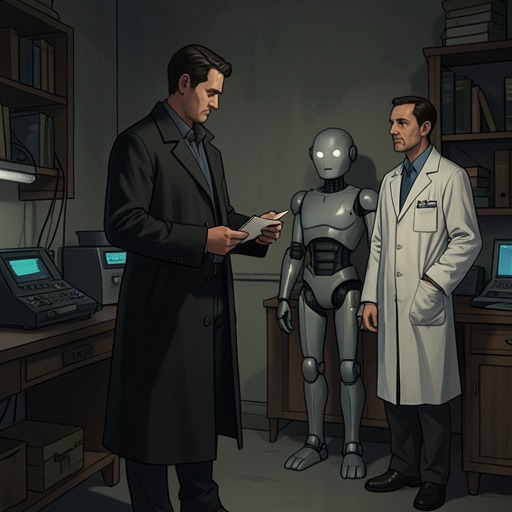
Baley enters the story as a city officer arriving at his desk, where R. Sammy is waiting for him. His professional standing is specified when he presents himself at Spacetown Approachway as a New York City plainclothes man, Rating C-5. He is apprehensive about meeting a Spacer robot, having known Earth-model robots but never encountered one of the formidable machines rumored to work on the Outer Worlds.
The case is already three days old when Commissioner Julius Enderby briefs him. Roj Nemennuh Sarton, an Auroran resident of Spacetown, has been murdered, and the Spacers suspect an Earthman. The Terrestrial Bureau of Investigation has left the matter to New York City because Spacetown lies within city limits, although the Spacers retain extraterritorial rights. Their ability to conduct their own inquiry and report to their home governments could bring indemnity demands from the Outer Worlds, making the case dangerous well beyond the police department.
Enderby assigns Baley to lead the investigation at a moment when Earth’s established livelihoods already feel threatened by replacement. He warns that mishandling the case could bring forward the day when officers can no longer look forward to their pension-tab booklets; a successful investigation might push that danger further away. The personal stake is joined to the diplomatic one: Baley’s work must produce an answer that can hold amid competing jurisdictions and political pressure.
Investigative Method and the Case
Baley presses Enderby to stop circling the subject and explain the trouble, addressing his superior by his first name despite their usual office formality. That directness marks his working manner: he wants the relevant facts, not a softened preamble. When he later reviews the case with R. Daneel, he begins from what can be established—that Sarton was killed by an unknown person or persons—and asks whether the Spacers connect the death to sabotage of their proposed integrated human-and-robot society. He understands that their suspicion of an organized terrorist group makes the murder part of a larger political contest, but he treats that theory as something to test rather than a conclusion.
His reasoning turns on details that acquire meaning through their relation to one another. When Baley is framed, he asks why anyone would want him removed from the investigation. The likely answer, he reasons, is that he is dangerous to the murderer. He considers whether the inner group of the Medievalists could know he had passed through the Williamsburg power plant and whether someone from that group might have followed him along the moving strips. If the effort to discredit him is connected to the Sarton case, identifying the murderer could also identify those trying to silence him. The two problems are therefore not separate: solving the murder may be his way out of the frame-up.
At 23:00, Baley tells R. Daneel that he knows who is framing him, how Sarton was killed, and by whom, and that he has an hour to explain the case, catch the culprit, and end the investigation. The compressed deadline gives his deductions an immediate practical purpose. He does not merely want to establish a theory; he must make it persuasive and act before the investigation is closed.
Partnership and Evidence
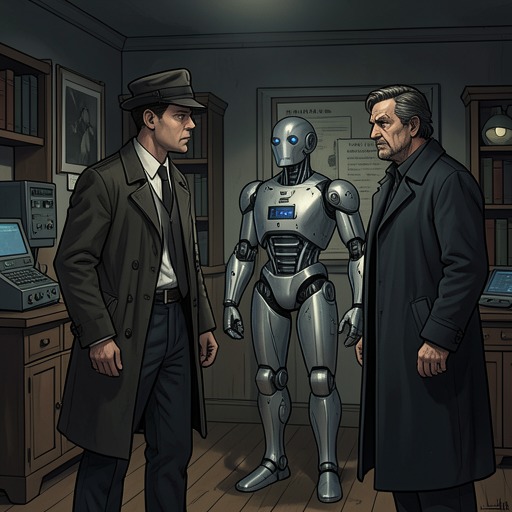
Baley’s relationship with R. Daneel changes as the case tests both his assumptions and his need for a reliable ally. Early on, he approaches the robot with distrust rooted in the gap between familiar Earth models and the powerful Spacer machines he has heard about. Later, while underground in New York City, the remembered tale of the Wandering Londoner leaves him uneasy; R. Daneel warns that they may be overheard, and Baley replies that there is no chance of it before turning to the Commissioner. Even in moments of apprehension, the investigation continues through their exchanges.
The partnership becomes personally important when Baley believes he is being framed. He recognizes R. Daneel as strong and faithful, without selfish interests, and values him as a friend despite the fact that he is a robot. That trust matters because Baley’s predicament is not only professional. He fears for Jessie and believes he has little time; R. Daneel is a companion on whom he can depend while he tries to connect the conspiracy to the murder.
Their alliance also faces a legal limit. Baley points out that R. Daneel could not serve as a witness in an Earth court if he disclosed that he was a robot: robots have no legal standing there. The limitation makes the distinction between knowing what happened and proving it consequential. R. Daneel can offer support and information, but Baley must find a case the human authorities and political actors cannot simply dismiss.
Enderby, the Murder, and the Confrontation
Baley confronts Enderby with the claim that the Commissioner had been at the Williamsburg power plant, obtained the Alphasprayer, and gave it to R. Sammy, intending to incriminate him. He also alleges that Enderby used Dr. Gerrigel’s return to bring him to the department and directed him with a deliberately maladjusted guide rod toward the photographic supply room, where he could find R. Sammy’s remains. In Baley’s account, Enderby’s actions were meant both to place Baley in trouble and to obstruct the Sarton investigation; R. Sammy had also learned too much about how a Spacer had been killed.
Baley then names Enderby as Sarton’s murderer. R. Daneel immediately says that this theory is untenable, because the Commissioner could not have killed Sarton. The disagreement forces Baley to distinguish between Enderby’s attempted frame-up and the actual death. His explanation is that Enderby, at Sarton’s dome, took off his glasses while nervous and dropped them. When the door opened, he saw a figure that resembled R. Daneel and fired. The figure was Sarton, who had designed R. Daneel in his own image; without his glasses, Enderby mistook one for the other. The dropped and damaged glasses, earlier a source of inconvenience to Enderby, become central to Baley’s reconstruction of the fatal misidentification.
Baley has no court-ready evidence that he considers sufficient, so he forces a hearing of his explanation rather than presenting the accusation as an already proven legal case. He holds a cocked blaster on Enderby and insists that the Commissioner listen before deciding what to do with him. R. Daneel strengthens the pressure by explaining that he is in communication with Dr. Han Fastolfe and that refusing to hear Baley could invite damaging political inferences. The confrontation exposes how an investigation constrained by evidence rules and jurisdiction can depend on informal leverage as well as official procedure.
Outcome and Significance
After Enderby becomes unconscious, Baley tells R. Daneel that he had only inferences, not evidence that would stand up in court, and that he had hoped the Commissioner would break down under questioning. Enderby does confess, Baley says, and R. Daneel confirms that he heard it. When Enderby regains consciousness, he calls the killing an accident and asks Baley to explain it that way. Baley answers that Enderby can make amends by helping Spacetown’s project and by quashing the R. Sammy matter, which he urges him to end as an accident or something similar. He also warns that Spacetown knows the truth and that removing Baley would ruin Enderby.
Baley’s final argument reaches beyond his own safety or the successful closing of the case. He tells Enderby that the colonization of space is Earth’s only possible salvation and urges him to consider it without prejudice. The man who began as a wary investigator of Spacer influence now makes cooperation with that project part of the remedy for the crisis he has uncovered. His achievement is thus twofold: he reconstructs how Sarton died and recognizes that the larger question is whether Earth will answer its fears with isolation or with a future shared with the Outer Worlds. His confidence in R. Daneel gives that argument a human measure: friendship and trust have become possible across the boundary that initially seemed to divide a man from a machine.